How to Improve Sales Conversion Rate for a Small Business: 12 Proven Ways
Most small businesses respond to a slow sales month the same way: generate more leads. More ads, more outreach, more traffic. But if your existing leads aren’t converting, pouring more people into a leaky funnel just multiplies the waste. The real fix usually isn’t more volume—it’s improving the percentage of qualified prospects who actually become paying customers.
This guide walks through a simple, repeatable framework: measure your funnel, find the bottleneck, fix it, test the change, and repeat. No fluff, no generic “just sell better” advice—just a practical path any small business owner can follow starting this week.
This guide synthesizes established sales-conversion frameworks, published industry guidance, and practical funnel-diagnostic methods for small businesses.

What Is a Sales Conversion Rate?
A sales conversion rate is simply the percentage of prospects who take the action you want—usually becoming a paying customer. It’s easy to confuse with lead conversion (inquiry to qualified lead) or website conversion (visitor to click), so small businesses get the clearest read by defining exactly what “conversion” means for their sales process before tracking anything.
Sales Conversion Rate Formula
Sales Conversion Rate = (Number of Sales ÷ Number of Qualified Leads) × 100
Simple Example
If you worked 100 qualified leads last month and 15 became paying customers, your sales conversion rate is 15%. Using qualified leads instead of all inquiries matters here—mixing in unqualified contacts quietly deflates the number and hides what’s really happening in your pipeline.
Why Small Businesses Struggle With Sales Conversion
Low conversion rarely comes from one big mistake. It’s usually a handful of small, fixable leaks working together.
Leads Are Not Properly Qualified
Chasing every inquiry regardless of fit wastes time on people who were never going to buy, and it drags your average conversion rate down with them.
Slow Response Times
A prospect who was excited on Tuesday can lose interest by Thursday. Momentum fades fast, and competitors are often one email away.
The Buying Process Has Too Much Friction
Unclear next steps, complicated forms, hidden pricing, and too many steps all give a hesitant buyer a reason to quietly disappear.
Sales Conversations Focus Too Much on the Product
Listing features doesn’t close deals. Prospects buy outcomes—the shift from “what it does” to “what changes for you” is what moves people forward.
Follow-Up Is Inconsistent
A lead shouldn’t go cold simply because nobody remembered to check back in. That’s a process gap, not a sales talent gap.
The Business Doesn’t Know Where Leads Drop Off
Without stage-by-stage visibility, you’re guessing at fixes. That’s exactly what the next section solves.
How to Improve Sales Conversion Rate for a Small Business
This is the core of the framework—twelve concrete steps you can start applying right away.
1. Measure Your Current Conversion Rate
Calculate your baseline over a consistent time period and compare it month over month. Resist the urge to change five things at once—you won’t know what actually worked.
2. Measure Conversion at Every Sales Stage
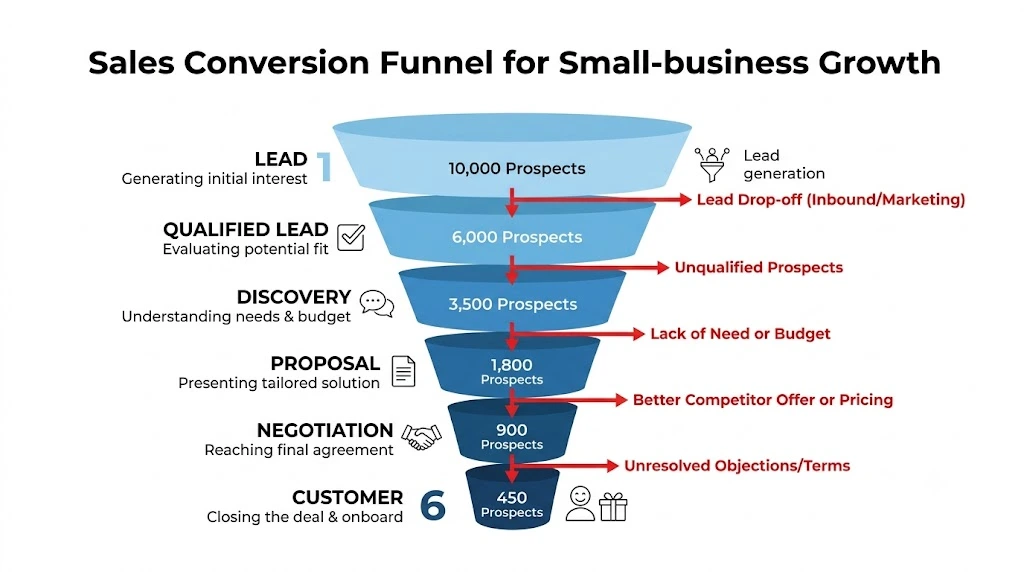
Map a simple funnel: Lead → Qualified → Discovery → Proposal → Negotiation → Customer. Track what percentage moves between each stage. A lightweight spreadsheet works fine—you don’t need enterprise software to see where people stall.
3. Find Your Biggest Conversion Bottleneck
Don’t assume the lowest percentage is automatically the biggest problem. Weigh it against the number of prospects lost, the revenue at stake, and the volume moving through that stage—then fix one major bottleneck before moving to the next. A consistent, well-run funnel makes this diagnosis far easier, which is why it’s worth pairing this step with a repeatable B2B sales process rather than treating each deal as a one-off.
4. Respond to New Leads Faster
Problem: Interested prospects cool off fast, and a slow first reply is one of the easiest ways to lose a deal you never even got to pitch. Action: Build a simple system—an immediate automated acknowledgment, a human follow-up within a set window, a CRM or task reminder so nothing sits untouched, and a response-time target the whole team commits to. Hypothetical example: Suppose a local service business reduces its average response time from six hours to fifteen minutes. It should then compare booking rates before and after the change to determine whether faster responses improved conversion. Metric to monitor: Average first-response time, tracked weekly.
5. Improve Lead Qualification
Problem: Chasing every inquiry regardless of fit fills your calendar with conversations that were never going to close. Action: Set two or three clear qualifying questions—budget range, timeline, and decision-making authority are a good starting point—and screen for them before booking a full sales call. Hypothetical example: Suppose a consultant adds a five-minute pre-call screening form. They should then track how many discovery calls involve genuinely qualified prospects before and after to see whether the screening step is filtering effectively. Metric to monitor: Qualified-lead-to-customer rate. For a full framework on separating serious buyers from browsers, see our guide on how to qualify sales leads for a small business.
6. Make Your Offer Easier to Understand
Problem: A confusing offer forces prospects to work too hard to understand what they’re buying, and confused buyers stall instead of committing. Action: Rewrite your core offer so it clearly answers who it’s for, what problem it solves, what outcome to expect, what’s included, the starting price when appropriate, and the next step to take. Hypothetical example: Suppose a small agency replaces a long, feature-heavy service description with a single paragraph covering those six points. It should then compare how many prospects move to a call before and after the rewrite to test whether the clearer offer changed behavior. Metric to monitor: Proposal-to-close rate.
7. Improve Your Sales Conversations
Lean on open-ended questions, active listening, and problem-focused discovery. End every conversation with a clear next step—ambiguity is where deals quietly die.
8. Address Objections Before They Stop the Sale
The most common objections—price, timing, trust, implementation, and competitor comparisons—can usually be softened in advance with strong FAQs, proof points, and clear explanations.
9. Make Follow-Up Consistent
Problem: A lead shouldn’t go cold simply because nobody remembered to check back in—yet that’s exactly how most small businesses lose winnable deals. Action: Build a simple cadence that runs automatically: Day 0 → Day 2 → Day 5 → Day 10 → longer-term nurture, adjusted to fit your actual sales cycle. Hypothetical example: Suppose a small consultancy schedules its follow-ups in a CRM instead of relying on memory. It should then compare how many previously quiet leads re-engage after the automated sequence starts to see whether consistent follow-up recovers stalled deals. Metric to monitor: Percentage of leads that receive at least three touchpoints before being marked lost.
10. Reduce Friction on Your Website and Buying Process
Problem: Unclear next steps, long forms, and hidden pricing give a hesitant buyer an easy excuse to leave without converting. Action: Audit your site and buying flow for a clear call to action, fewer form fields, an obvious way to book or contact you, solid mobile usability, transparent pricing, and visible testimonials. Hypothetical example: Suppose a small business trims its contact form from nine fields to four. It should then track completed-inquiry volume before and after the changeover over a comparable period to check whether the shorter form actually reduced drop-off. Metric to monitor: Website-visitor-to-lead conversion rate.
11. Use Social Proof at the Right Stage
Testimonials, case studies, and client results build trust fastest when they appear right where doubt shows up—on the landing page, inside a proposal, in a sales email, or in a discovery follow-up.
12. Test One Conversion Improvement at a Time
Whether it’s your CTA, offer wording, follow-up email, or pricing presentation—change one variable, track before versus after, and let the data tell you what’s working.
How to Know Which Sales Conversion Problem to Fix First
Rather than guessing, use this quick diagnostic table to match what you’re seeing to the likely cause.
| Symptom | Likely Problem | First Thing to Check |
|---|---|---|
| Lots of leads, few qualified | Lead quality | Targeting and qualification |
| Qualified leads don’t book calls | Offer or CTA | Booking process |
| Calls happen, but few proposals follow. | Discovery | Customer needs and fit |
| Many proposals, few closes | Trust or objections | Proposal and objections |
| Customers disappear after inquiry. | Follow-up | Response and follow-up system |
Hypothetical scenario: Consider a service business that receives 100 leads in a month. Forty qualify, twenty of those request a proposal, and five ultimately become customers. That gives three different conversion figures depending on what you measure: a lead-to-customer rate of 5% (5 ÷ 100), a qualified-lead-to-customer rate of 12.5% (5 ÷ 40), and a proposal-to-close rate of 25% (5 ÷ 20). These figures do not identify the bottleneck by themselves because the business still needs historical or stage-specific targets for comparison. However, if its proposal-to-close rate has recently declined while earlier stages remain stable, the business should investigate proposal clarity, trust, objection handling, and follow-up. If improvements at that stage move two more prospects from proposal to close, the business gains seven customers instead of five—raising its lead-to-customer rate to 7%, its qualified-lead-to-customer rate to 17.5%, and its proposal-to-close rate to 35%, without generating additional leads.
What Is a Good Sales Conversion Rate for a Small Business?
There’s no single “good” number to chase—conversion rates shift with industry, price point, sales cycle, lead source, and whether you’re selling B2B or B2C. Salesforce’s breakdown of sales conversion rate makes the same point: the metric only means something once it’s tied to your own process and definitions, so treat any generic benchmark as a loose guide, not a target.
Why Your Own Historical Rate Matters More
Compare your current numbers against last month, last quarter, and across different lead sources or sales stages. Your own trendline tells you far more than an industry average ever will.
When a Low Conversion Rate Is Not Necessarily a Problem
Sometimes a lower rate reflects deliberate filtering—a business that walks away from poor-fit leads may show a lower percentage while actually protecting its time and margins.
Sales Conversion Metrics Small Businesses Should Track
Keep your tracking simple enough to actually maintain. Highspot’s guide to improving sales conversion rate highlights how much clarity comes from tracking conversion at each individual stage rather than relying on one blended number—the same principle applies at small-business scale, just with fewer, lighter-weight metrics.
Lead-to-Qualified Rate
This measures the percentage of incoming leads that meet your qualification criteria. Calculate it as Qualified Leads ÷ Total Leads × 100. A falling rate may indicate weak targeting or overly broad lead generation.
Qualified-Lead-to-Customer Rate
This is the core sales conversion rate covered earlier in this guide. Calculate it as Customers ÷ Qualified Leads × 100. It tells you how effectively your sales process turns genuinely interested prospects into paying customers.
Proposal-to-Close Rate
This measures how many proposals actually result in a sale. Calculate it as Customers ÷ Proposals Sent × 100. A low rate here usually points to pricing, trust, or objection-handling issues rather than lead quality.
Conversion Rate by Lead Source
This breaks your qualified-lead-to-customer rate down by channel—referrals, ads, organic search, and so on. Calculate it the same way as your overall conversion rate, but filtered per source, so you can see which channels produce leads that actually close.
Average Sales Cycle
This is the average number of days from first contact to closed sale. Track it by recording the date each lead enters your pipeline and the date it closes, then averaging that gap across recent deals. A lengthening cycle often signals rising friction somewhere in the funnel.
Lost-Deal Reasons
This is a simple tally of why deals were lost—price, timing, trust, fit, or competitor choice—logged at the moment a deal is marked closed-lost. Reviewing this list monthly often reveals a single recurring reason worth fixing first.
A Simple 30-Day Plan to Improve Sales Conversion Rate
Here’s a practical rollout you can start this month.
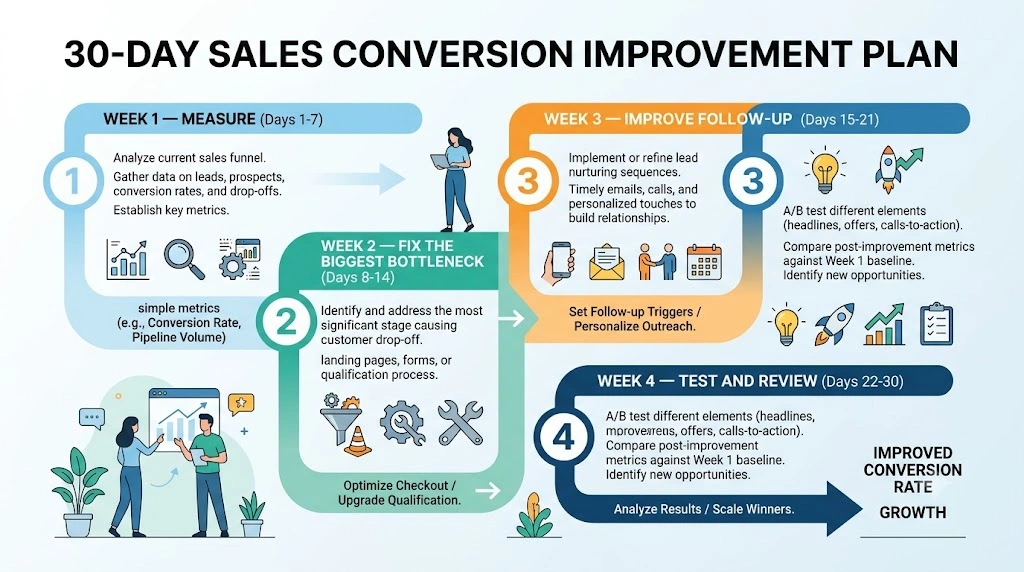
Week 1 — Measure: Calculate your baseline, map your funnel stages, and identify the biggest drop-off point.
Week 2 — Fix: Tighten lead qualification, improve response time, and remove one major friction point.
Week 3—Improve Follow-Up: Build a follow-up sequence, set reminders, and re-engage suitable lost opportunities.
Week 4 — Test and Review: Compare results against your baseline, identify the winning change, and choose your next bottleneck to tackle.
Before adding more spend to lead generation, it’s worth applying this same 30-day cycle to your acquisition costs too—our guide on scaling sales without upfront costs covers how to grow without inflating your budget.
Frequently Asked Questions
How can I improve my sales conversion rate quickly?
Start by fixing your fastest-moving lever: response time. Acknowledging new leads within minutes rather than hours, paired with one clear next step, often produces a visible lift within the first few weeks.
What is a good sales conversion rate for a small business?
There isn’t one universal number—it depends on your industry, price point, and sales cycle. Focus on improving your own historical rate rather than chasing an outside benchmark.
How do you calculate sales conversion rate?
Divide the number of sales by the number of qualified leads, then multiply by 100. For example, Shopify’s formula guide uses the same basic structure, adapted for online storefronts.
How can a small business convert more leads into customers?
Combine faster response times, tighter lead qualification, a clearer offer, consistent follow-up, and reduced friction in the buying process. Fixing the single biggest bottleneck first produces the fastest results.
Does faster lead response improve sales conversion?
Yes. Prospects lose momentum quickly, and a delayed response is one of the most common reasons interested leads go cold before a conversation even starts.
How often should a small business measure its conversion rate?
Monthly is typically enough to spot real trends without overreacting to short-term noise. Compare the same time period consistently so the numbers stay meaningful.
Final Takeaway
Don’t start by trying to generate more leads. First find where your existing sales funnel is losing good prospects—that’s usually where the fastest, cheapest wins are hiding.
Measure → Diagnose → Fix → Follow Up → Test → Repeat.
Ready to put this into practice? Start with Week 1 today: calculate your current conversion rate, map your funnel stages, and find your single biggest drop-off point. That one number will tell you exactly where to focus next—and it’s the fastest path to turning the leads you already have into the customers you’re looking for.