
How to Scale Sales Without Upfront Costs: A Practical Small Business Guide
Introduction
Every small business owner eventually hits the same wall: sales have flattened, the team feels stretched, and the obvious next move—spend more on ads, hire more reps, or buy a bigger tool stack—requires cash that doesn’t exist yet. It feels like a trap. Growth seems to demand money, but there isn’t extra money until there’s more growth.
If you want to scale sales without upfront costs, the first step is not spending more — it is improving the sales system you already have.
Scaling sales without upfront costs is not a myth or a marketing slogan. It is a repeatable process built on fixing what you already have, squeezing more value out of relationships you’ve already earned, and automating the parts of your sales process that eat up time without adding judgment. Founders and lean teams do this successfully all the time — not by spending less effort, but by spending it more precisely.
In this guide, you’ll learn what it actually means to “scale” sales versus simply pushing more leads into a leaky funnel, how to diagnose where your current process is losing money, and how to build a low-cost system using existing customers, automation, and partnerships instead of ad budgets. By the end, you’ll have a five-step framework you can start applying this week with minimal additional budget.
What Does It Mean to Scale Sales Without Upfront Costs?
Before building any tactics, it helps to be precise about the goal. “Scaling without upfront costs” isn’t about refusing to ever spend money—it’s about sequencing spending so it comes after the process is already working, not before.
Scaling vs. Simply Increasing Sales
Increasing sales usually means doing more of the same thing — more cold calls, more ad spend, more outreach — and hoping volume produces revenue. Scaling is different. Scaling means building a system where each additional sale costs less effort and less money than the one before it, because the process, the tools, and the messaging have already been proven and standardized. A business that scales sales has removed the guesswork; a business that simply increases sales is often just working harder for the same margins.
What “Upfront Costs” Actually Are
Upfront costs are the big, non-negotiable investments many owners assume they need before they can grow: paid advertising budgets, a large sales team, expensive enterprise software, or a rebuilt website. These are real levers — but they are amplifiers, not starting points. Spending on any of them before your sales process is efficient just means you amplify inefficiency faster. Understanding this distinction is the real starting point if you want to scale sales without upfront costs.
The Lean Sales Scaling Model
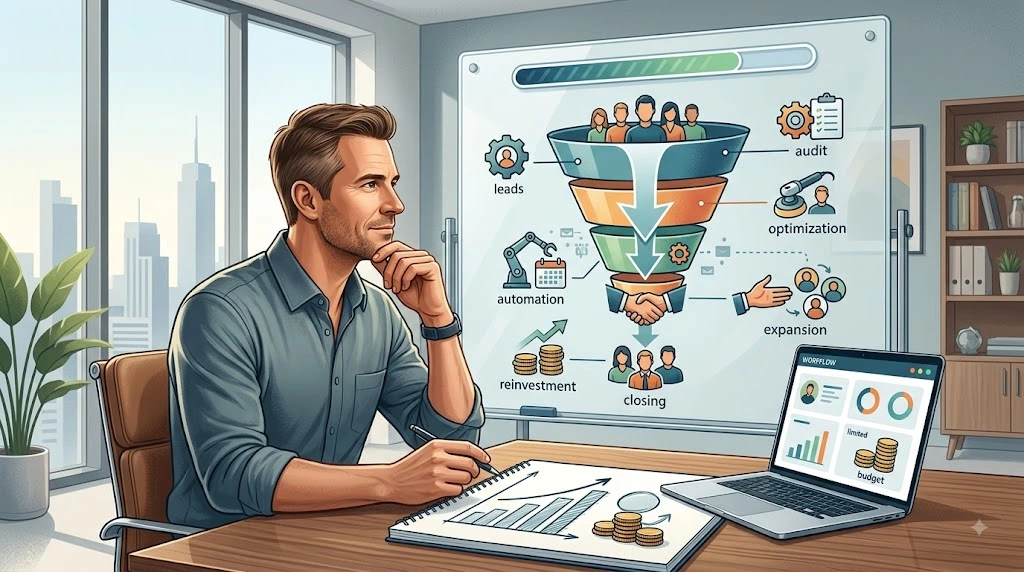
The lean model works in the opposite order. Instead of spending first and hoping conversion improves, you fix conversion first; automate the repeatable parts; and only then reinvest the additional revenue into paid channels—using money the business has already earned, not money it’s borrowing against future growth.
Revenue Growth and Cash Flow
This order matters because of cash flow. A small business that spends heavily before its funnel converts well is spending cash it may not get back for months. A business that scales the existing process first turns each dollar of revenue into fuel for the next stage of growth, which keeps the business solvent while it grows.
Start by Fixing Your Existing Sales Process
Before adding anything new, look closely at what’s already happening in your funnel. Most small businesses can unlock meaningful revenue just by tightening the process they already run.
Identify Where Leads Are Being Lost
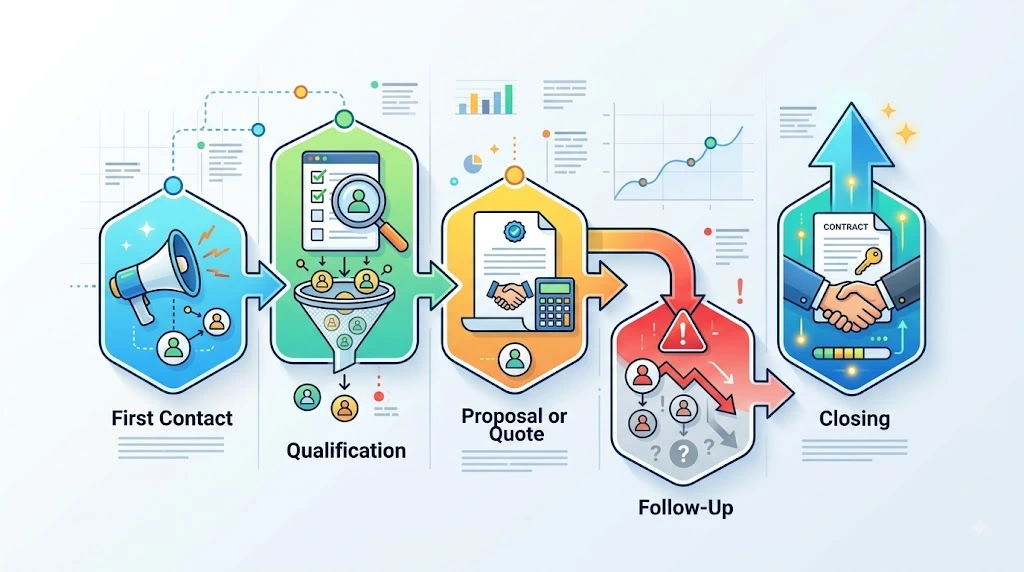
Most small businesses lose more revenue to a leaky funnel than they lose to a lack of leads. Map your process end to end: first contact, qualification, proposal or quote, follow-up, and close. At each stage, ask what percentage of leads actually move forward. In most cases, the biggest drop-off isn’t at the top of the funnel — it’s in follow-up, where leads simply go cold because no one circled back in time.
Simplify Your Sales Funnel
A funnel with too many steps, too many decision points, or too many people involved creates friction, and friction is what kills conversion. Look for steps that exist out of habit rather than necessity—an extra approval, a redundant form, a call that could have been an email—and cut them.
Track the Metrics That Matter
You cannot fix what you don’t measure. At minimum, track:
- Leads generated per channel
- Qualified leads — leads that actually match your ideal customer
- Conversion rate at each funnel stage
- Average deal value
- Customer acquisition cost
- Repeat purchase rate
These six numbers tell you, with no guesswork, exactly where your process is strong and where it’s bleeding revenue.
Generate More Sales From Existing Opportunities
The fastest, cheapest revenue is almost always sitting inside the customer relationships you already have—one of the easiest ways to scale sales without upfront costs.
Follow Up With Old Leads
Leads that went quiet three or six months ago are not dead — they’re often just poorly timed. A simple, personal re-engagement message (“Just checking in — is this still something you’re exploring?”) converts a meaningful share of old leads with minimal additional effort.
Re-Engage Past Customers
Past customers already trust you, which means the cost of selling to them again is a fraction of acquiring someone new. A short check-in, a relevant update, or a seasonal reminder is often all it takes to open a repeat conversation.
Increase Repeat Purchases
If your product or service naturally repeats—a consumable, a subscription, a recurring service—build a simple reminder system so customers don’t have to remember to come back to you. You remember them.
Create Upsell and Cross-Sell Opportunities
Every existing customer relationship is an opportunity to offer something adjacent and useful. Upsells and cross-sells carry close to zero additional acquisition cost because the trust and the relationship already exist — you’re not paying to win attention, only to add value to attention you already have.
Automate Sales Follow-Up Without a Large Budget
Once the process itself is tighter, automation is what keeps it running consistently — without adding headcount. A basic business automation strategy for a small business usually starts right here, with follow-up.
Automate Lead Follow-Up
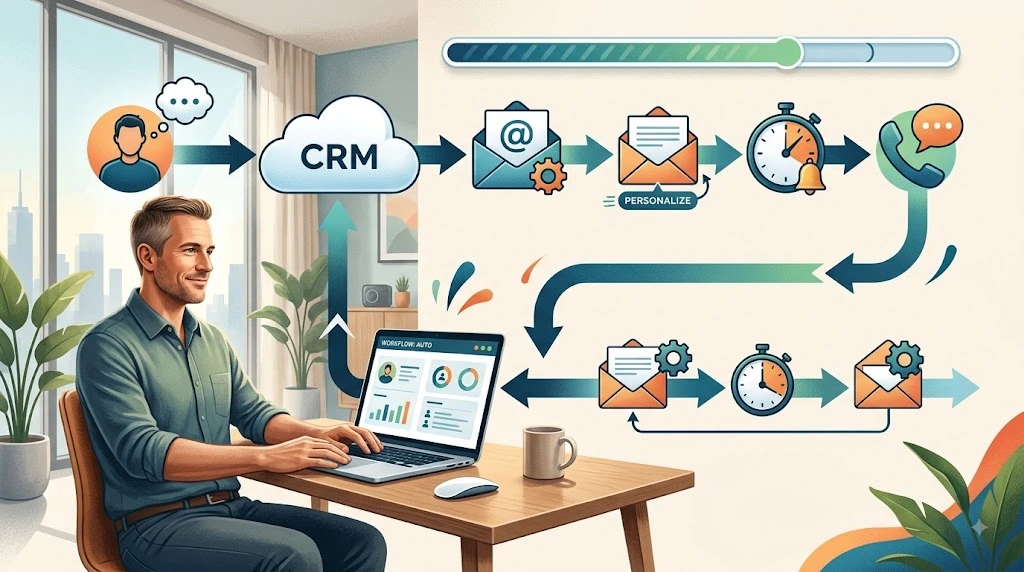
Automated follow-up sequences (email or SMS) ensure that no lead is lost simply because a human forgot to reply. Even a basic three-touch sequence—day 1, day 3, and day 7—recovers leads that would otherwise fall through the cracks.
Use CRM and simple workflow automation.
You don’t need enterprise software to bring structure to your pipeline. Free or low-cost CRM tools let you track every lead’s stage, set automatic reminders, and see your whole pipeline in one place—turning a set of scattered spreadsheets and inboxes into a single source of truth. HubSpot’s own guide for small business sales software makes a similar point: sales software gives lean teams the process infrastructure to sell consistently and scale without a major upfront investment. If your team is also managing repetitive internal handoffs, it’s worth pairing this with a broader automation strategy so sales, fulfillment, and follow-up all move on the same rails.
Automate Appointment Reminders
No-shows quietly kill sales pipelines. Automated reminders sent by email or text the day before (and the hour before) a call meaningfully reduce no-show rates without adding any manual work.
Create Automated Sales Notifications
When a lead opens an email, visits a pricing page, or replies, an automatic notification to the right person means the team responds while intent is highest—which is often the single biggest lever in conversion rate. This kind of lightweight notification setup keeps hot leads from sitting untouched in a shared inbox.
These steps can help a small business scale sales without upfront costs while keeping repetitive follow-up work manageable.
Use No-Code Tools to Build a Lean Sales System
The goal here isn’t to list software—it’s to understand the system a lean sales operation needs and to know that each piece can be built without code or a developer.
CRM and Lead Management
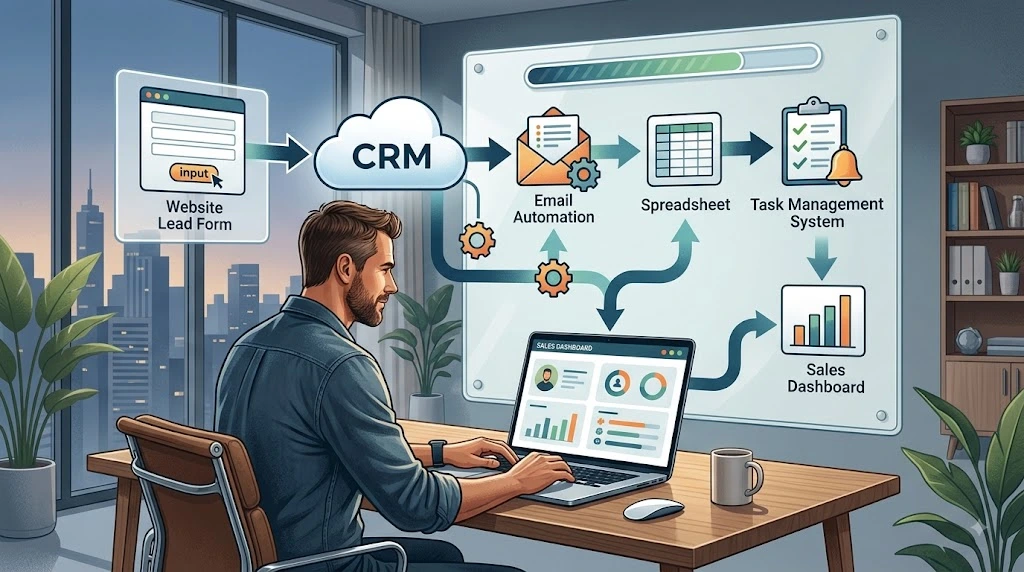
A central place to see every lead, their stage, and their next action — this is the backbone of the whole system.
Forms and Lead Capture
Simple, fast forms on your website or landing pages that feed directly into your CRM, so no lead capture depends on someone manually copying an email into a spreadsheet.
Email Automation
Sequences that nurture leads and re-engage old contacts automatically, based on triggers like “no response in 5 days” or “downloaded a resource.”
Task and Workflow Automation
Rules that move a lead to the next stage, assign a follow-up task, or send an internal alert — without a person having to remember to do it. A well-planned no-code integration between your form, CRM, and calendar pays off here, since it removes the manual re-entry that causes leads to slip through.
Reporting and Sales Tracking
A simple dashboard showing the metrics from earlier in this guide, updated automatically, so you always know where the pipeline stands without building a report by hand each week.
Put together, these five pieces are enough to run a lean sales system and scale sales without upfront costs, long before a bigger tool stack is necessary.
Use Partnerships to Generate Sales Without Heavy Ad Spending
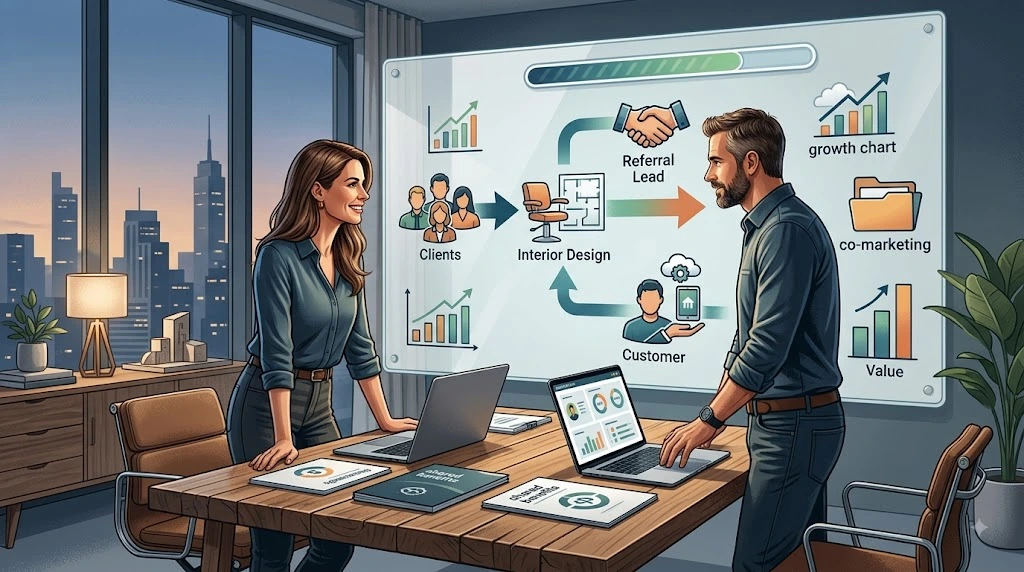
Other businesses have already built the trust and audience you’d otherwise have to pay to earn. Partnerships let you borrow that trust in exchange for something equally useful in return.
Find Non-Competing Businesses
Look for businesses that already serve your ideal customer but don’t compete with you—a caterer and an event photographer, an accountant and a bookkeeper, a gym and a nutrition coach. These businesses have already done the hard work of earning your future customer’s trust.
Build Referral Partnerships
A structured referral arrangement — even an informal one — turns another business’s existing customer base into a new, low-cost lead source for you, and vice versa.
Create Co-Marketing Opportunities
Joint webinars, shared content, or bundled offers let two businesses split the cost and effort of reaching an audience while each gaining credibility from the other’s endorsement.
Turn Partnerships Into a Repeatable Sales Channel
The goal isn’t a single referral — it’s a standing relationship with a clear, simple process for sending business back and forth consistently. Done well, this becomes one of your most reliable channels, and it pairs naturally with a longer-term strategic partnerships approach to growth.
Strategic partnerships can also help businesses scale sales without upfront costs by creating referral opportunities without relying entirely on paid acquisition.
Improve Your Sales Conversion Before Spending More on Marketing
Conversion improvements are one of the highest-leverage ways to scale sales without upfront costs, since they raise revenue from the traffic and leads you’re already getting.
Improve Your Offer
Sometimes the problem isn’t traffic or leads—it’s the offer itself. A clearer value proposition, a more specific promise, or a lower-risk entry point can lift conversion more than any amount of extra spend.
Remove Friction From the Buying Process
Every extra click, extra form field, or extra step between interest and purchase is a chance for a customer to hesitate and leave. Audit your buying process the way a stranger would experience it, and remove anything that isn’t essential.
Build Trust Before the Sales Call
Testimonials, case studies, and clear pricing information — shared before a prospect ever talks to a salesperson — reduce hesitation and shorten the sales cycle.
Create a Clear Follow-Up Sequence
A prospect who doesn’t buy immediately isn’t a lost sale — they’re a sale on a different timeline. A clear, scheduled follow-up sequence keeps the door open without relying on memory.
How to Scale Sales Without Increasing Costs Too Quickly
Start With the Highest-Converting Channel
Look at your existing data and find the channel that already converts best. That is where additional effort pays off fastest — not the channel that feels newest or most exciting.
Standardize What Works
Once you know what works, turn it into a repeatable process: a script, a template, or a checklist—so the result doesn’t depend on one person’s memory or instinct.
Automate Repetitive Work
Anything that happens the same way every time — reminders, follow-ups, data entry — is a candidate for automation, freeing your team to spend their time on the parts of selling that actually require judgment.
Reinvest Revenue Into Proven Channels
Once a channel is proven and standardized, reinvest the revenue it generates — not borrowed or projected revenue — into scaling it further.
Scale One Process at a Time
Trying to fix and scale everything simultaneously usually means nothing gets fixed well. Pick one process, get it working, then move to the next.
Discipline about sequencing — one proven process at a time — is what makes it possible to scale sales without upfront costs instead of scaling costs alongside them.
A Simple Low-Cost Sales Scaling Framework
Here is a five-step framework you can apply starting this week, without a large upfront investment.
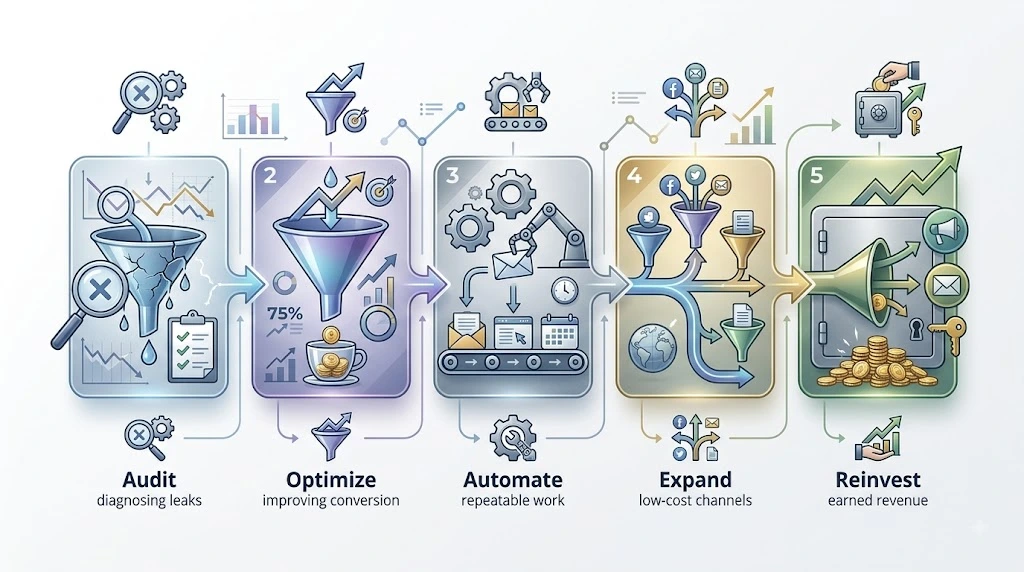
1. Audit
- Goal: Understand exactly where your current sales process is losing leads and revenue.
- Action: Map the funnel, pull the six core metrics, and identify the single biggest drop-off point.
- Metric: Conversion rate at each funnel stage.
- Expected outcome: A clear, specific list of where the leaks are.
2. Optimize
- Goal: Fix the leaks before adding volume.
- Action: Simplify the funnel, improve the offer, remove friction from the buying process.
- Metric: Improved conversion rate at the weakest stage.
- Expected outcome: More sales from the same number of leads.
3. Automate
- Goal: Make the improved process repeatable without manual effort.
- Action: Set up automated follow-up, reminders, and notifications using simple CRM and workflow tools.
- Metric: Reduction in lost or unresponded leads.
- Expected outcome: A sales process that runs consistently even when the team is busy.
4. Expand
- Goal: Add new, low-cost channels on top of a process that already works.
- Action: Build referral and partnership relationships; re-engage past customers and old leads.
- Metric: New leads or revenue generated from partnerships and re-engagement.
- Expected outcome: Additional revenue with little to no acquisition cost.
5. Reinvest
- Goal: Fund further growth using revenue the business has already earned.
- Action: Direct a portion of new revenue into the highest-converting, already-proven channel.
- Metric: Return on the reinvested revenue.
- Expected outcome: Sustainable, cash-flow-positive scaling.
Followed in order, this framework is what it actually looks like to scale sales without upfront costs — each step earning the right to the next.
Common Mistakes When Scaling Sales on a Limited Budget
Most of these mistakes come from the same root cause: spending before the process has earned it. Here are the ones that show up most often.
Spending on Ads Before Fixing Conversion
Paid traffic sent into a weak funnel just means you pay more to lose the same percentage of leads.
Automating a Broken Sales Process
Automation makes a good process faster and a bad process fail faster. Fix the process first, then automate it.
Chasing Too Many Channels
Spreading effort across five channels at once usually means none of them get the attention needed to actually work.
Ignoring Existing Customers
Acquiring a new customer is almost always more expensive than re-engaging one you already have. Neglecting your existing base is one of the most common — and most expensive — mistakes small businesses make.
Scaling Costs Faster Than Revenue
If your expenses are growing faster than the revenue that’s supposed to justify them, you’re not scaling—you’re just spending. This is especially common with paid channels, where a rising customer acquisition cost can quietly erase the margin a channel used to generate.
When Should a Small Business Start Investing More in Sales?
An upfront investment eventually makes sense—but only once certain signals are in place:
- Revenue consistency — growth is showing up reliably, not just in occasional spikes.
- Predictable conversion — you know, with reasonable confidence, what percentage of leads become customers.
- Positive unit economics—each customer brings in more than it costs to acquire and serve them.
- A repeatable acquisition channel—you have at least one channel that consistently produces results, not a one-off success.
- Capacity to fulfill additional demand — your team and operations can actually handle the growth you’d be paying for.
Until most of these are true, additional spending is more likely to expose weaknesses than to accelerate growth — which is exactly why it pays to scale sales without upfront costs first and add budget only once the signals above are in place.
Final Takeaway
Don’t scale spending first. Scale the system first.
Every dollar spent on ads, tools, or headcount works harder once your process is efficient, your follow-up is automated, and your existing customers and partners are actively contributing to your pipeline.
The goal is not to avoid spending forever. It is to scale sales without upfront costs by first building a sales system that can support growth efficiently.
If you’re starting this week, focus on these five actions:
- Audit your existing funnel and find where leads are actually being lost.
- Recover lost leads through simple, personal re-engagement.
- Automate follow-up so no lead depends on someone remembering to respond.
- Add one or two referral or co-marketing partnerships.
- Reinvest revenue — not new debt or savings — into the channel that’s already proven to work.
This is the approach that small, lean teams use to grow sustainably: not by spending more but by wasting less and by treating every existing relationship—leads, customers, and partners—as the sales channel it already is.