Why Is My CAC Increasing on Meta Ads? 7 Costly Causes and Smart Fixes (2026)
Why is my CAC increasing on Meta ads? Rising customer acquisition costs can happen when CPM increases, ad creatives lose engagement, tracking becomes less reliable, or fewer visitors convert after clicking. This guide explains seven common causes and how to diagnose and fix them.
If your Meta ads are spending more but bringing in fewer new customers, the problem may not be targeting alone. Rising customer acquisition cost (CAC) can come from auction pressure, creative fatigue, tracking gaps, attribution differences, landing-page friction, audience overlap, or the way catalogue campaigns mix new and returning customers.
This guide helps ecommerce businesses diagnose why CAC is increasing on Meta ads, find the likely cause in Ads Manager, and choose a practical fix. Start with the numbers that changed, then test one improvement at a time.
Quick answer: Compare CPM, outbound CTR, conversion rate, frequency, and new-customer purchases over the same period. A higher CPM points toward auction pressure; falling CTR can indicate creative fatigue or weaker relevance; falling conversion rate suggests a post-click problem; and a gap between Meta-reported purchases and store orders may indicate attribution or tracking differences.
What Is Customer Acquisition Cost (CAC)?
Customer acquisition cost is the amount a business spends to acquire a customer during a defined period.
Basic formula: \[ \text{CAC} = \frac{\text { \frac{\text{Acquisition spend}}{\text{New customers acquired}} \]
For paid social, paid-media CAC can be calculated as \[ \text{Paid-media CAC} = \frac{\text{Meta ad spend}}{\text {New customers attributed to Meta}
Be clear about what you include in “acquisition spend”. Ad-only CAC excludes salaries, agency fees, creative production, discounts, and other costs. Fully loaded CAC includes the costs your business chooses to allocate to acquisition.
Worked example
Suppose a store spends $3,000 on Meta ads in a month and acquires 100 first-time customers attributed to those ads. \[ \$3,000 \div 100 = \$30 \]
Its ad-only new-customer CAC is $30. If the same spend produces 75 new customers the following month, CAC becomes $40: [$3,000 \div 75 = \$40\].
That is a 33.3% increase. The next step is not automatically to cut spend: diagnose whether the change came from CPM, click-through rate, conversion rate, customer mix, or measurement.
A 5-Minute Diagnostic: Find Where CAC Is Rising
Use the same date range and comparison period when reviewing results. Avoid comparing a short, incomplete period with a full previous week.
| What changed? | Possible explanation | Where to investigate |
|---|---|---|
| CPM increased, and CTR and conversion rate are stable | Auction pressure, seasonality, or a changed delivery mix | Ads Manager: CPM, campaign breakdowns, placement and geography |
| Frequency increased while CTR, or conversion rate, fell. | Audience saturation or creative fatigue may be contributing. | Ads Manager: frequency, reach, creative-level trends |
| Outbound CTR fell. | Creative, offer, or audience-message fit may have weakened | Ads Manager: outbound clicks, CTR, ad-level results |
| Clicks are stable, but purchases fell. | Landing-page, checkout, offer, or product-demand issue | Store analytics, landing-page tests, checkout funnel |
| Meta purchases differ from store orders. | Attribution settings, event implementation, deduplication, or reporting windows | Events Manager, Ads Manager attribution settings, ecommerce platform |
| Meta purchases are stable, but new-customer CAC rose. | More attributed purchases may be from existing customers. | Ecommerce customer records, new-versus-returning customer reporting |
| Catalogue campaign results look strong, but new-customer growth is weak. | Retargeting or returning customer sales may be contributing heavily. | Catalogue audience setup, customer exclusions where available, new-customer reporting |
These are diagnostic clues, not proof. Several causes can occur at the same time. Confirm the pattern with your own account and store data before making major changes.
7 Reasons Your Meta Ads CAC Is Increasing—and How to Fix Each
1. Auction Pressure Is Increasing Your CPM
What may be happening: The cost of reaching your audience has increased. This can happen because of competition, seasonality, changes in placement or geography mix, or shifts in campaign delivery.
How to check:
- Compare CPM across equivalent date ranges.
- Review campaign, placement, and country breakdowns.
- Check whether spending has shifted toward more expensive placements or markets.
- Compare CPM with CTR and conversion rate; CPM alone does not explain CAC.
How to fix it:
- Reassess whether the current market and audience remain commercially viable.
- Test new creative and offers rather than changing multiple campaign settings at once.
- Review contribution margin and allowable CAC before increasing bids or budgets. If you need to calculate your threshold first, use this guide to the small business break-even point.
- Consider testing another market only when shipping, taxes, returns, and customer value make it viable.
Do not assume that broad targeting is “dead”. Automated or broad delivery can work, but results depend on the offer, creative, data, market, and campaign objective.
2. Creative Fatigue Is Reducing Response
What may be happening: People who have repeatedly seen an ad may be responding less, or the creative may no longer stand out. Frequency can be a clue, but there is no universal frequency threshold that proves fatigue.
How to check:
- Review frequency alongside reach, outbound CTR, conversion rate, and spend.
- Compare performance by ad and creative over time.
- Check whether the decline affects one creative or the whole campaign.
How to fix it:
- Develop new concepts, not just minor edits to the same image.
- Test different customer problems, demonstrations, objections, and proof points.
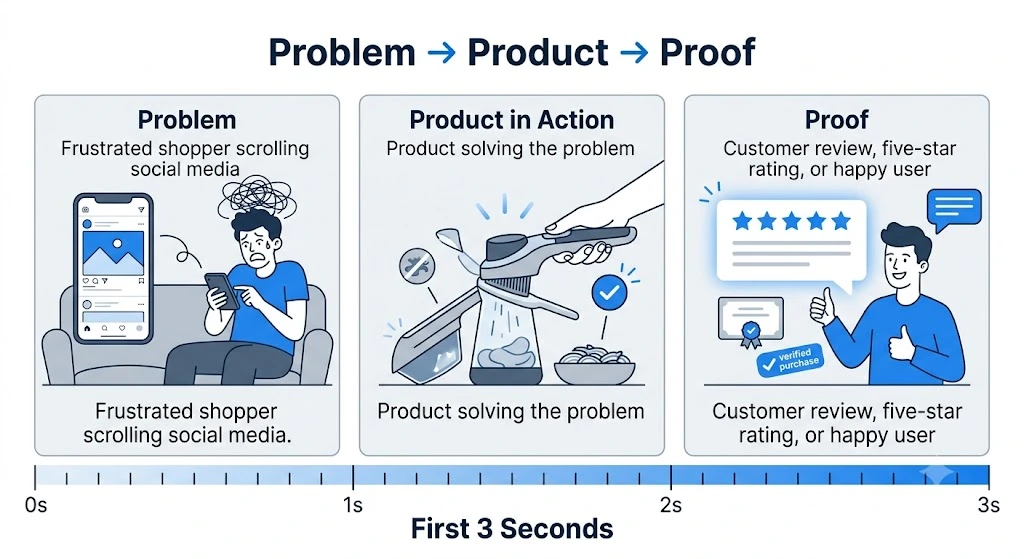
- Use a clear sequence: Problem → Product in action → Evidence.
- Keep claims accurate and use genuine reviews or demonstrations with permission.
For creative research, use the Meta Ads Library to study active ads in relevant markets. Competitor activity is inspiration, not evidence that a creative is profitable.
3. Tracking or Signal Loss Is Making Results Harder to Measure
What may be happening: Browser restrictions, consent choices, event configuration, or implementation issues can affect the conversion signals available to Meta. This can make platform reporting incomplete or inconsistent with store records.
How to check:
- Review event activity and diagnostics in Meta Events Manager.
- Confirm that purchase events fire once and pass the intended value and currency.
- Check Pixel and Conversions API implementation, including deduplication where both send the same event.
- Compare reported purchases with actual orders for the same period, while accounting for attribution windows and time zones.
How to fix it:
- Correct event configuration and investigate warnings.
- Implement the Conversions API where appropriate, following Meta’s documentation and applicable consent requirements.
- Keep event names, values, currency, and deduplication settings consistent.
- Document changes so you can distinguish tracking changes from real performance changes.
Reference: Meta Conversions API documentation.
Conversions API can improve the data available to Meta, but it does not guarantee complete tracking or make platform-attributed results identical to your store’s records.
4. Attribution Is Inflating or Obscuring Your Reported CAC
What may be happening: Meta and your ecommerce platform may assign credit differently because of attribution windows, view-through conversions, cross-device journeys, or other channel interactions. Meta-reported purchases are not automatically the same as incremental new customers caused by Meta.
How to check:
- Note the attribution setting used in Ads Manager.
- Compare Meta-attributed purchases with store orders and new-customer records.
- Separate first-time customers from returning customers.
- Review results using consistent date ranges and reporting definitions.
How to fix it:
- Report Meta-attributed CAC and blended new-customer CAC separately.
- Use UTMs consistently across campaigns.
- Add a post-purchase “How did you hear about us?” question if appropriate.
- Where feasible, use controlled experiments to estimate incrementality rather than treating attribution as causal proof.
A useful distinction:
| Metric | What it tells you |
|---|---|
| Meta-attributed CAC | Ad spend divided by new customers credited to Meta under a stated attribution setup |
| Blended new-customer CAC | Total acquisition spend divided by all new customers acquired across channels |
| MER | Total store revenue divided by total marketing spend; useful as a broad efficiency ratio, but not a CAC measure |
| Payback period | How long it takes for customer contribution profit to recover acquisition cost |
5. Landing Page or Checkout Conversion Rate Has Fallen
What may be happening: Ads still attract visitors, but fewer complete a purchase. Potential causes include slow or unstable pages, a mismatch between ad and landing-page promise, unclear product details, shipping costs, payment issues, or checkout friction.
How to check:
- Compare landing-page views, add-to-cart, checkout, and purchase rates.
- Test the customer journey on mobile and in target markets.
- Review site changes, checkout errors, stock availability, shipping, and payment options.
- Check whether the decline affects one landing page or multiple products.
How to fix it:
- Match the landing page to the ad’s promise and product.
- Make price, shipping, delivery estimates, returns, and relevant taxes clear before checkout.
- Improve mobile usability and investigate performance using Google PageSpeed Insights.
- Test one meaningful change at a time and evaluate purchases—not only add-to-cart events.
For a step-by-step process, see how to improve the sales conversion rate for a small business.
For checkout research, consult the Baymard Institute’s cart abandonment research. Do not use a broad abandonment statistic as proof that a particular issue is causing your own CAC increase.
6. Audience Saturation or Retargeting Overlap Is Changing Customer Mix
What may be happening: A campaign may be reaching a limited pool repeatedly, or multiple campaigns may compete for similar users. Retargeting can also receive credit for customers who were already likely to purchase.
How to check:
- Review reach and frequency over time.
- Inspect audience definitions and overlap in your account where available.
- Separate prospecting from retargeting in reporting.
- Check the share of purchases from new versus returning customers.
How to fix it:
- Simplify overlapping campaign structures where appropriate.
- Review audience exclusions and campaign objectives.
- Use email or other opted-in channels for suitable follow-up instead of relying only on paid retargeting. See our guide to business automation strategies for small businesses for ways to systematise follow-up.
- Evaluate retargeting by incremental contribution where possible, not just platform-reported ROAS.
Retargeting is not inherently inefficient. The question is whether it is generating additional profitable customers or mainly receiving credit for existing demand.
7. Catalog Campaigns Are Acquiring Returning Customers Instead of New Ones
What may be happening: Catalog campaigns can serve different customer groups. If returning customers or high-intent visitors make up a large share of attributed purchases, the campaign may look efficient while contributing less new-customer growth than expected.
How to check:
- Compare first-time and returning customers in your store data.
- Review catalog campaign audience and optimization settings.
- Check whether new-customer reporting is available and configured for your campaign.
- Compare catalog campaign results with overall new-customer acquisition, not only reported ROAS.
How to fix it:
- Define the business goal clearly: new-customer acquisition, repeat purchase, or total revenue.
- Use available new-customer controls and reporting appropriately.
- Evaluate the campaign’s contribution to new customers and margin.
- Test prospecting and retargeting approaches separately where the account structure and budget allow.
Long-tail question to investigate: How can you reduce cost per new customer through Meta catalog campaigns for a D2C fashion brand? The answer depends on the brand’s customer mix, catalog, margins, campaign setup, and measurement—not one universal setting.
How to Measure New-Customer Acquisition Separately from Retargeting
To understand whether Meta is bringing in new customers, create a consistent reporting view that separates first-time and returning purchasers.
A practical monthly report can include:
| Metric | Calculation or source |
|---|---|
| Meta ad spend | Ads Manager |
| Meta-attributed purchases | Ads Manager, with attribution setting recorded |
| Meta-attributed new customers | Meta reporting where available; validate against store records |
| Storewide new customers | Ecommerce platform customer/order data |
| Blended new-customer CAC | Total acquisition spend ÷ storewide new customers |
| Meta-attributed new-customer CAC | Meta spend ÷ Meta-attributed new customers, with the attribution method stated |
| MER | Total store revenue ÷ total marketing spend |
| Contribution margin after marketing | Revenue less variable costs and marketing, using a consistent definition |
A simple comparison
Suppose the store spends $8,000 across all acquisition channels and gains 200 first-time customers during the month.
Blended new-customer CAC:\[ \$8,000 \div 200 = \$40 \]
Meta spends $3,000 and reports 100 purchases, but store records show that only 60 of those attributed purchasers are first-time customers.
Meta-attributed new-customer CAC using that store-based count:\[ \$3,000 \div 60 = \$50 \]
The two figures answer different questions. Blended CAC measures the overall acquisition system; Meta-attributed CAC describes the cost associated with the new customers your chosen method credits to Meta. Neither alone proves incrementality.
How to Fix Rising CAC Without Scaling Blindly
Once you identify the likely cause, make a controlled change.
- Set a baseline: Record spend, new customers, CAC, CPM, outbound CTR, conversion rate, frequency, and contribution margin.
- Choose one hypothesis: For example, “CAC rose because landing-page conversion rate fell after a checkout change.”
- Make one focused change: Avoid changing creative, budget, audience, and landing page simultaneously.
- Allow enough data to accumulate: Use a period appropriate to purchase volume and sales cycle; do not treat a handful of conversions as conclusive.
- Compare business outcomes: Look at new customers, contribution margin, and blended performance—not only the platform’s preferred metric.
- Scale cautiously: Increase investment only when results are stable enough and the economics support it.
What about testing international markets?
International expansion can be a useful growth strategy, but it is not the first diagnostic fix for every rising-CAC problem. First establish whether the current campaign’s economics and measurement are sound.
If you test another country, evaluate local demand, currency, shipping, duties, returns, payment methods, and contribution margin. A lower media CAC can still produce worse profit. For growth beyond paid acquisition, see how to scale sales without upfront costs.
Frequently Asked Questions
Why is my CAC increasing on Meta ads?
Common causes include higher CPMs, creative fatigue, lower conversion rates, tracking or attribution differences, audience saturation, and a higher share of returning customers in reported purchases. Compare the funnel metrics over the same period to identify the likely cause.
How do I fix rising CAC?
Find the metric that changed first. If CPM rose, investigate auction and market mix. If CTR fell, review creative and audience-message fit. If conversion rate fell, inspect the landing page and checkout. If Meta and store numbers differ, audit tracking and attribution.
How do I fix high cost per acquisition?
Calculate CAC using a clearly defined customer count and spend. Then diagnose CPM, click-through rate, conversion rate, and customer mix. Fix the largest verified bottleneck before increasing budget.
What is a good CAC for ecommerce?
There is no universal benchmark. Allowable CAC depends on contribution margin, average order value, repeat purchases, returns, and payback requirements. Compare CAC with the contribution profit you expect to earn from a customer over a defined period.
Does Advantage+ automatically lower CAC?
No campaign type guarantees lower CAC. Advantage+ can automate parts of delivery, but performance still depends on creative, offer, product-market fit, data quality, landing-page experience, and economics. Evaluate new-customer outcomes rather than assuming automation is the cause of a change.
How can I measure new-customer acquisition separately from retargeting in Meta catalog campaigns?
Use consistent store-level first-time-customer data, review campaign audience and reporting settings, and compare new versus returning customer outcomes. Where available, use Meta’s new-customer reporting or controls, but validate the figures against your ecommerce records and stated attribution method.
Final Checklist: Diagnose Before You Scale
- CAC formula and included costs are clearly defined
- Comparison uses equivalent date ranges
- CPM, outbound CTR, conversion rate, and frequency reviewed
- Creative-level trends checked for fatigue
- Pixel and Conversions API events reviewed for configuration issues
- Meta attribution settings documented
- New and returning customers separated
- Landing page, mobile experience, and checkout tested
- Catalog campaign customer mix reviewed
- Blended CAC, MER, and contribution margin tracked separately
- One hypothesis tested before making multiple changes
- Budget increased only after business results support scaling
Conclusion
When CAC rises, changing targeting or increasing budget may not address the real problem. Diagnose the funnel first: auction costs, creative response, tracking, attribution, conversion rate, audience mix, and new-customer share can all affect the number.
Use a consistent definition of CAC, compare Meta reporting with store data, and focus on acquiring incremental, profitable new customers. That gives you a clearer basis for deciding what to fix—and when it is safe to scale.