
How to Build a Repeatable B2B Sales Process for a Small Business
Most small businesses don’t actually have a sales process. What they have is a collection of habits living in the owner’s head, their inbox, and a half-updated CRM. Leads get handled differently depending on who’s busy that week. Qualification is a gut feeling, not a standard. Follow-up happens when someone remembers. Proposals look different every time, and deals quietly stall because nobody agreed on what “next step” even means.
The result? The moment the owner steps back, sales slow down.
This guide fixes that. You’ll walk away with a simple 7-stage B2B sales process, complete with entry criteria, required actions, exit criteria, and the KPIs that tell you whether each stage is actually working.
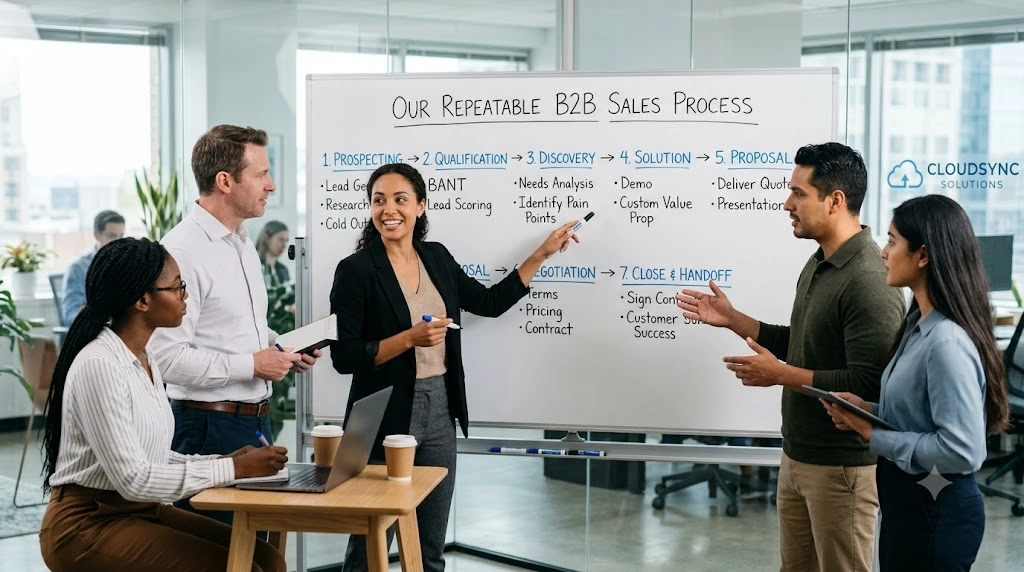
What Is a B2B Sales Process?
A B2B sales process is the repeatable sequence of steps your team follows to turn a stranger into a paying customer. It’s different from your sales pipeline, which is simply where each deal currently sits, and different from your sales methodology, which is how your team conducts each conversation.
B2B selling also behaves differently than B2C. There are usually multiple stakeholders involved, longer buying cycles, higher-stakes decisions, and often an internal approval process before anyone signs anything. A documented process is what keeps all of that predictable instead of chaotic. Salesforce’s own guide to building a sales process covers this same groundwork in more depth if you want the enterprise-side view.
Why Small Businesses Need a Repeatable B2B Sales Process
Without a defined process, growth depends entirely on one person’s memory and energy. That’s fragile.
A repeatable process reduces founder-dependent selling, stops leads from slipping through the cracks, and makes follow-up consistent regardless of who’s handling the account. It also improves forecasting accuracy, makes onboarding new salespeople far easier, and shows you exactly where deals are getting stuck.
Repeatable doesn’t mean robotic. You’re standardizing the structure, not scripting every conversation word-for-word. Quality becomes dependable without every call sounding identical.
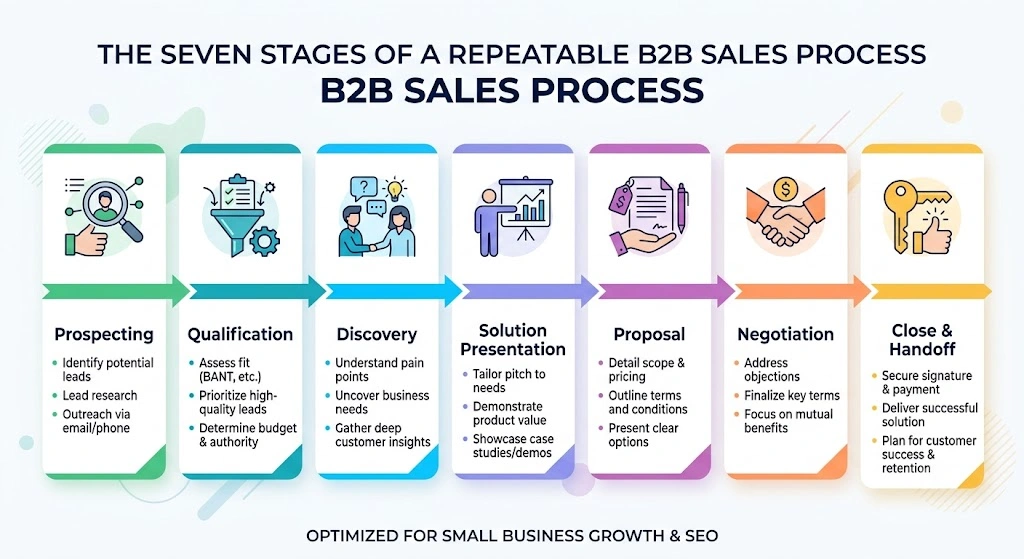
The 7 Stages of a Repeatable B2B Sales Process
Each stage below follows the same framework—call it our repeatability framework: Goal → Entry Criteria → What to Do → Exit Criteria → KPI. This structure is what actually makes a process repeatable, because everyone knows exactly when a deal should move forward and why.
1. Prospecting and Lead Generation
Goal: Identify potential customers who match your ideal customer profile. Entry criteria: Prospect matches the ICP and has a relevant business problem or buying signal. What to do: Define your ICP, identify target accounts, run inbound and outbound outreach, ask for referrals, and research each prospect before contacting them. Exit criteria: Two-way engagement that justifies qualification. KPI: New leads, response rate, meetings booked.
2. Lead Qualification
Goal: Confirm the lead is a real, winnable opportunity before investing more time. Entry criteria: The lead has responded or shown genuine buying intent. What to do: Qualify on problem, fit, budget, authority, timeline, and urgency. Exit criteria: The lead meets your defined qualification standard. KPI: Lead-to-qualified rate.
Want the deeper framework for this stage? Read our full guide on how to qualify sales leads for a small business—it walks through exactly which questions separate a real opportunity from a time-waster.
3. Discovery
Goal: Fully understand the prospect’s problem, impact, and buying process before proposing anything. Entry criteria: The lead has passed qualification and is worth a discovery conversation. What to do: Uncover the prospect’s current problem, its business impact, what they’ve already tried, their desired outcome, urgency, and who else is involved in the decision. Ask questions like, “What happens if this problem isn’t solved in six months? ” Who else needs to sign off? What does success look like to you? Exit criteria: The prospect confirms the problem and the desired outcome and agrees to a next step. KPI: Discovery-to-proposal rate.
4. Solution Presentation / Demo
Goal: Show the prospect exactly how your solution solves the problem uncovered in discovery. Entry criteria: Discovery confirms a relevant problem and potential solution fit. What to do: Don’t open with features. Structure the conversation as Problem → Impact → Solution → Evidence → Expected Outcome. Personalize the presentation, use a relevant case study, and end with a clear next-step agreement. Exit criteria: The prospect confirms the solution is worth evaluating commercially. KPI: Demo-to-proposal rate.
5. Proposal and Commercial Evaluation
Goal: Put a clear, decision-ready offer in front of the buyer. Entry criteria: The prospect confirms interest in evaluating the solution commercially. What to do: Build a proposal with the problem summary, desired outcome, recommended solution, deliverables, timeline, pricing, terms, and a defined next step. Never send a proposal without agreeing on what happens after it’s reviewed. Exit criteria: Proposal reviewed, feedback received, and a decision date agreed. KPI: Proposal-to-close rate, proposal aging.
6. Negotiation and Objection Handling
Goal: Resolve remaining objections and lock in commercial terms both sides can commit to. Entry criteria: The buyer has reviewed the proposal and is discussing terms, objections, or approval. What to do: Handle common objections—price, timing, competitors, internal approval, “I need to think about it”—with the same framework: Clarify → Understand → Respond → Confirm next step. Set discount rules in advance: know your minimum acceptable price, what you can trade instead of discounting, and when to walk away. Exit criteria: Buyer agrees to terms or clearly states what’s still unresolved. KPI: Negotiation-to-close rate, discount rate.
7. Close and Handoff
Goal: Convert the agreement into a signed customer and a clean internal handoff. Entry criteria: Buyer has accepted the commercial terms and is ready to complete the purchase. What to do: Confirm the signed contract and payment, then hand the account to delivery or customer success with the customer’s problem, promised outcome, scope, commitments, and next milestone clearly documented. “Closed Won” isn’t the finish line—it’s a handoff. Exit criteria: Contract signed and handoff completed. KPI: Win rate, time-to-handoff, time-to-first-value.
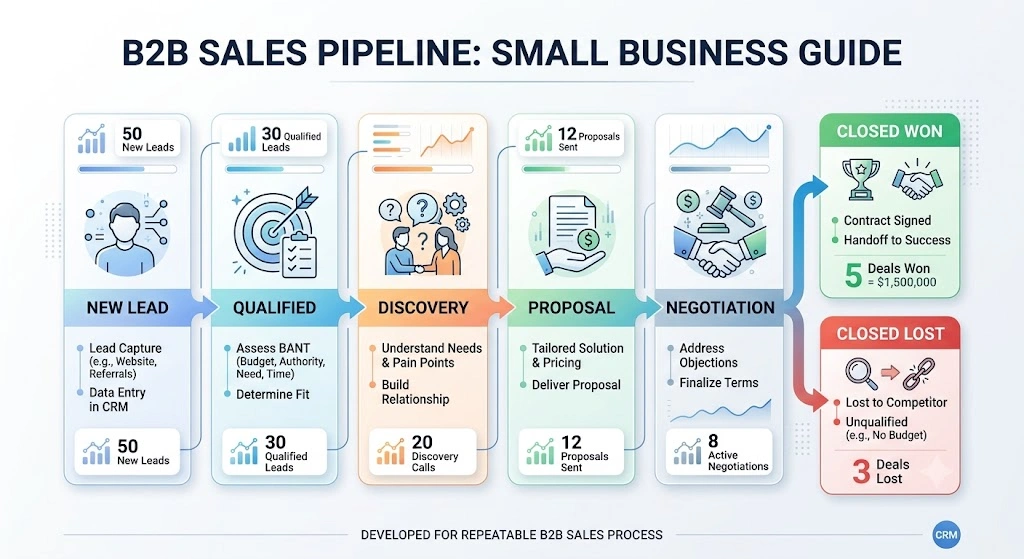
Not every deal reaches Closed Won. Closed lost isn’t a seventh stage—it’s an outcome that can happen at any point in the pipeline. When it does, don’t just mark it lost. Record why: price, competitor, timing, no decision, budget, or poor fit. That single data point becomes one of the most useful signals for improving your process later.
How to Build Your B2B Sales Process From Scratch
Knowing the seven stages isn’t the same as having a working process. Here’s how to actually build one, following the same sequence our repeatability framework is built on: ICP → Qualification → Stages → Criteria → Actions → Documentation → CRM.
One quick clarification before you dive in: the seven stages above describe how a deal moves through your sales process. The eight steps below explain how you build and document that process for your business in the first place.
Step 1—Define your Ideal Customer Profile. Get specific about industry, company size, revenue range, the core problem you solve, and who the buyer typically is.
Step 2—Define what makes a lead qualified. Write explicit rules: fits ICP, has a relevant problem, has budget potential, has a timeline, and has access to the decision-maker.
Step 3—Define your sales stages. A clean pipeline looks like this: New Lead → Qualified → Discovery → Solution Presentation / Demo → Proposal → Negotiation → Closed Won. “Closed Lost” isn’t a stage in that line—it’s an outcome that can end a deal at any point, so track it as a status with a required reason, not as a pipeline step. Stages should represent buyer progress, not just your team’s activity.
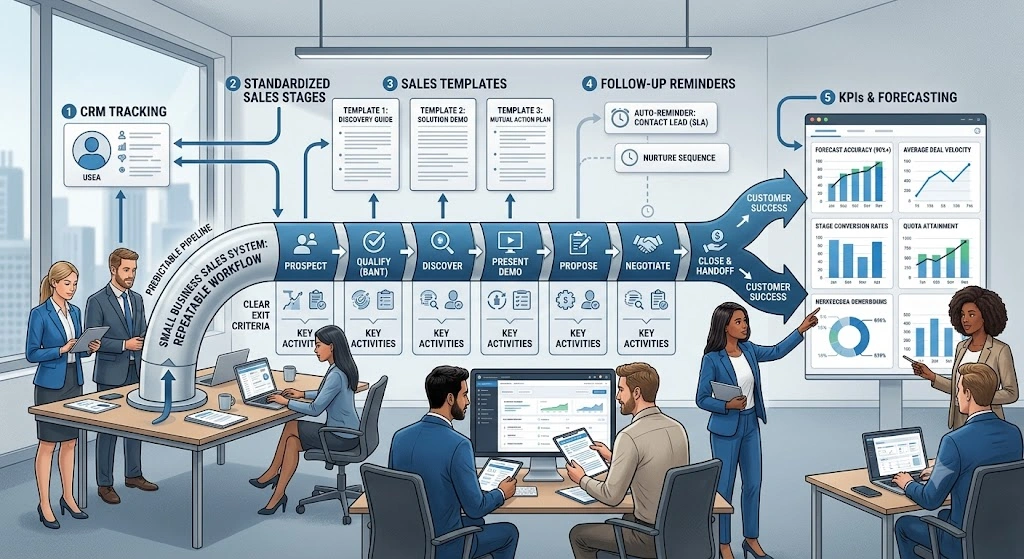
Step 4—Define entry and exit criteria for every stage. This is the actual repeatability mechanism—it removes guesswork about when a deal should move forward.
Step 5—Standardize the actions. For every stage, define the required action, the owner, the timeframe, and the template to use.
Step 6—Create follow-up rules. Decide when to follow up, who owns it, and what happens to stale deals. Our guide on automating lead follow-up for small businesses covers the templates and reminders worth setting up first.
Step 7—Document the process. Build a one-page sales process, a qualification checklist, discovery questions, a proposal template, and an objection library.
Step 8—Put the process into your CRM. Don’t start by asking which CRM to buy. Start by asking what process the CRM needs to enforce—stages, required fields, tasks, and reminders. Process first, technology second.
A Simple B2B Sales Process Template for Small Businesses
Use this table as a working reference—copy it straight into your CRM or a shared document.
| Stage | Goal | Required Action | Exit Criteria | KPI |
|---|---|---|---|---|
| Prospecting | Find prospects. | Research + outreach | Response received | Contact rate |
| Qualification | Confirm fit. | Qualification questions | Lead qualified | Qualification rate |
| Discovery | Understand the problem. | Discovery call | Need confirmed | Discovery→proposal rate |
| Solution Presentation / Demo | Show fit. | Demo/presentation | Buyer interest confirmed | Demo→proposal rate |
| Proposal | Make an offer. | Send the proposal and the next step. | Proposal reviewed | Proposal→close rate |
| Negotiation | Agree on terms | Handle objections. | Terms agreed | Win rate |
| Close/Handoff | Convert | Contract + handoff | Customer onboarded | Time-to-value |
Closed Lost is tracked as a status with a required reason code, not as a row in this pipeline—it can happen at any stage above.
How to Make a B2B Sales Process Repeatable
Standardize what should never change: qualification criteria, pipeline stages, required CRM fields, follow-up ownership, and your proposal structure. Keep flexibility where buyers genuinely differ—conversation style, industry-specific questions, and how you customize proposals.
Use templates as a starting point, not a script, and run a weekly pipeline review to catch stalled deals, overdue follow-ups, and weak stage conversion before they become a bigger problem.
Here’s the real test: a process is repeatable when two different people can follow it and make reasonably consistent decisions. Documenting a process isn’t the same as making it repeatable—repeatability comes from pairing the same criteria, the same stages, the same required actions, and the same decision rules, so the outcome doesn’t depend on who happens to be running the deal.
Repeatability Is What Lets You Scale
Once qualification, stages, and follow-up are standardized, growth stops depending on hiring more salespeople. Our guide on how to scale sales without upfront costs shows how a documented, repeatable process becomes your biggest growth lever once this foundation is in place.
B2B Sales Metrics Small Businesses Should Track
You don’t need twenty dashboards. Track these eight: lead-to-qualified rate, qualified-to-opportunity rate, opportunity-to-close rate, win rate, average deal size, sales cycle length, stage conversion rate, and pipeline coverage. These numbers tell you exactly where your process is working and where it isn’t.
How to Find and Fix Bottlenecks in Your Sales Process
If you’re generating leads but few get qualified, the problem is usually targeting or qualification criteria. Plenty of discovery calls but few proposals? That points to a discovery or solution-fit issue. Lots of proposals, but few close, usually come down to pricing, objections, or an unclear decision process. And if deals sit stuck for weeks, it’s almost always a missing next step. HubSpot’s breakdown of B2B pipeline stages is a useful cross-check if you want to compare your stage structure against a broader industry standard.
The fix is always the same loop: Measure → Find the bottleneck → Change one thing → Measure again.
When Should You Automate Your B2B Sales Process?
Automate the repetitive, low-judgment work: lead routing, reminders, meeting scheduling, follow-up tasks, CRM updates, and reporting. Keep humans in charge of discovery, complex objections, negotiation, and relationship building—that’s where deals are actually won.
For a broader look at what’s worth automating first, see our guide to business automation strategies for small businesses—a genuinely useful next step once your process is documented.
Common B2B Sales Process Mistakes
Watch for these recurring traps: building the process around the CRM instead of the other way around, having too many pipeline stages, advancing deals without exit criteria, qualifying too late, pitching before discovery, sending proposals with no defined next step, inconsistent follow-up, measuring activity instead of conversion, treating every lead as equally valuable, and never revisiting the process once it’s built.
How Often Should You Review Your B2B Sales Process?
Review your pipeline weekly, analyze conversion rates monthly, and revisit the overall process quarterly. Any time your ICP, pricing, or offer changes significantly, review the process immediately—an outdated process quietly costs you deals.
B2B Sales Process vs Sales Funnel vs Sales Pipeline
These terms get used interchangeably, but they mean different things.
| Term | Meaning |
|---|---|
| Sales process | The steps your team follows |
| Sales pipeline | Deals organized by stage |
| Sales funnel | How prospects narrow down through stages |
| Sales cycle | Time from opportunity to close |
| Sales methodology | The approach used during selling |
FAQs
What is a B2B sales process? It’s the repeatable sequence of steps a team follows to move a prospect from first contact to a closed deal, covering prospecting, qualification, discovery, proposal, and close.
What are the 7 stages of a B2B sales process? Prospecting, Qualification, Discovery, Solution Presentation / Demo, Proposal, Negotiation, and Close and Handoff.
How do you create a B2B sales process from scratch? Start by defining your ICP and qualification criteria, map your stages, set entry and exit criteria for each one, standardize the required actions, document everything, and build it into your CRM.
How can a small business make its sales process repeatable? Standardize qualification rules, pipeline stages, and proposal structure, while keeping flexibility in conversation style and customization. Review the pipeline weekly.
What should the stages of a B2B sales pipeline be? New Lead, Qualified, Discovery, Solution Presentation/Demo, Proposal, Negotiation, and Closed Won. Closed Lost is tracked as an outcome that can occur at any stage, not as a final pipeline step.
What are the most important B2B sales process metrics? Lead-to-qualified rate, opportunity-to-close rate, win rate, average deal size, sales cycle length, and pipeline coverage.
What is the difference between a sales process and a sales pipeline? A sales process is how you sell; a sales pipeline is where each deal currently sits within that process.
When should a small business automate its sales process? Automate repetitive administrative work like reminders, routing, and CRM updates—but keep discovery, negotiation, and relationship-building human.
Final Takeaway
Building a repeatable B2B sales process doesn’t require a big team or expensive software. It requires clarity: define your ICP, qualify consistently, map your stages, set real exit criteria, standardize the actions, document it, track the right numbers, and improve it over time.
Ready to put this into practice without hiring a full sales team? Talk to Gofundscale about building a sales process that runs—even when you’re not the one running it.