Meta Ads CAC Too High? 5 Proven Ways to Lower Customer Acquisition Cost
Meta Ads CAC Too High? If your customer acquisition costs are rising while conversions stay flat, it’s time to optimize your campaigns. This guide shares five proven strategies to lower CAC, improve ROAS, and scale your e-commerce business profitably.
You check the dashboard on a Monday morning. Ad spend is up 22%. Orders are flat. And that little number at the top—your Meta Ads CAC (Customer Acquisition Cost)—has crept up again for the third month straight.
If this sounds familiar, you’re not doing anything wrong. You’re just running into a wall that almost every e-commerce brand hits once they try to scale past their home market: broad targeting simply isn’t cheap anymore. Meta’s algorithm has matured, competition has multiplied, and audiences everywhere—from Austin to Auckland—have learned to scroll past anything that doesn’t earn their attention in the first three seconds.
The good news? CAC isn’t a fixed cost. It’s a symptom. And symptoms respond to treatment. Whether you’re running Meta Ads, Facebook Ads, or both side by side, the fixes below apply the same way.
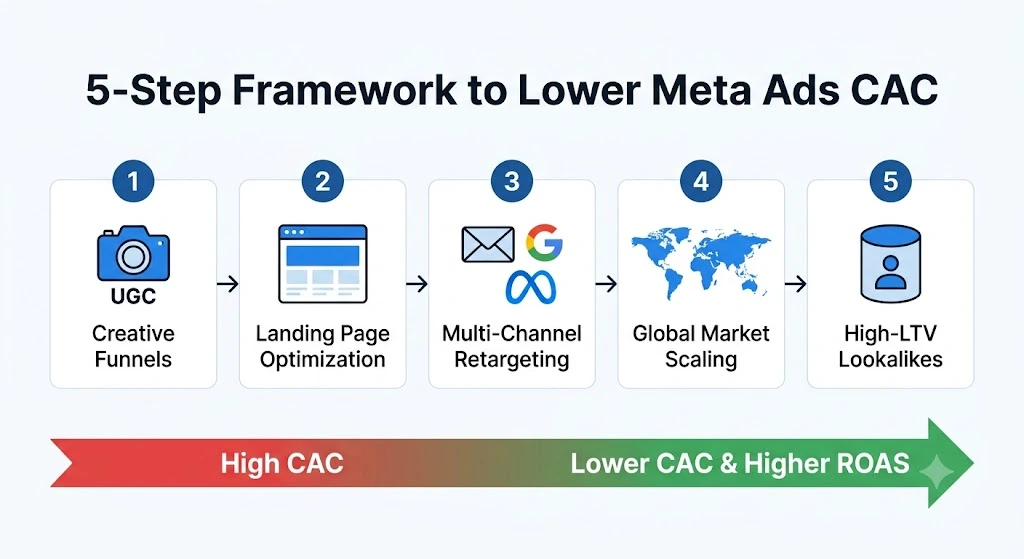
In this guide, we’ll walk through five field-tested steps to improve Meta ad efficiency—the same framework performance marketers use to bring acquisition costs back under control while scaling into new, international markets, without burning the budget testing blind. This is the same ecommerce performance marketing approach we use when auditing accounts for global brands.
⚡ Quick Summary: Key Takeaways
Broad targeting on Meta is dead. To reduce paid acquisition costs in global markets, you need to:
- Use hook-based UGC creative instead of interest-stacked targeting
- Localize currency and shipping transparency on every landing page
- Diversify retargeting across email and SMS, and let Meta carry the whole funnel
- Scale horizontally into Tier-2 markets using the 70/20/10 budget rule
Short on time? Skip straight to the Final Action Plan checklist.
Step 1: Why Is Meta Ads CAC Too High? Start with Creative Funnels
Meta Ads CAC Too High is often the result of relying on outdated audience targeting instead of creative that captures attention. Before changing budgets or bidding strategies, start by improving how your ads engage cold audiences.
Why Creative Is the New Targeting (and How It Can Cut CAC by 20–30%)
For years, “targeting” meant stacking interests, behaviors, and lookalikes until Meta found the right person. That playbook is fading—and it’s a big reason acquisition costs keep climbing for ecommerce brands still running it that way in 2026. With iOS privacy changes and Meta’s own AI-driven delivery (Advantage+), the platform increasingly decides who sees your ad—your real lever now is deciding what they see.
This is why creative has quietly become the new targeting layer. A generic product shot competing in a Tier-1 market feed gets scrolled past in under a second. A raw, relatable UGC clip—someone unboxing the product, reacting honestly, showing it in real use—earns a pause. And in advertising, a pause is the first purchase decision.
Brands scaling internationally often make the mistake of running the same polished, studio-style creative everywhere. But a customer in Manila and a customer in Melbourne don’t respond to the same visual cues, humor, or pacing. Localized, native-feel consistently outperforms “global” polish.
Structuring Top-of-Funnel (TOFU) Ads: The 3-Second Rule for Cold Global Audiences
Cold audiences abroad don’t know your brand, don’t trust your currency conversion, and definitely don’t have three minutes to figure out what you sell. Your first three seconds have to do three jobs simultaneously:
- Interrupt the scroll—a bold visual pattern break, a question, or an unexpected first frame
- Establish relevance—show the product solving a problem the viewer instantly recognizes
- Earn one more second—a hook line or on-screen text that promises value ahead
A simple framework that works across markets: Problem → Product-in-action → Proof. Show the pain point first, not the product. People don’t buy products; they buy relief from a problem they already have.
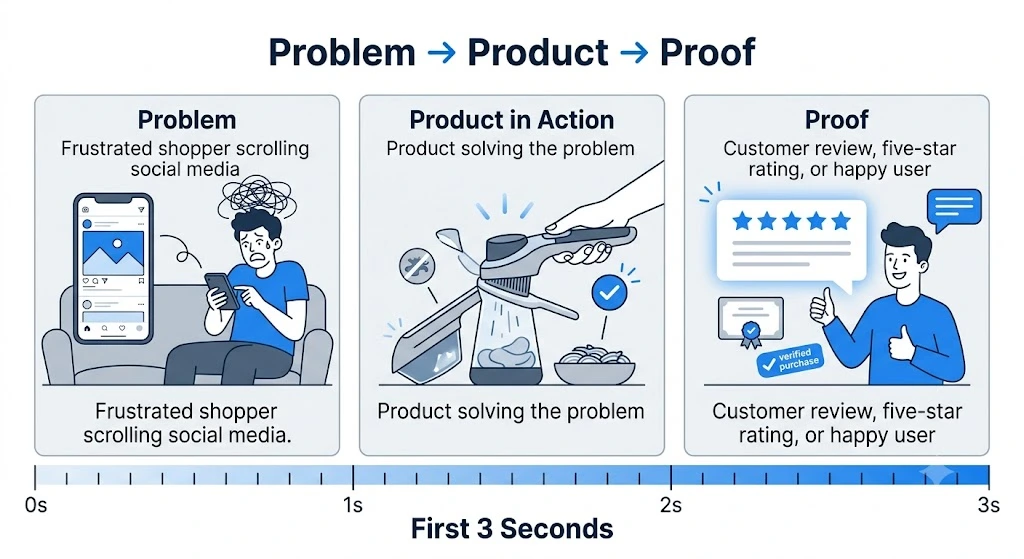
A few formats consistently perform well for the “product in action” beat specifically: unboxing that flows straight into use, before-and-after transformations shown in real time, first-person POV demos, side-by-side comparisons, quick multi-use montages, and a broken-way-then-fix cut. The diagram below breaks down all six.
For deeper creative benchmarking, Meta’s own Ads Library is a genuinely underused tool—you can study what competitors in your target country are running right now, completely free.
Step 2: Reduce Meta Ads CAC Too High with Landing Page Optimization
If Meta Ads CAC Too High continues despite strong ad performance, your landing page may be reducing conversions. Optimizing the post-click experience is one of the fastest ways to lower acquisition costs.
Eliminating Friction Points: Currency, Shipping, and Social Proof (60%+ of Cart Abandonment Starts Here)
International shoppers abandon carts for reasons that rarely show up in an ad dashboard:
- Currency confusion—if a shopper in the UK sees prices in USD, that’s an instant trust tax. Auto-detect location and display local currency.
- Hidden duties and taxes—surprise charges at checkout are one of the top reasons for cart abandonment in cross-border e-commerce, according to research from Baymard Institute. Show landed cost upfront, not at the final step.
- Missing local trust signals—a US-based review widget means little to a first-time buyer in Germany. Localized reviews, regional payment icons, and recognizable delivery partners matter more than most brands realize.
Post-Click Experience Optimization to Improve Campaign Profitability
Page speed isn’t a technical detail anymore—it’s a direct line item in your ad spend efficiency. A landing page that loads even one second slower can quietly inflate CAC, because Meta’s algorithm and your own conversion rate both punish drop-off.
A few checks worth running this week:
- Compress hero images and defer non-critical scripts
- Test load speed specifically from the regions you’re targeting, not just your home country
- Match landing page messaging word-for-word with the ad’s hook—mismatched promises are one of the quietest conversion killers
Google’s PageSpeed Insights is a fast way to catch this before it shows up as wasted spend.
📋 Not sure where your funnel is leaking budget? A quick, self-serve audit covering creative, landing page, attribution, and budget allocation—built from the exact framework in this article.
Step 3: Solve Meta Ads CAC Too High Using Multi-Channel Retargeting
Many brands struggle with Meta Ads CAC being too high because they rely on a single advertising channel. Expanding your retargeting strategy across multiple channels can improve efficiency and reduce dependency on Meta alone.
Middle-of-Funnel and Bottom-of-Funnel Traffic Mix
Here’s an uncomfortable truth: if Meta is the only channel touching a customer from first impression to final purchase, you’re funding the entire buying journey out of one ad account’s budget—and paying Meta’s rising CPMs at every stage of it.
Spreading the funnel across channels reduces that dependency:
- Google Search & Shopping ads to catch high-intent visitors who searched your brand name after seeing the Meta ad but didn’t convert yet
- Email flows triggered by site visits or cart abandonment, which cost a fraction of paid retargeting
- WhatsApp or SMS workflows, especially effective in markets across South and Southeast Asia and Latin America where messaging apps outperform email open rates
This isn’t about spending more—it’s about letting the cheapest channel do the work at each funnel stage, instead of asking Meta to do all of it at premium prices. If these workflows are still manual on your end, it’s worth reading our guide on business automation strategies for small businesses—most of this retargeting mix can run on autopilot once it’s set up correctly.
Fixing Attribution Loss: Why Your “Real” ROAS Is Higher Than Meta Reports
Cross-device, cross-border shopping journeys break traditional last-click attribution constantly. A shopper might see your ad on mobile in one country, browse later on desktop, and buy a week after that.
The fix is building first-party data collection into every touchpoint:
- Server-side tracking (Conversions API) alongside pixel tracking
- Post-purchase surveys asking, “How did you hear about us?”
- UTM discipline across every channel so blended ROAS reflects reality, not a single platform’s self-reported numbers
Meta’s Conversions API documentation is a solid starting point if this isn’t set up yet—it directly addresses the data loss caused by browser privacy restrictions.
Step 4: Scale Without Making Meta Ads CAC Too High
When Meta Ads CAC Too High makes scaling difficult, expanding into new markets strategically is often more effective than increasing budgets in saturated markets.
Micro-Testing High-Purchasing-Power Countries
The instinct when CAC rises in one market is to push harder into that same market. Often, a better move—especially if Facebook Ads CAC is climbing specifically in a saturated home market—is to test sideways first.
A simple tiering approach:
- Tier 1 (US, UK, Canada, Australia)—highest purchasing power, but also the most competitive and expensive CPMs
- Tier 2 (UAE, Singapore, parts of Western Europe, growing Latin American markets)—often less saturated, with surprisingly strong average order values
Running small, controlled budget tests (even $10–20/day per country) across 3–4 markets simultaneously reveals where your CAC is naturally lower before committing serious spend. This horizontal testing phase almost always uncovers at least one market performing better than the “obvious” home market.
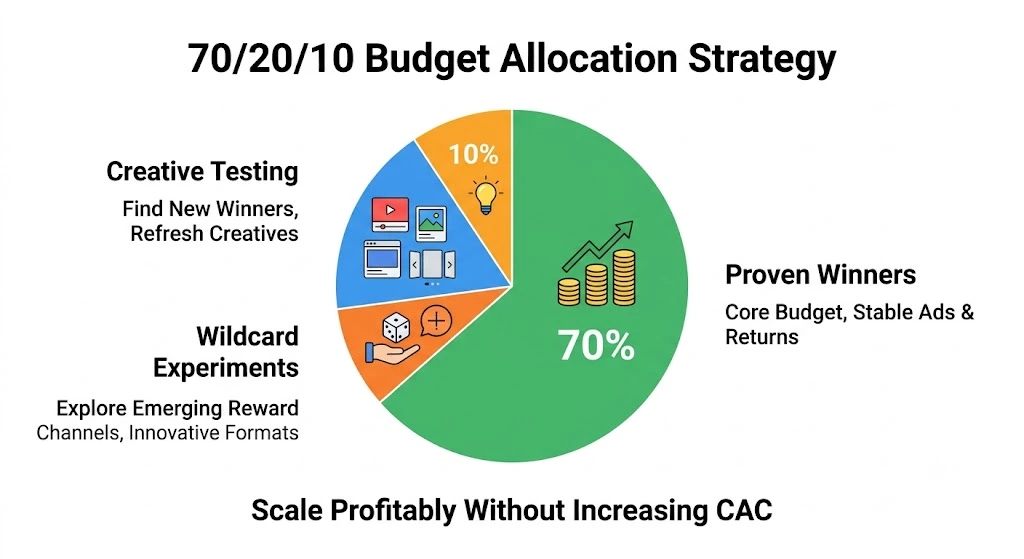
Budget Allocation Rule: The 70/20/10 Scaling Strategy (Used by Top-Scaling DTC Brands)
Once winning markets and creatives emerge, budget discipline keeps CAC stable while scaling:
- 70% into proven winning campaigns and audiences
- working—20% new into creative iterations of what’s already working—new hooks, new formats, same core angle
- 10% into genuine wildcard tests—new markets, new formats, new offers
This structure protects the account from the two most common scaling mistakes: over-investing in an unproven idea or never testing anything new because the “safe” campaign is comfortable.
Step 5: Prevent Meta Ads CAC Too High with High-LTV Audiences
Solving Meta Ads CAC Too High isn’t just about ads. Using first-party customer data and high-LTV lookalike audiences helps Meta find higher-value customers while keeping acquisition costs under control.
Lookalike Audiences Built on Customer Lifetime Value (Not Just Purchase Count)
Most brands build lookalike audiences from all purchasers. That’s a mistake hiding in plain sight—it teaches Meta to find more of your average customer, including the ones who bought once and never returned.
A sharper approach: segment your customer list by lifetime value first. Pull your top 10–20% of buyers by LTV—repeat purchasers, high-AOV customers, and subscription renewals—and build lookalikes from that list specifically on both Meta and Google.
This single shift often does more to lower blended CAC over time than any bid strategy change, because the algorithm stops optimizing for “anyone who’ll buy” and starts optimizing for “someone who’ll buy again.” It’s one of the highest-leverage ways to improve campaign profitability once you have even a few months of purchase data to work with.
Frequently Asked Questions
Why Is Meta Ads CAC Too High?
Usually it’s a combination of three things: broad, interest-based targeting competing in an increasingly expensive auction; generic creative that doesn’t earn a scroll-stopping pause; and a landing page with friction (slow load time, unclear pricing, missing local trust signals) that quietly kills conversion rate. High CAC is almost never one single cause—it’s small leaks across the funnel adding up.
What is a good CAC for e-commerce?
There’s no universal number—it depends entirely on your average order value, margin, and repeat purchase rate. A useful benchmark instead of a fixed figure: your CAC should stay meaningfully below your customer’s first-order gross profit if you want cash-positive acquisition, or below their 90-day LTV if you’re comfortable acquiring at a short-term loss to build a repeat base.
How do I lower Meta Ads CAC?
Focus on the five levers covered in this guide: shift from broad targeting to hook-based creative, remove cross-border landing page friction, diversify retargeting beyond Meta alone, test new markets horizontally before scaling one market vertically, and build lookalike audiences from your highest-LTV customers instead of all purchasers.
Does Advantage+ reduce CAC?
It can, but not automatically. Advantage+ campaigns are effective at finding efficient placements and audiences when fed strong, varied creative—the algorithm still needs good inputs to make good decisions. Brands that hand Advantage+ the same one or two ad variations often see CAC plateau or rise, while brands that feed it a wide, hook-diverse creative set tend to see it improve efficiency over time.
How long does it take to reduce CAC?
Creative and landing page fixes can show movement within 1–2 weeks, since they affect click-through and conversion rate almost immediately. Structural changes—like building LTV-based lookalikes or seeing horizontal market tests stabilize—typically take 4–8 weeks, since they depend on enough purchase data accumulating for the algorithm and your own analysis to work with.
Final Action Plan: The Global Performance Marketing Checklist
Before your next campaign launch, run through this:
- Audited current creative—is it interest-based or hook-based?
- Localized top 3 creatives for each target market (language, pacing, cultural cues)
- The landing page shows local currency and upfront landed cost
- Page speed tested from actual target-market locations
- Conversions API set up alongside Pixel for accurate attribution
- At least one non-Meta retargeting channel active (Google, email, or WhatsApp)
- 3–4 markets micro-tested before committing a full budget to one
- Budget split following the 70/20/10 rule
- LTV-based lookalike audience built from top 10–20% customers
- UTM tracking consistent across every channel
Lowering advertising costs rarely comes down to one single mistake—it’s small inefficiencies stacking up quietly across creative, landing page, funnel, and audience strategy. Fix one layer, and the number moves a little. Fix all five, and it moves a lot.
e-commerce The brands that successfully reduce e-commerce CAC with Meta Ads and scale profitably into global markets aren’t spending more than everyone else. They’re just wasting less at every single step of the funnel.