
How to Find Long-Tail Keywords: 9 Practical Methods for New Websites

Most new websites don’t struggle with keyword ideas. They struggle with keyword choices.
If you want to learn how to find long-tail keywords, the discovery part is the easy half. Open Google, type a few words, and suggestions appear. The hard half is deciding which of those suggestions a brand-new site can realistically rank for.
That’s where most guides stop. They hand you a list of tools and leave you staring at a spreadsheet of 200 phrases.
This guide follows one path: discover, validate, choose, and group. A GoFundScale research example shows how we compared keyword demand and difficulty across the UK, US, and India.
Quick Answer: How Do You Find Long-Tail Keywords?
Start with the problems your customers already describe. Expand those phrases with Google Autocomplete, People Also Ask, and communities like Reddit. Check demand in Google Keyword Planner, then read the actual search results to see how strong the competition is.
Finally, group closely related phrases into one page. Put relevance and search intent ahead of raw volume.
What Are Long-Tail Keywords?
A long-tail keyword is a specific search phrase that usually reflects a narrower need or clearer intent. It often has lower search demand than a broad keyword, although length alone does not determine whether a query is long-tail.
“Affordable accounting software for a small agency” is long-tail. So is a tight three-word niche product term. A rambling five-word phrase with no clear purpose isn’t.
What really matters is how much the query tells you. A specific query shows who is searching and what they need. That clarity helps you create a focused page that better matches the searcher’s needs.
Long-Tail vs. Short-Tail Keywords: Examples
Here is the difference at a glance.
| Feature | Short-tail | Long-tail |
|---|---|---|
| Example | Accounting software | Affordable accounting software for a small agency |
| Intent | Broad | Specific |
| Search demand | Usually higher | Often lower |
| Content requirement | Broad coverage | Focused answer |
The same pattern shows up in every industry:
- Bakery: “wedding cakes” becomes “affordable wedding cake for 50 guests”
- Bookkeeping: “bookkeeping” becomes “how to organise receipts before hiring a bookkeeper”
- SaaS: “project management” becomes “project management tool for a three-person remote team”
- Fitness studio: “yoga classes” becomes “beginner yoga classes for back pain near me”
Each long-tail version reads like a real sentence a customer would say. That’s the point. Search intent matters far more than word count.

How to Find Long-Tail Keywords: 9 Practical Methods
Here are nine ways to find long-tail keyword ideas using free Google features and community sources. Some methods require an existing website or account: Search Console needs site data, and Keyword Planner requires a Google Ads account.
You don’t need every method. Pick the ones that match how your customers actually search.
1. Start With Customer Questions and Problems
Your best keyword research may already be sitting in your inbox.
Go through sales emails, contact form messages, support tickets, reviews, and call notes. Customers rarely talk in “keyword tool” language. They describe problems in full sentences.
A broad topic like “bookkeeping” becomes “how to organise receipts before hiring a bookkeeper” once you read what customers actually ask. Treat those phrases as seed keywords, then validate them with search data later.
Customer conversations can reveal problems and phrases that keyword tools may miss. See our guide on using existing customer feedback to understand customer needs before turning those questions into keyword ideas.
2. Use Google Autocomplete.
Autocomplete is fast and easy to overlook.
Type your seed topic into Google and add a modifier before or after it. Try words like “how,” “best,” “for,” “without,” “near,” and “under.” For example, typing “accounting software for” might surface suggestions such as “accounting software for freelancers” or “accounting software for small agencies”.
Check different countries and languages too, because suggestions change by location. And remember that a suggestion is a starting point, not proof of demand.
3. Find Questions in People Also Ask
Search your seed keyword and open relevant questions in the People Also Ask box. Expanding some questions may reveal additional related questions.
Collect recurring questions and group those that share the same search intent. Related questions can often be answered together in one useful section or article.
For a broader approach to search discovery, see our guide on how to discover what people are searching for on Google.
4. Check Google Related Searches.
Scroll to the bottom of the results page. The Related Searches section shows how people reword the same need.
Use it to spot variations and subtopics. Skip the ones that don’t fit your audience. A suggestion can be popular and still irrelevant to your business.
5. Use Google Keyword Planner.
This is where you check ideas against data. In Google Keyword Planner:
- Open “Discover new keywords.”
- Enter your seed terms.
- Select the right country and language.
- Export the results and keep the useful columns.
Here is what each column actually tells you.
| Keyword Planner metric | What it tells you |
|---|---|
| Average monthly searches | Estimated search demand |
| Three-month change | Recent movement |
| YoY change | Annual movement |
| Competition | Google Ads advertiser competition |
| Top-of-page bid | Advertiser bidding signal |
The “Competition” column measures advertiser competition in Google Ads. It does not measure organic SEO difficulty. A keyword can show low advertiser competition while its search results are dominated by established websites.
6. Analyse Competitor Pages
Look at how competitors structure their articles. Read their headings, see which subtopics they cover, and note the questions they leave unanswered.
These gaps may reveal opportunities to create a more complete and relevant answer. But don’t copy a keyword just because a competitor ranks for it. Their site may have years of authority; yours doesn’t.
7. Explore Reddit, Forums, and Industry Communities
Communities are where people talk without an SEO filter.
Look for repeated questions, exact wording, and common frustrations. These threads often reveal phrases no tool suggests.
A busy discussion does not prove that many people search for the topic on Google. Validate promising ideas using Keyword Planner and by reviewing the actual search results.
8. Use Google Trends and Other Search Suggestions
Google Trends shows whether interest is rising, falling, or seasonal. It also lets you compare countries.
Other search boxes add new angles. YouTube suggestions work well for how-to topics. Amazon suggestions help product-based businesses. Use the sources that fit your market, and ignore the rest.
9. Find Long-Tail Opportunities in Google Search Console
This method needs data, so a brand-new site can’t use it yet. But plan for it early.
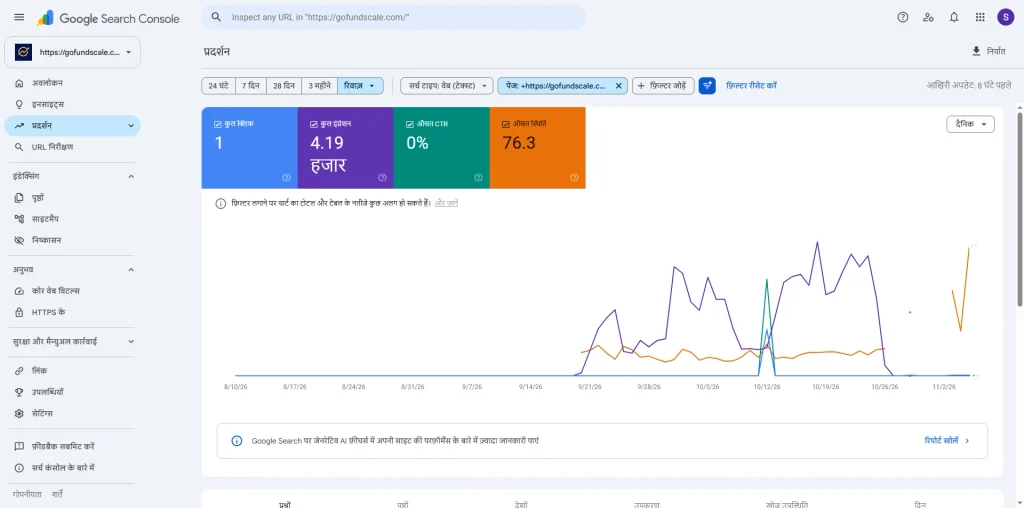
Once your pages start receiving impressions, open Search Console, go to Performance → Search results, and open the Queries tab. Look for specific queries with impressions, especially those where the page is not yet receiving strong visibility. These may reveal opportunities to improve existing content. Google explains each report column in its performance report documentation.
Then decide by intent. If the query matches an existing page, update that page. If it needs a different kind of answer, create a new one.
How to Choose the Right Long-Tail Keywords
Collecting ideas is easy. Choosing is where strategies fall apart. Run every candidate through these six filters.
1. Relevance
Ask whether the searcher is someone you can genuinely help. If the honest answer is “sort of”, skip it.
Example: A bookkeeping firm that serves freelancers shouldn’t chase “enterprise accounting software”, even if the volume looks tempting.
2. Search Intent
Is the searcher looking for a guide, a comparison, a tool, or a local service? Your page must match. Google’s guidance on creating helpful, people-first content is a useful reference for what searchers expect.
Example: Someone searching “free keyword research tools” wants a list of tools. A methodology guide won’t satisfy them, however good it is.
3. Search Demand
Volume alone shouldn’t decide anything. Check whether demand is stable, falling, or seasonal.
Also avoid adding close variants together without checking the data. Keyword Planner may group similar search terms, so two phrases showing 500 searches each do not necessarily represent 1,000 separate searches.
4. SERP Competition
This is how to check keyword competition without paying for a big SEO suite. Search the keyword yourself and review the first ten results:
- Who ranks? Forum threads, small niche sites, and outdated articles can signal an opening.
- How good are the pages? Thin or generic answers leave room for a better one.
- How strong are the competing sites? Consider their topical relevance, the quality of their pages, and the strength of their websites. A weak page on a well-established domain may still be difficult to outrank.
- What formats appear? Videos, tools, and shopping results can crowd out a written guide.
Keyword difficulty scores can help you compare candidates, but treat them as directional signals. A low score never guarantees a ranking. If you want to go deeper into evaluating weak SERPs and finding opportunities for newer websites, read our guide on how to find low-competition keywords for a new website.
5. Click Potential
A ranking only helps if people click. Check whether an AI overview or a featured snippet already answers the query completely.
If it does, your title needs to promise something extra, such as a worksheet, a template, or a real example.
6. Existing Page or Keyword Fit
Before creating a new page, ask whether the keyword belongs inside an article you already have. If it shares intent with a keyword you’re already targeting, it probably does.
Long-Tail Keyword Examples: A Real GoFundScale Research Case Study
Theory is useful. A worked example is better. Here is the exact process we followed to choose the keyword for this article.
Step 1: Start With a Seed Topic
The first idea was wide and clunky: how to find long-tail keywords for a new small business website.
We trimmed it into a cleaner, searchable term: how to find long-tail keywords.
Step 2: Collect Keyword Ideas
We shortlisted eight candidate phrases from the keyword research process. They covered the main query and related needs such as examples, free methods, keyword selection, and competition checking.
Step 3: Compare UK, US, and India Search Volumes
We checked each keyword in three markets, since a keyword that works in one country may be quiet in another. The figures below are average monthly searches for October 2025 to September 2026. This is the long-tail keyword research behind the article.
| Keyword | UK | US | India | SCrawl difficulty |
|---|---|---|---|---|
| how to find long-tail keywords | 50 | 500 | 500 | 49 |
| long-tail keyword examples | 50 | 500 | 500 | 33 |
| long-tail keyword research | 50 | 500 | 500 | 35 |
| how to find long-tail keywords for free | 50 | 50 | 50 | 43 |
| how to choose long-tail keywords | 50 | 50 | 50 | 39 |
| keyword research for a new website | 50 | 50 | 50 | 48 |
| how to find low-competition keywords | 50 | 500 | 500 | 55 |
| how to check keyword competition | 50 | 50 | 50 | 40 |
Source and data note: Average monthly search figures come from Google Keyword Planner for October 2025 to September 2026. SCrawl is a separate tool, and its difficulty scores come from our research screenshots, not from Keyword Planner. Figures are estimates and can vary by location, language, and Google’s grouping of close variants. These figures should be compared within the same tool and market settings; they are not exact counts of unique people or searches.

Step 4: Compare Search Intent and Difficulty
Next, we asked which keywords share one reader and which don’t.
- “How to find long-tail keywords” has 500 average monthly searches in the US and India and 50 in the UK in our Keyword Planner export. Its SCrawl difficulty score is 49. It matches the exact problem this article solves, so it remains the primary target despite its moderate difficulty.
- “Long-tail keyword examples” (33) fits the examples section and has the same broad informational audience.
- “How to find long-tail keywords for free” (43) fits the free discovery methods covered in this guide.
- “How to choose long-tail keywords” (39) fits the selection section because choosing is part of the same research task.
- “How to check keyword competition” (40) fits the SERP evaluation filter rather than needing a separate article.
- “How to find low-competition keywords” and “keyword research for a new website” serve slightly different needs, so they are not formal targets for this page.
Step 5: Final Keyword Selection
Here is what we settled on:
- Primary: how to find long-tail keywords
- Secondary: long-tail keyword examples; how to find long-tail keywords for free; how to choose long-tail keywords
- Supporting: long-tail keyword research; how to check keyword competition
We did not add up variants like “how to get long-tail keywords.” They share the same intent, so they belong on the same page.
How to Group Related Long-Tail Keywords
Once you have a shortlist, resist the urge to give each phrase its own page.
- Same intent: usually one page
- Different intent: consider a separate page
For example, “how to find long-tail keywords” and “how to get long-tail keywords” share the same search intent and usually belong on one page. Separate pages should be considered only when the search intent is genuinely different.
Long-Tail Keyword Research Worksheet
Copy this table into a spreadsheet and fill one row per keyword. Write short notes instead of numeric scores. Words force you to think; numbers let you rush. Fill the SERP and click cells only after you have checked the live Google results.
| Keyword | Business relevance | Search intent | Volume/trend | SERP competition | Click potential | Cluster fit | Keep/reject |
|---|---|---|---|---|---|---|---|
| how to find long-tail keywords for free | High | Informational | 50 in each market | Review live SERP | Review live SERP | Same main topic | Keep as secondary |
A 30-Minute Keyword Research Workflow
Use this as a quick first-pass workflow for one seed topic. A thorough SERP review may take longer, especially in competitive markets.
| Time | Action | Output |
|---|---|---|
| 0–5 min | List customer problems and seed topics (Method 1) | 3–5 seeds |
| 5–10 min | Check Autocomplete, People Also Ask, and Related Searches (Methods 2–4) | 15–20 ideas |
| 10–17 min | Add community wording and competitor gaps (Methods 6–7) | Expanded list |
| 17–22 min | Check volume and trends in Keyword Planner and Trends (Methods 5 and 8) | Shortlist of 5–8 |
| 22–27 min | Review the search results for your top five | Competition and click risk |
| 27–30 min | Fill the worksheet and group by intent | Primary plus secondary set |
Common Keyword Research Mistakes
Avoid these six slip-ups:
- Choosing keywords only by volume. A lower-volume keyword may be a better fit when its intent is more relevant and the current search results leave room for a more useful answer.
- Confusing Google Ads competition with SEO difficulty. They measure different things.
- Assuming every long phrase is long-tail. Specificity matters, not length.
- Ignoring search intent. If your content format does not match what searchers want, the page may struggle to perform.
- Trusting suggestions without SERP validation. Tool and AI-generated lists still need a real check.
- Targeting topics outside your expertise. This may attract visitors whose needs your business cannot serve effectively.
Frequently Asked Questions
What is the easiest free way to find long-tail keywords?
Start with questions customers ask in emails, reviews, and support conversations you can access. Then expand those phrases using Google Autocomplete and People Also Ask. These Google search features are free to use.
What search volume is good for a new website?
There’s no universal number. A keyword with 50 to 500 monthly searches can be worth targeting when the intent matches your business and the current results leave a clear gap. Let the search results guide the decision, not volume alone.
How do I know whether a long-tail keyword is easy to rank for?
Search it and study the top ten results. Forum threads, outdated pages, thin answers, or an intent mismatch may signal an opening. But that isn’t proof. Also weigh the authority of the remaining results and the quality of your own content.
How many words should a long-tail keyword have?
There’s no fixed count. Many have three to five words, but some are shorter. What defines a long-tail keyword is a specific, clear intent with lower search demand, not its length.
Should similar long-tail keywords have separate pages?
Generally no. Close variants that share intent fit better on one comprehensive page. Splitting them can cause cannibalization and thin content.
Conclusion
Learning how to find long-tail keywords isn’t about luck. It’s a repeatable process: discover ideas, validate them, choose the ones that fit, and group the rest.
Finding ideas is just the first step. The real work is selection, where relevance, intent, and competition decide which phrases earn a page. Free tools are enough for a solid shortlist, as long as the manual checking behind them is thorough.
Open the worksheet, list your seed topics, and run your first keywords through the filters today






Pretty section of content. I just stumbled upon your site and in accession capital to
assert that I acquire in fact enjoyed account your blog posts.
Anyway I’ll be subscribing to your augment and even I achievement you access
consistently rapidly.
Welcome! We are here to provide you with useful and important information at all times. Please feel free to ask if you need specific information on any question or topic. We look forward to your continued engagement!