
How to Ask Customers for Reviews Without Feeling Awkward

Asking for a review can feel uncomfortable, especially when you don’t want the customer to feel pressured.
The hesitation is understandable. But asking and pressuring are different things. A clear, polite request respects the customer’s choice. Pressure takes it away.
This guide covers how to ask customers for reviews with better wording. You’ll see before-and-after examples, three short scripts for common situations, and one message template you can adapt today.
Why Asking Customers for Reviews Feels Awkward
Two fears sit behind most of the discomfort.
The first is that the customer will feel you’re asking for a favour. The second is sounding promotional or needy right after finishing the job.
Some customers may still read it as a favour, and that’s fine. What matters is that they can say no easily.
A clear, polite request gives the customer room to decide without feeling obligated.
How to Ask Customers for Reviews Naturally
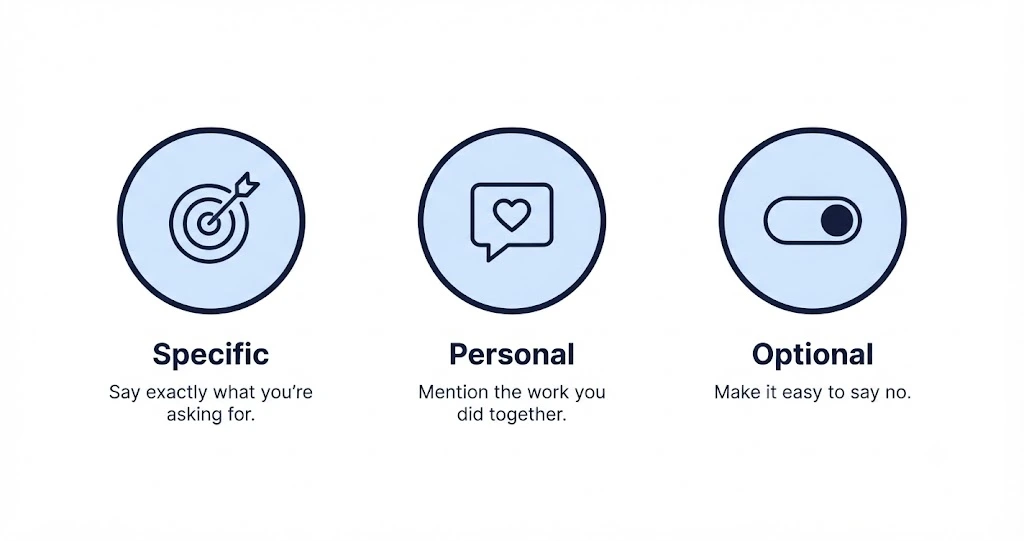
Be Specific About What You’re Asking For
“Please support our business” doesn’t tell the customer what to do.
Say what you want: a short, honest review of their experience. If it helps, name the platform, such as Google or your website.
Keep the Request Personal and Conversational
Generic or overly formal language reads like a mass message, and people skim past it.
Mentioning the project or service you worked on together makes the request feel more personal than a generic message.
Make It Easy to Say Yes—or No
Let the customer decide. Don’t use guilt, and don’t hint at the rating you’d like.
What the research says. Lehigh University researchers’ findings on positive review requests come from Nevena Koukova and Rebecca Wang, who studied conditional requests, where a retailer asks for a positive review. They found these requests can hurt how customers view the retailer. In their study, changing the message wording lessened that effect but did not remove it. Their advice to retailers: don’t ask for a five-star review.
So ask for an honest review, not a good one.
If you also need help with local visibility and Google reviews, see our guide to local SEO for small businesses.
Awkward vs. Natural: How to Improve Your Review Request
Three common wording problems, each fixed differently.
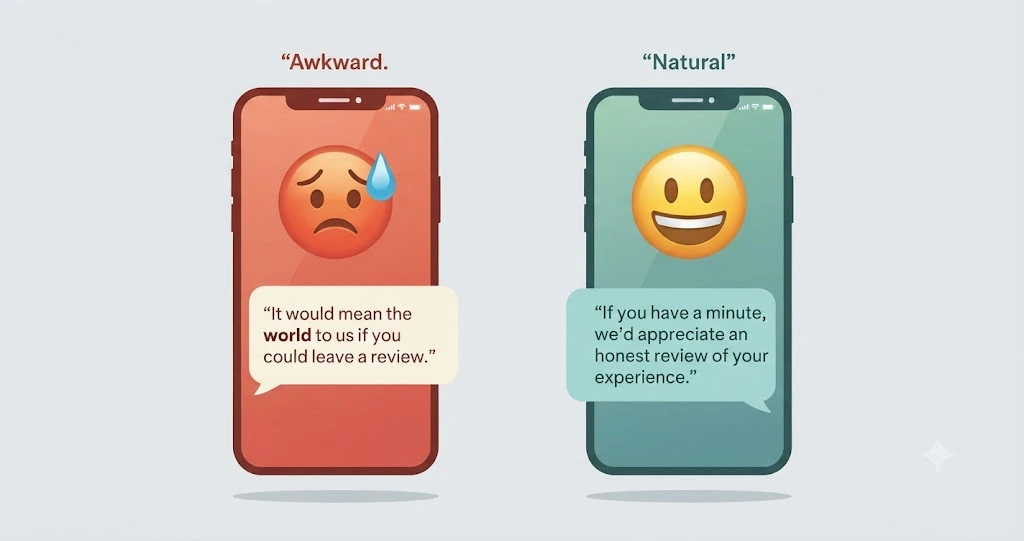
1. Emotional Pressure
Original: “It would mean the world to us if you could leave a review.”
Improved: “If you have a minute, we’d appreciate an honest review of your experience.”
Why it works: The original puts the focus on your feelings. The improved version puts it on the customer’s experience, so they can answer honestly without feeling responsible for how you react.
2. Vague Wording
Original: “Please support our business online.”
Improved: “Would you share a short review on Google about working with us? Here’s the link: [link]”
Why it works: The original never says what to do or where. The improved version names the action and the place, so the customer doesn’t have to work it out.
3. Demanding Wording
Original: “Please leave a review today.”
Improved: “Whenever you get a chance, we’d love to hear how it went.”
Why it works: A deadline ignores the customer’s schedule. Removing it lets them respond when it suits them
What the data says about urgency. Yotpo’s analysis of 3.5 million review requests looked at post-purchase email subject lines. On average, subject lines with urgency words like “now” or “today” were linked to review rates about 26% lower. This is Yotpo’s own ecommerce data, not proof that the same wording causes the same drop for service businesses. Still, it fits the idea that pushing the customer tends to work against you.
What to Say When Asking a Customer for a Review
Each script below suits a different moment.
After Completing a Service
Use when: the work is finished and the result is fresh.
“Hi [Name], it was great working with you on [project]. If you’re open to it, I’d value a short, honest review of your experience: [link]. Thanks again!”
After a Customer Shares Positive Feedback
Use when the customer has already said something kind, in person or by message.
“Thank you; that’s really kind to hear! If you’d like to share it publicly, a short review would help others see what working with us is like. No pressure at all.”
Not every satisfied customer wants to write a review, so leave room for a “maybe not”. Also, don’t reserve review requests only for customers who have praised you; use the same criteria for everyone you ask.
When Asking a Returning Customer
Use when: you already have an ongoing relationship.
“Hi [Name], thanks for coming back to us. If you ever feel like leaving a review, here’s the link: [link]. Either way, we appreciate you.”
A Review Request Message You Can Adapt
If you only use one thing from this article, use this template. Change the details so it sounds like you.
Hi [Name],
Thanks for choosing [Business Name] for [service/project]. I hope it turned out the way you wanted.
If you have a couple of minutes, would you share an honest review of your experience? Here’s the link: [review link]
No pressure at all. Thanks again, and feel free to reach out if you need anything.
[Your Name]
It has four parts: a reference to their experience, a direct request, the link, and a closing that respects their choice.
WhatsApp version:
“Hi [Name], thanks again for [project]! If you’re happy to, I’d appreciate a short honest review here: [link]. No worries if you’re busy 🙂.”
What If the Customer Doesn’t Respond?
Silence rarely means anything personal. People get busy, forget, or prefer not to write reviews.
One polite reminder is a reasonable default if the situation allows it:
“Hi [Name], just a quick note in case my earlier message got buried. Happy to skip it if you’d rather not. “Thanks, either way!”
Repeated reminders can make the request feel pressuring, so after one, let it rest.
For broader guidance on respectful follow-ups, read how to follow up with leads without being pushy.
Frequently Asked Questions
Should I ask every customer for a review?
You don’t have to send an individual request to every customer, but use consistent criteria rather than selecting customers based on whether you expect a positive review. Ask for honest feedback without influencing the rating or review content. Google’s rules point the same way: see Google’s Maps user-generated content policy for what businesses can and can’t do when asking for reviews.
Can I ask in person and send the link afterward?
Yes. A quick in-person or phone mention feels personal, and a follow-up message with the link saves the customer from searching for it. Keep the same tone: honest review, no pressure.
Your Next Step
Pick one customer you’ve recently helped. Take the template above, adjust a few words to sound like you, and send it.
Get Practical Tips for Growing Your Small Business
Subscribe to GoFundScale for practical guides and useful ideas to help you grow your small business.