
How to Follow Up With Leads Without Being Pushy

You had a good conversation. The lead seemed interested. Then silence. This is the moment when many people hesitate to follow up with leads.
Now you’re staring at the screen, wondering how to follow up with a lead without being annoying. Send too many messages and you can look pushy. Send nothing and a promising conversation can quietly go cold.
Here’s the good news. A follow-up doesn’t feel pushy when it’s useful. It feels pushy when it only serves you. This guide shows you how to follow up with leads using the right timing, frequency, message examples, and a plan for when a lead stops replying.
What Makes a Lead Follow-Up Feel Pushy?
A follow-up usually feels different from nagging when it gives the lead a clear reason to respond and respects their time.
The difference comes down to a few habits.
Repeating “Just Checking In”
This line says nothing. The lead has to guess why you’re writing, and most won’t bother.
Following Up Too Frequently
Three messages in two days feels like chasing. Space gives people room to think.
Asking for a Decision Too Soon
If the lead is still comparing options, a “ready to sign?” message adds pressure, not progress.
Sending the Same Message Every Time
Copy-paste follow-ups are easy to spot. If message three reads like message one, it gets ignored.
Adding Pressure Without Giving New Value
“I wanted to bump this to the top of your inbox” gives the lead nothing. Every message should carry something fresh: an answer, a resource, or a useful idea.
How to Follow Up With a Lead Without Being Annoying
The best way to follow up with leads is to keep every message short, specific, and easy to answer. Here are seven ways to do it.
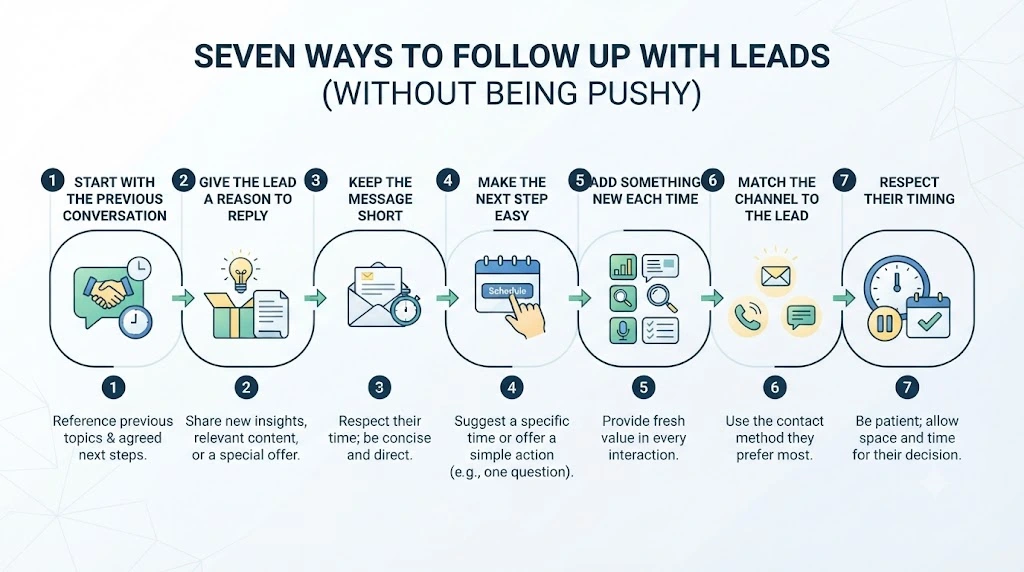
1. Start With the Previous Conversation
Open with something from your last chat. A detail they mentioned, a problem they described, and a deadline they gave you.
“You mentioned your team is losing track of new inquiries” lands far better than “Hope you’re well.”
2. Give the Lead a Reason to Reply
Ask yourself: why would they answer this? If you can’t name a reason, hold the message.
A reason can be a quick answer to their question, a case example, or a small idea that fits their situation.
3. Keep the Message Short
Keep the message short enough to scan quickly. Three or four lines is often enough to make your point without creating extra work for the reader.
4. Make the Next Step Easy
Ask for one thing. “Does Thursday at 11 work for a 15-minute call?” is easier to answer than “Let me know your thoughts.”
5. Add Something New Each Time
Bring one fresh thing with every message: an answer, an example, a resource, or an update. If you have nothing new to add, wait.
6. Match the Channel to the Lead
Email suits detailed information. A text suits a quick question. If the lead has been replying by email, don’t jump to calling without a reason.
7. Respect Their Timing
Leads have their own calendars, budgets, and priorities. A slow reply doesn’t necessarily mean no. The lead may be busy, still evaluating options, or simply not ready to respond. Keep that in mind, and your tone changes without you trying.
How Often Should You Follow Up With a Lead?
There’s no magic number. A hot lead who just asked for pricing needs a faster reply than someone you met at an event three weeks ago.
What matters is that each message has a reason and enough gap to breathe.
A Simple Follow-Up Timeline
Use this as a starting point, then adjust to the lead’s pace and your sales cycle.
| Stage | Rough timing | Goal |
|---|---|---|
| Initial contact | Day 0 | Start the conversation. |
| First follow-up | 2–3 days later | Recap and ask one clear question. |
| Second follow-up | About 1 week later | Add a new detail or answer a likely doubt. |
| Value-based follow-up | Around week 2 | Share something genuinely useful. |
| Final follow-up | Around week 3–4 | Close the loop politely |
If the lead replies at any point, drop the timeline and follow their lead.
How Many Times Should You Follow Up With a Lead?
Many sales conversations need more than one follow-up, and giving up after a single unanswered message can leave opportunities unexplored.
There isn’t a universal number of follow-ups that works for every lead. For many small-business sales cycles, four or five well-spaced, useful messages can be a reasonable starting point if the prospect hasn’t said no. Adjust the cadence based on buying intent, sales cycle, and the lead’s responses. Past that, move them to a slower, low-pressure rhythm, like an occasional helpful update.
What Research Says About Lead Response Speed
You don’t have to take this opinion. Researchers have studied how companies actually handle leads.
In a well-known Harvard Business Review article, “The Short Life of Online Sales Leads” (2011), researchers James Oldroyd, Kristina McElheran, and David Elkington tested how businesses respond to web inquiries. Three findings stand out:
- Among companies that replied within 30 days, the average response time was 42 hours.
- Firms that contacted a lead within an hour were roughly 7 times more likely to have a meaningful conversation with a decision maker than firms that waited even one hour longer.
- Compared with companies that waited 24 hours or more, the odds were over 60 times higher.
A separate secret-shopper audit by InsideSales in 2012 found that sales reps attempted contact an average of 1.30 times per lead, suggesting that many companies were not persistent in their follow-up.
What does this mean for you? Speed matters for the first reply, and a few thoughtful follow-ups can set you apart without being pushy.
One honest note: the HBR study measured response speed to new inquiries, not how many follow-ups close a deal. Use it as a guide on timing, not as a rule for every lead.
When Should You Stop Following Up?
Stop when the lead says no, asks you to stop, or stays silent after your closing message. Then step away and only consider reaching out again if there is a legitimate reason or something genuinely useful to share. Silence isn’t always rejection, but pushing past a clear signal turns a possible future customer into someone who remembers you for the wrong reason.
How to Follow Up Without Sounding Desperate
Desperation shows up in tone. The words “any update?” read very differently from “I found something that fits your plan.”
Replace “Just Checking In” With a Useful Reason
Swap it for a specific purpose.
- Instead of: “Just checking in on my last email.”
- Try: “I put together a short example of how a similar team handled this. Want me to send it over?”
Avoid Urgency You Haven’t Earned
“Limited spots!” and “Offer ends today!” backfire when they aren’t true. Only use a deadline if it’s real, and say why it exists.
Give the Prospect an Easy Way to Say No
This sounds backwards, but it works. A line like “If this isn’t a priority right now, just tell me and I’ll stop reaching out” takes the pressure off. People often reply because you gave them permission to be honest.
Know When to Step Back
Confidence means being comfortable with a “no.” If you’ve sent a useful message and heard nothing, wait. Let space do some of the work.
What to Say When Following Up With a Lead
The right words depend on where the lead is in the process. These examples work well for email or general messages.
When You’re Following Up After an Initial Conversation
“Hi [Name], great talking yesterday. You mentioned [specific problem]. I’ve attached a short overview of how we’d approach it. Would a quick call on [day] work to go through it?”
Why it works: It references the previous conversation and gives the lead a simple next step.
When the Lead Showed Interest
“Hi [Name], thanks for checking out [product/service]. Since you were looking at [feature], here’s a two-minute example of how it works. Happy to answer questions if useful.”
When the Lead Asked for More Information
Answer fully, then add one small next step.
“Hi [Name], here’s the pricing breakdown you asked for. The [plan name] fits what you described. If it helps, I can walk you through it in 10 minutes.”
When the Lead Has Gone Quiet
“Hi [Name], I know things get busy. I’ll leave this with you. If it [topic] comes back up, I’m happy to pick it up whenever suits you.”
Why it works: It removes pressure and leaves the door open.
When You Need a Simple Yes-or-No Answer
“Hi [Name], so I can plan my week, is moving forward with this still on the table, or should I close it on my side? Either answer is completely fine.”
Why it works: It makes it easy for the lead to answer honestly.
Sales Follow-Up Text Message Examples
Texts work best when the lead has already shared their number or prefers quick messages. Keep them short, human, and easy to respond to. Avoid creating pressure or making the lead feel obligated to reply immediately.
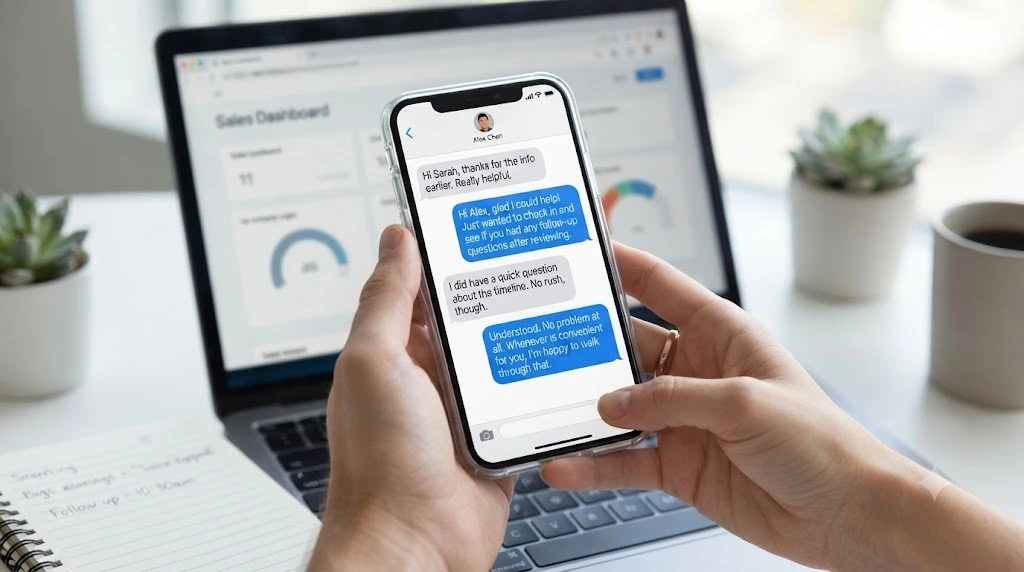
First Sales Follow-Up Text
“Hi [Name], it’s [Your Name] from [Company]. Good chatting earlier. I’ll send the details by email today. Anything specific you’d like me to include?”
Follow-Up Text After No Response
“Hi [Name], [Your Name] here. I know my last message may have slipped by. Would it be easier if I sent a quick summary instead of calling?”
Follow-Up Text for a Warm Lead
“Hi [Name], I saw you had a look at the [proposal/page]. Any questions I can clear up? Glad to jump on a 10-minute call this week.”
Value-Based Sales Follow-Up Text
“Hi [Name], came across a short guide on [their topic] that reminded me of our chat. Want me to send it your way?”
Final Follow-Up Text
“Hi [Name], I don’t want to crowd your inbox, so this is my last note for now. If the timing changes, just message me here. Wishing you a great quarter.”
Why it works: It closes politely without guilt and keeps a way back open.
Follow-Up Message Examples for Different Situations
These examples cover specific moments in the sales process, from the first call to a stalled deal.
After a Sales Call
“Hi [Name], thanks for your time today. To recap: you need [goal], your main concern is [concern], and we agreed on [next step]. I’ll send [item] by [date].”
After Sending a Proposal
“Hi [Name], the proposal went over on [day]. If any part is unclear, I can walk you through it or adjust it. Which section would you like to look at first?”
Why it works: It offers help and asks one small, specific question.
After a Product Demo
“Hi [Name], thanks for joining the demo. You seemed most interested in [feature], so I’ve put together a short note on how it would work for your team.”
When a Prospect Says “I’ll Think About It”
“Of course, take your time. Would it help if I answered any questions that might come up while you’re thinking? I’ll check back on [date] unless you’d rather I didn’t.”
Why it works: It respects their pace and sets a light, clear check-in.
When a Prospect Says “Not Right Now”
“Understood, and thanks for being upfront. Would it be okay if I checked back in [month]? Meanwhile, I’m happy to send useful resources if you want them.”
When a Lead Stops Responding
“Hi [Name], I haven’t heard back, so I’m guessing priorities shifted. Should I keep this open or close it for now? No pressure either way.”
How to Follow Up With a Lead After No Response
No reply is one of the most common situations salespeople have to handle, and one of the most stressful. Stay calm. The goal is to be remembered as helpful.
Wait Before Sending Another Message
Give it a few days at least. A rushed second message looks anxious, and it rarely changes the result.
Add Something New to the Conversation
Don’t repeat yourself. Bring a new example, an answer to a likely objection, or a small piece of news related to their business.
Change the Question or Call to Action
If “Can we schedule a call?” got no answer, try something lighter: “Would a short summary by email be easier?” A smaller ask is easier to say yes to.
Send a Breakup/Closing Message
A final note that closes the loop politely can make it easier for the lead to respond, or gives both sides a clear stopping point. It tells the lead you won’t keep chasing.
“Hi [Name], I’ll stop following up so I don’t clutter your inbox. If this becomes a priority, I’m one message away.”
When to Stop Contacting the Lead
Stop if they ask you to, if they’ve clearly declined, or if they’ve ignored your closing message. Note it in your CRM and revisit in a few months with something genuinely new.
Mistakes to Avoid When You Follow Up With Leads
Avoid these mistakes and your follow-ups will be more useful, relevant, and respectful.
Sending Too Many Messages
More messages don’t mean more interest. Quality and spacing beat volume.
Using Generic Templates Without Personalization
Templates are fine as a starting point. Send them untouched and they read like mass mail.
Making Every Message About Your Product
If every note is a pitch, the lead tunes out. Mix in answers, ideas, and useful context.
Creating Fake Urgency
Invented deadlines damage trust fast. If a lead catches one, the whole conversation suffers.
Ignoring the Prospect’s Previous Response
If they told you “check back in March,” don’t write in January. Listening builds more trust than any clever message.
Continuing After a Clear No
A “no” is information. Respect it, thank them, and move on.
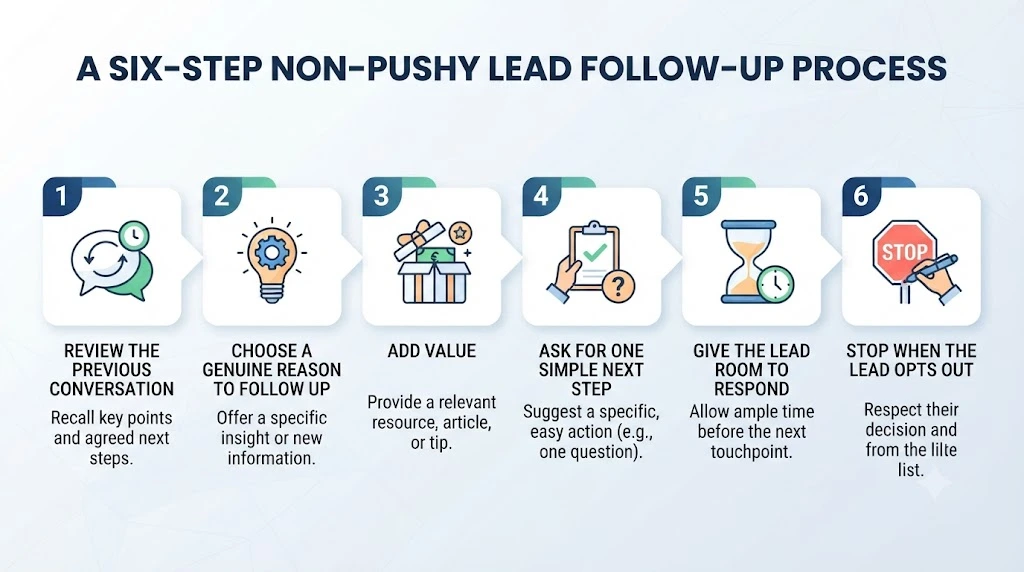
A Simple Process to Follow Up With Leads Without Pressure
Here’s the whole approach in six steps you can repeat for any lead.
- Review the previous conversation. Re-read notes, emails, and anything they said about timing.
- Choose a genuine reason to follow up. A question, a resource, a change in their situation.
- Add value. Give them something they didn’t have before your message.
- Ask for one simple next step. One question, one action.
- Give them room to respond. Wait before the next touch.
- Stop when the lead clearly opts out. Close politely and leave the door open.
When Should You Automate Lead Follow-Up?
Manual follow-up works best when the lead is high-value, the conversation is detailed, or the situation needs a personal touch. A proposal check-in or a reply to a specific objection should come from a real person.
Automation is useful for repetitive parts like instant confirmations, reminders, and a quick first reply when you can’t answer right away. Keep personalized conversations human.
Want the full picture on setting this up? Read our guide on how to automate lead follow-up for your small business.
Frequently Asked Questions
How often should you follow up with a lead?
It depends on the lead’s interest and your sales cycle. A common rhythm is a first follow-up after 2–3 days, then roughly weekly, with each message adding something new. Slow down if the lead stays quiet.
How many times should you follow up with a lead?
There’s no universal number. Four or five well-spaced, useful messages can be a reasonable starting point if the lead hasn’t declined. After that, stop active outreach and check in occasionally with something genuinely helpful.
How do you follow up without being annoying?
Reference your last conversation, offer something useful, keep it short, and ask for one easy next step. Give the lead time between messages.
What should you say when following up with a lead?
Mention what you discussed, add one useful detail, and ask a single simple question. Avoid “just checking in” on its own.
How do you follow up after no response?
Wait a few days, then send a message with something new, such as an answer, an example, or a lighter question. If there’s still no reply, send a polite closing note.
How do you follow up without sounding desperate?
Lead with value instead of urgency. Avoid fake deadlines, and make it easy for the lead to say no. Confidence comes from being fine with either answer.
What is a good sales follow-up text message?
A short, friendly text with your name, a reference to your last chat, and one easy question. For example: “Hi [Name], good chatting earlier. Would a quick summary by email help?”
Final Thoughts
Learning to follow up with leads well is part of good service, not a pest-control problem. When each message is useful, short, and respectful of the lead’s time, follow-up feels less like chasing and more like helping the buyer move forward.
Start small. Pick one lead who’s gone quiet today, and send one message that gives them a real reason to answer.
Need help turning more leads into conversations? Explore GoFundScale’s guides on sales and business automation, and build a follow-up system that works while you focus on closing.
Sources
- Oldroyd, J., McElheran, K., & Elkington, D. (2011). “The Short Life of Online Sales Leads.” Harvard Business Review, 89(3), 28. Archived at BYU ScholarsArchive.
- InsideSales: 2012 AA-ISP ResponseAudit Research