
How to Set Quarterly Goals for a Small Business: A Practical 90-Day Framework

Most small business owners don’t have a goals problem. They have a “too many goals” problem. Grow sales, fix the website, hire someone, clean up the books, and start Instagram. Everything feels urgent, so nothing really moves.
If you want to know how to set quarterly goals for a small business, the answer is simpler than it sounds: pick fewer things, measure them properly, and review them every week. This guide walks you through a 90-day framework, real examples, and a copyable worksheet you can use today.
What Are Quarterly Business Goals?
Quarterly business goals are the few results you want to reach in the next 90 days. They sit between your big annual vision and your daily to-do list.
A good one tells you what you want, how you’ll measure it and when it’s due.
Quarterly goals vs. annual business goals
An annual goal gives direction. A quarterly goal gives you something to actually do on Monday morning.
“Grow revenue this year” is a direction. “Raise monthly revenue from a known starting point to a specific number by the end of the quarter” is a goal you can act on.
Why a 90-day planning cycle helps small businesses
Twelve months is too long to stay focused. A week is too short to see real change. Ninety days sits in the middle.
You get enough time to finish something meaningful, and enough pressure to stop drifting. It also gives you four fresh chances a year to fix what isn’t working.
One thing worth separating early: an outcome is the result you want, a target is the number that proves it, and actions are the tasks that get you there. Mixing these up is where most plans quietly fall apart.
How to Set Quarterly Goals for a Small Business
Here’s the 7-step method. Each step has an action, a decision rule and a short example, so you’re never guessing.
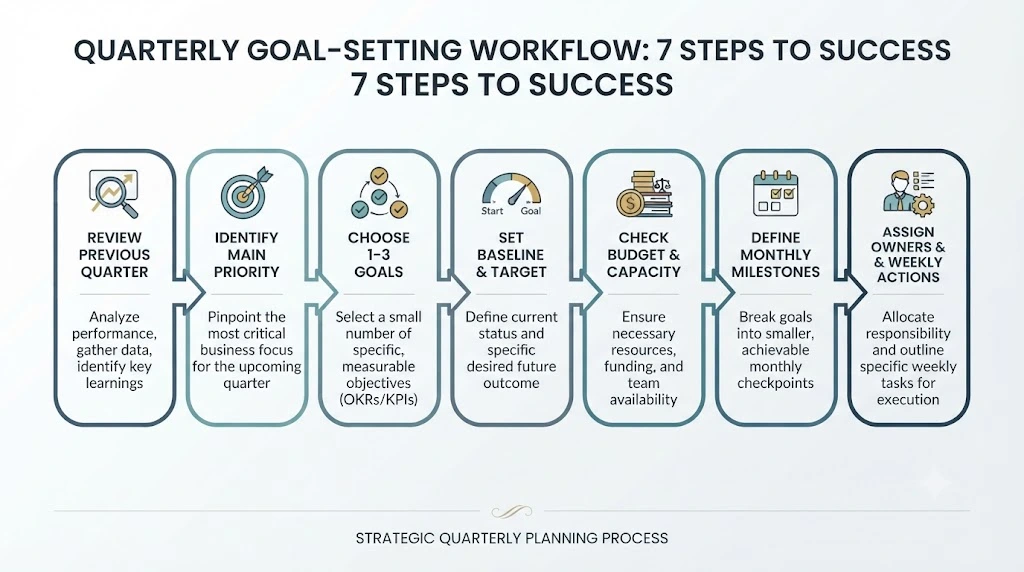
1. Review the Previous Quarter
Action: Look at last quarter’s numbers before you plan anything new. Check revenue, expenses, new customers, repeat customers and what you planned but never finished.
Decision rule: If a goal was missed, find out why before you repeat it. Was the target unrealistic, or did something else get in the way?
Be honest about time, too. Before you commit to anything new, review your small business workload so you know how much room your team really has.
Example: A bakery planned to launch catering last quarter but never did. Looking back, the owner sees that every Saturday was already full. The problem wasn’t the idea. It was capacity.
2. Identify Your Biggest Business Priority
Action: Ask one question: “If I could fix only one thing in the next 90 days, what would make the biggest difference?”
Decision rule: Pick the priority that touches money, customers or stress the most. If two compete, choose the one that unlocks the other.
Example: A small design studio has slow client payments, a messy website and an overloaded founder. Late payments are choking cash, so that’s the priority.
3. Choose One to Three Quarterly Goals
Action: Turn your priority into a short list of goals. One is fine. Three is plenty.
Decision rule: If you can’t explain each goal in one sentence, it’s too fuzzy. If your list needs a second page, it’s too long.
SCORE, the small business mentoring network, suggests SCORE’s one-page 90-day action plan built around a handful of focus areas, so the plan fits on a single page. That’s a good guide, not a rule that every business needs exactly three.
4. Set a Baseline, Target and Deadline
Action: For every goal, write three things: where you are now (baseline), where you want to be (target) and the date.
Decision rule: No baseline, no target. If you don’t know today’s number, your first goal is to measure it.
Using SMART goal-setting guidance for small businesses helps here. Make each goal specific, measurable, achievable, relevant and time-bound.
Example: Instead of “get more customers”, write: “Go from 18 repeat customers a month (baseline) to 25 (target) by the end of the quarter.”
5. Check Your Budget and Available Capacity
Action: Match each goal against your money and your people. What will it cost? Who will do the work? What gets paused to make room?
Decision rule: If a goal needs more cash or hours than you have, shrink it or move it to next quarter.
Before you lock in a revenue target, create a small business budget so you can see whether the goal fits your available resources. For a wider view of financial and operational responsibilities, the SBA guidance on managing a small business is a useful reference.
6. Break Each Goal into Monthly Milestones
Action: Split the 90 days into three checkpoints, one per month.
Decision rule: Month one should feel almost easy. Month two is the heavy lifting. Month three is finishing and fixing.
Example: For the repeat-customer goal above, in month one, set up a simple loyalty offer and track visits. Month two, send a monthly email to past customers. Month three, review what worked and double down.
7. Assign Ownership and Weekly Actions
Action: Every goal needs one name next to it, even if that name is yours. Then pick two or three weekly actions for each goal.
Decision rule: If two people own a goal, nobody does. One owner, always.
If tasks keep falling through the cracks, it usually means the steps live in someone’s head. Try to document your business processes so anyone on the team can pick up the work.
Small Business Quarterly Goals Examples
Here are four sample goals. The numbers are illustrative only. Your starting point, targets and deadlines will differ, so treat these as a format to copy, not benchmarks to chase.
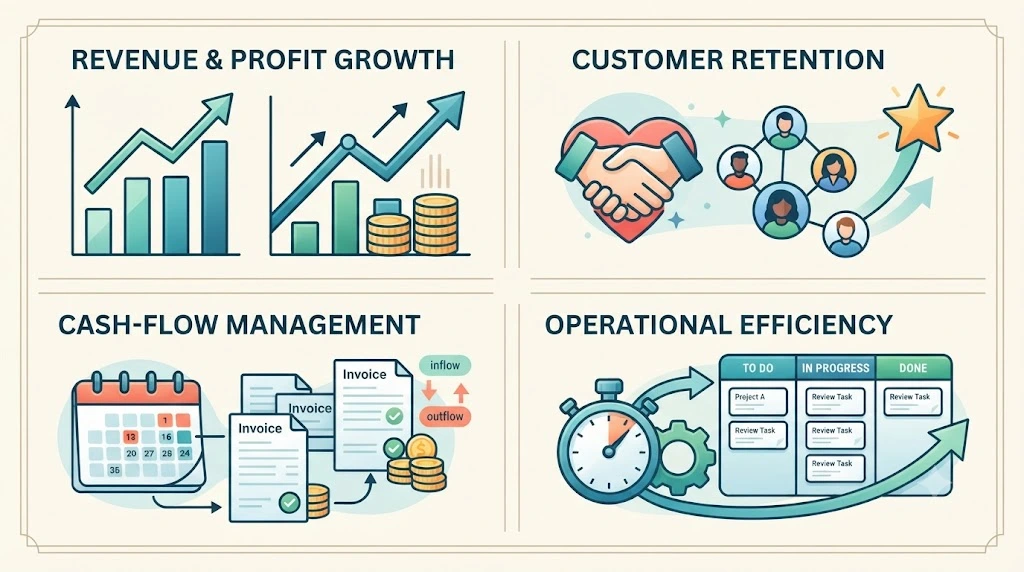
Revenue and profit goals
Revenue is only useful if you keep some of it. Start by knowing the minimum you need to cover costs. You can calculate your small business break-even point first, then set your profit goal above it.
| Element | Example |
|---|---|
| Starting point | Monthly profit margin is currently 12%. |
| Target | Raise the margin to 15%. |
| Deadline | End of the quarter |
| How to measure | Monthly profit and loss statement |
Customer acquisition and retention goals
Acquiring a new customer can cost more than retaining an existing one, although the difference varies by business. For some small businesses, improving customer retention is a practical goal to test.
| Element | Example |
|---|---|
| Starting point | 18 repeat customers per month |
| Target | 25 repeat customers per month |
| Deadline | End of the quarter |
| How to measure | Customer list or POS report, reviewed monthly |
Cash-flow and expense-control goals
Profit on paper doesn’t pay salaries. Cash does. If timing is your pain point, build a 13-week cash flow forecast to see shortfalls before they arrive.
| Element | Example |
|---|---|
| Starting point | Average invoice paid in 45 days |
| Target | Average invoice paid in 30 days |
| Deadline | End of the quarter |
| How to measure | Accounts receivable ageing report, checked weekly |
Operational efficiency goals
Operational goals free up your time so you can work on the business, not just in it. If your team wastes hours chasing updates, it may help to automate project management and task assignments.
| Element | Example |
|---|---|
| Starting point | 10 hours a week spent on manual status updates |
| Target | Reduce to 4 hours a week. |
| Deadline | By the end of the quarter |
| How to measure | Weekly time log |
What Small Businesses Can Learn from Google’s Use of OKRs
When investor John Doerr introduced Objectives and Key Results (OKRs) to Google in 1999, the company was less than a year old and had only about 40 employees. The method is simple: an objective says what you want, and key results are the measurable markers that show whether you got there. Workpath’s write-up notes that it rests on quarterly and annual goals.
Google’s later growth had many causes, so this isn’t proof that quarterly goals guarantee success. What a small business can borrow is the habit:
- Write every goal as a result you can measure, not a vague intention.
- Work in short cycles, so you can see what’s working.
- Check progress regularly instead of waiting for the end.
Sources: Workpath: Google’s OKR success story; John Doerr, Measure What Matters (Portfolio, 2018).
How to Track Quarterly Business Goals
A goal without tracking is a wish with a deadline. The good news: tracking doesn’t need fancy software. A simple sheet does the job.
Build a simple goal-tracking scorecard.
This is the quick-start version. Put every goal in one place and record the metric, target, actual result, owner and next action.
| Goal | Metric | Target | Actual | Owner | Next action |
|---|---|---|---|---|---|
| Improve repeat customers. | Repeat customers per month | 25 | 21 | Priya | Send a monthly email. |
| Speed up payments. | Average days to payment | 30 | 38 | Rahul | Call 3 overdue clients. |
Review progress weekly and monthly.
Spend 15 minutes every week looking at the scorecard. Ask: Are we on track, and what’s the next action?
Once a month, step back further. Are the milestones on time? Does the target still make sense?
What to do when a goal falls behind
Don’t panic, and don’t ignore it. Ask three questions:
- Is the target realistic?
- Is the right person doing the work?
- Did something change in the business?
Then adjust the action, the deadline or the target, and write down why. Dropping a goal on purpose is a decision. Letting it die quietly is a habit.
A Simple 90-Day Business Goal-Setting Template
Use this template at the start of the quarter to plan each goal in detail. The scorecard above is what you open during weekly check-ins.
Download the full 90-day worksheet (Excel).

| Goal | Baseline | Quarterly target | Month 1 milestone | Month 2 milestone | Month 3 milestone | Owner | Progress | Next action |
|---|---|---|---|---|---|---|---|---|
How to use it:
- Fill in no more than three goals.
- Record the baseline before setting a target.
- Add monthly milestones, an owner, and the next action.
Common Quarterly Goal-Setting Mistakes
Most failed plans fail in the same five ways.
Setting too many goals
Ten goals mean ten half-finished projects.
Choosing targets without baseline data
Without a starting number, any target is a guess.
Ignoring cash and team capacity
A great goal that your team can’t staff or your bank account can’t fund will only stress everyone out.
Tracking activities without measuring outcomes
“Posted 20 times on social media” is an activity. “Got 12 new enquiries from social media” is an outcome. Track the second.
Failing to review or adjust the plan
A plan nobody reopens stops being a plan after the first month.
Frequently Asked Questions
How many quarterly goals should a small business set?
One to three works for most small businesses. Fewer goals mean more focus and a better chance of finishing. There’s no universal rule, so match the number to your time, team and cash.
What are examples of quarterly business goals?
Common examples include raising profit margin, increasing repeat customers, shortening the time it takes to get paid, and cutting manual admin hours. Each should have a baseline, target and deadline.
How do you measure quarterly business goals?
Pick one clear metric per goal, record the starting number, and compare it with your actual result every week or month. A simple scorecard with target, actual, owner and next action is enough.
How often should a small business review its goals?
A quick weekly check and a deeper monthly review work well for most teams. Adjust the rhythm to your business, but don’t go a whole quarter without looking.
Conclusion
Setting quarterly goals isn’t about writing a bigger plan. It’s about choosing the few things that matter, measuring them honestly and checking in often.