
How to Separate Personal and Business Finances: Easy, Proven Steps

Picture tax season. You open a year of bank statements and find a client payment sitting between a grocery run and a streaming subscription. A $60 charge could be software for your business or a gift for a friend. You can’t tell, and neither can anyone else.
That’s the cost of mixing money. The fix isn’t complicated. To separate personal and business finances, use a dedicated account where permitted, set clear payment rules, and record every transaction consistently. This guide explains how to separate personal and business finances without making bookkeeping more complicated than it needs to be.
This guide walks through that system step by step. You’ll get a short example, a real court case, and notes for the US, UK and India. The goal is to make it practical to separate personal and business finances consistently, even when you work across currencies or serve international clients.
How to Separate Personal and Business Finances With a Dedicated Account
A separate account makes it easier to identify business transactions, track expenses, and reconcile your records. If you cannot open one immediately, use a permitted alternative and keep business transactions clearly documented.
When you compare accounts, look at four things:
- Fees: monthly charges, transfer fees and minimum balances.
- Payment tools: whether it connects to the platforms your clients use, such as PayPal, Stripe or Wise.
- Statement exports: a clean CSV or PDF download saves hours at reconciliation time.
- Currency options: useful if you invoice clients in more than one currency.
If you cannot open a business account, ask your bank whether a separate personal account may be used for business transactions. Check the account terms and local requirements before using this alternative.
Your business structure matters too. Companies may need a dedicated business account or specific banking arrangements, depending on local law and bank policy. Sole traders and freelancers may have different options. Check the requirements for your country and business structure, and ask your bank which documents it needs.
Pick an account name that makes its purpose clear, such as “Studio Operating”, if your bank supports custom labels. If available and permitted, you could also use a separate savings account for funds reserved for taxes or slower business periods. This is a cash-management tool, not a substitute for calculating your actual tax obligations.

How to Separate Personal and Business Finances
Once the account exists, give every dollar a clear home.
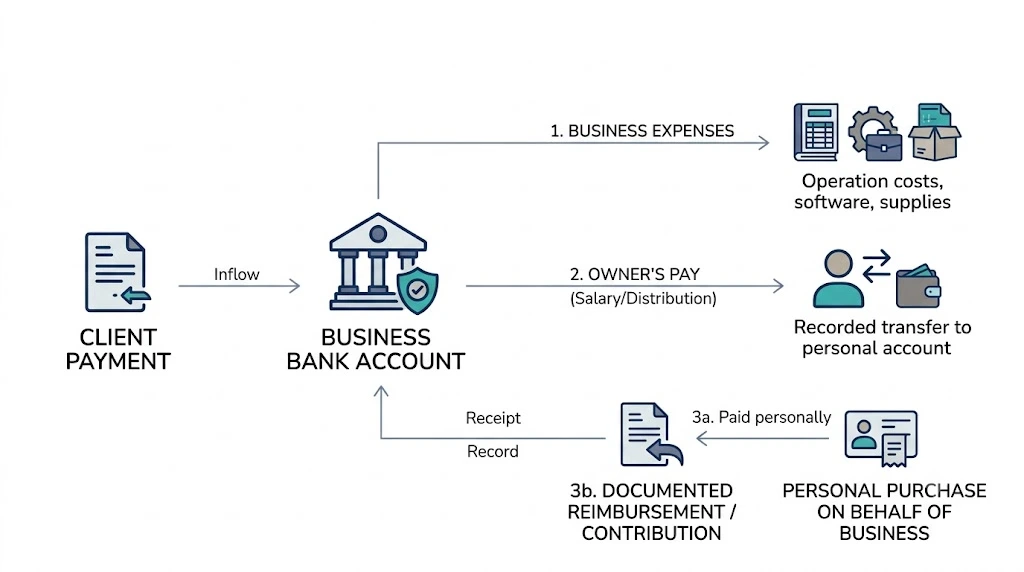
Income goes in one place. Point client payments and platform payouts to the business account. Put those account details on your invoices so nobody pays you in the wrong place “just this once”. If a payment does land in your personal account, move it across and note it, so the income trail stays complete.
Expenses come out of one place. Get a business debit or credit card and use it for software, ads, tools and supplies. Move your recurring subscriptions to it this week. That alone cleans up most of your records.
Mixed-use costs need a method. Your phone, internet or home office may serve both personal and business purposes. Keep evidence of the business use and calculate the business portion using a method accepted under your local rules. Record how you arrived at the amount, and check the applicable tax guidance before claiming a deduction.
A small habit helps here. When a bill is mixed-use, always pay it from the same account every month, and keep the calculation in the same note or spreadsheet cell. Next year you won’t have to remember how you reached that number. You’ll just open the file and see it.
Decide How to Pay Yourself.
If you take money from the business whenever you need it, your records turn into a puzzle. A routine fixes that.
If your business structure permits it, consider a regular owner-payment schedule based on available cash and upcoming obligations. Transfer money to your personal account rather than paying personal bills directly from the business account.
The appropriate method—such as an owner’s draw, salary, dividend or another permitted payment—depends on your business structure and local rules. For a sole proprietor, money taken for personal use is often recorded as an owner’s draw, while personal funds added to the business may be recorded as an owner contribution. The correct account names and tax treatment depend on the applicable accounting rules and business structure. Do not assume every transfer to an owner is treated the same way for accounting or tax purposes.
If you run a company, the rules change. Pay might arrive as salary, dividends or a director’s loan, and each one is treated differently. Ask a local accountant who fits your situation before you pick.
Once your pay routine is set, put it into a plan. If you need a place to start, learn how to create a small business budget that covers both business spending and your own pay.
Record Expenses Paid With Personal Money
It will happen. You’ll buy something for work with your personal card because the business card wasn’t in your pocket. That’s fine, as long as you document it.
Here’s the routine:
- Save the receipt. A photo is enough.
- Write the business purpose. One line: what it was and why the business needed it.
- Record it in your books under the appropriate category and note that you paid personally.
- Record how it was funded. Depending on your business structure and accounting method, the amount may be recorded as owed to you or as an owner contribution. Follow the appropriate bookkeeping treatment and document any later reimbursement without creating a second expense.
Tag these purchases the moment you make them. A quick note on your phone, or a forwarded receipt to a dedicated email folder, is enough. Memory fades fast, and “what was this charge?” is a hard question to answer three months later.
Use the treatment appropriate for your business structure and accounting method. Do not record both a reimbursement and an owner contribution for the same funding unless your accounting records reflect two genuinely separate transactions. If the business reimburses you later, record the transfer as settling the amount owed to you—not as a new expense.
A Quick Example
The names and amounts below are made up to show the steps.
Maya is a freelance designer. A client pays her $2,400 into her business account.
- Business expenses: She pays $45 for design software with her business card. She records it as a software expense.
- Owner payment: At month-end she transfers $1,200 to her personal account and records it as an owner’s draw. It’s not an expense.
- Personal card purchase: She buys a $180 monitor stand for her home studio with her personal card. She saves the receipt, documents its business purpose, and records the purchase and funding source using the accounting treatment applicable to her business.
Here’s how Maya’s books look after those three moves:
| Date | What happened? | Where it’s recorded | Type |
|---|---|---|---|
| Oct 3 | Client payment, $2,400 | Business income | Income |
| Oct 5 | Design software, $45 | Software expense | Expense (business card) |
| Oct 12 | Monitor stand, $180 | Equipment purchase, paid personally | Purchase and funding source |
| Oct 31 | Transfer to personal, $1,200 | Owner’s draw | Not an expense |
Three situations, three clear records, no guessing. This example shows the steps only. How each item is taxed depends on where you live.
Fix Accidental Mixing
Even careful owners slip. What matters is how you fix it.
The business account paid for something personal. Don’t hide or delete the transaction. Record it clearly and correct the books using the treatment appropriate for your business structure. For a company, do not automatically classify the payment as an owner’s draw or loan; check the applicable rules and seek accounting advice where necessary. If you repay the business, document the repayment date and reason.
Personal account paid for something business. Follow the steps in the previous section: receipt, purpose, record, and then reimbursement or contribution.
In both cases, keep the evidence. Add a short note to the transaction, keep the statement line, and fix it at your next monthly check rather than months later. Fixing it with a note and a date shows a pattern of care. Quietly ignoring it shows the opposite.
If accidents keep happening, look for the cause. Maybe a business subscription is still on your personal card, or your phone auto-fills the wrong card at checkout. Remove the trigger, and the mistakes usually stop.
Keep Receipts and Reconcile Monthly
Reconciliation means checking that your bookkeeping matches your bank. It’s the habit that keeps the whole system honest.
Organise receipts as you go. Store digital copies in one folder and name them by date, vendor and amount, for example 2026-10-14_Figma_45.pdf.
Match every line. Once a month, compare your bank statement with your records. Check that the opening balance plus money in, minus money out, equals the closing balance. Then confirm each transaction appears in your books once.
Resolve the unclear ones. If you can’t place a transaction, search your email and invoices, or ask a client or supplier. Don’t leave it for next month. A pile of unknowns only gets harder to sort.
A quick month-end checklist:
- Every bank and card statement is downloaded.
- Every transaction has a category and a receipt, or a note explaining why not.
- Owner’s draws and contributions are labelled.
- Closing balances match the bank.
Set a recurring calendar slot, such as the first Friday of each month, and treat it like a client meeting. The time required will depend on your transaction volume and how consistently you maintain your records. Close the month only when every line has an explanation.
If you track your numbers in a spreadsheet, our guide to the Google Sheets profit and loss template shows how to turn this monthly check into a simple profit view.
Common Mistakes
These are the slip-ups that cause the most trouble:
- Treating personal spending as a business expense. Paying for something from a business account does not automatically make it a deductible business expense. Keep evidence of its business purpose and follow the deduction rules that apply in your country.
- Misclassifying owner withdrawals. Draws, salary and expenses are different things. Mixing them up distorts your profit.
- Losing receipts or recording twice. Missing proof weakens a claim, and double entries inflate your costs.
- Leaving mixed transactions unresolved. “I’ll sort it later” is how a small gap becomes a year-end mess.
- Moving money back and forth without notes. Transfers between accounts need a label, or they look like unexplained income or spending.
A Real Case: Why Clear Documentation Matters
In Reed v. Commissioner, T.C. Memo. 2026-64, decided on August 5, 2026, the US Tax Court considered tax years 2012–2015 involving Scott Reed, a real estate consultant, and several related ventures. His single-member LLC, RRA, did not have complete books, and business deposits and withdrawals passed through the couple’s personal bank accounts.
According to EisnerAmper’s summary of the decision and Liskow’s legal summary, the couple transferred about $811,000 from personal accounts to project entities in 2014–2015. The entities recorded those transfers as loans. The court rejected attempts to deduct the transfers under the theories raised, including business expenses, unreimbursed partnership expenses and bad debt. The form and records of the transactions mattered; the transfers were not automatically deductible merely because money had moved.
The court also accepted one $40,000 deposit as a non-taxable advance, while other disputed deposits and deductions were not substantiated. The case included a 20% accuracy-related penalty, along with a late-filing addition. The final deficiency calculation was left for a later computation, so this article does not state a total deficiency figure.
This was a complex case involving several disputed tax positions, not a ruling that simply having mixed personal and business accounts automatically creates a penalty. The practical lesson is narrower: document the source, purpose and treatment of each transaction, and make sure the books reflect what actually happened.
Country-Specific Considerations
The basic recordkeeping principles in this guide are useful across many countries, but banking, accounting and tax requirements vary by location and business structure. Here’s a starting point.
United States. The IRS says your records should clearly show business income and expenses. Personal, living and family expenses are generally not deductible, and mixed-use costs must be divided between personal and business use. See the IRS guidance on what kind of records to keep and business and personal expenses.
United Kingdom. Sole traders and limited companies have different obligations. Sole traders generally do not have a universal legal requirement to open a separate business bank account, but they must keep accurate business records and identify business transactions. Bank terms may restrict business use of personal accounts. A limited company is a separate legal entity, so its finances should be kept clearly distinct from those of its owners and directors. See GOV.UK’s guidance on records to keep if you’re self-employed and company and accounting records.
India. Recordkeeping obligations depend on the applicable income-tax rules, business structure and GST status. The Income-tax Act, 2025 came into effect on 1 April 2026; Section 62 covers books of account for specified businesses and professions, replacing the earlier Section 44AA reference under the 1961 Act. GST-registered persons covered by Section 35 of the CGST Act must also maintain the accounts and records required by that provision. These rules should not be read as a universal requirement for every proprietor to open a separate business bank account. See the Income Tax Department’s Section 62 guidance and Section 35 of the CGST Act.
Elsewhere. Check your local tax authority and your bank’s business-account terms. A short chat with a local accountant can save a lot of guessing. Ask three things: what records you must keep, how long to keep them, and how owner payments are taxed for your structure. Those answers shape everything in the steps above.
FAQs
Can I use my personal bank account for business?
In some places, sole traders may be able to use a personal account for business, but bank terms or local requirements may restrict this. Ask your bank whether a separate personal account can be used for business transactions. Keep all business transactions clearly documented, and use a dedicated business account where required or appropriate.
What happens if I mix personal and business expenses?
You may struggle to show which costs belong to the business. That can mean missed deductions, disallowed claims or extra questions from a tax authority. If you’re already mixed, start separating from today and clean up past months with notes and receipts.
How do I record a business purchase made with personal money?
Keep the receipt, note the business purpose, and record the purchase and its funding source. Depending on your business structure and accounting method, it may be recorded as an amount owed to you or as an owner contribution. If the business reimburses you later, record that payment as settling the amount owed—not as a second expense.
Should I pay myself from my business account?
Use the payment method appropriate for your business structure. Depending on the country and entity type, this could involve an owner’s draw, salary, dividend or another permitted method. Record the transaction correctly and check the relevant local rules.
How often should I reconcile transactions?
Monthly is a good rhythm for most small businesses. Weekly works if you have many transactions.
Your Next Step
You don’t need to fix everything today. To separate personal and business finances over the long term, start with clear account boundaries and consistent records. Clean records also make it much easier to see when money comes in and goes out, which is the starting point to improve small business cash flow. Start with three moves:
- Open or designate a business-only account.
- Move your business subscriptions onto a business card.
- Block 30 minutes at the end of this month to reconcile.
These three steps establish a practical foundation for keeping personal and business finances separate. If you want to separate personal and business finances successfully, maintain the routine and review your records regularly. When you’re ready to turn clean records into a clear profit picture, open the Google Sheets profit and loss template guide and set up your monthly tracker.
This article is general information, not tax, legal or accounting advice. Rules vary by country and business structure, so check with a qualified local professional for your situation.