
11 Proven Cash Flow Improvement Strategies Without Increasing Sales
Most small business owners assume the fix for a tight bank account is simple: sell more. But plenty of profitable, growing businesses still run out of cash—not because demand is weak, but because money is sitting in the wrong place at the wrong time. The gap between “profit on paper” and “cash in the bank” is where most cash flow problems actually live, and it’s exactly why cash flow improvement strategies matter even when sales look healthy.
This guide focuses on the four levers you can pull without chasing a single new customer: faster collections, leaner inventory, smarter expense management, and better-timed payments.
Quick Answer
Small businesses can improve cash flow without increasing sales by collecting invoices faster, reducing excess inventory, renegotiating supplier terms, cutting low-value recurring expenses, and matching payment dates with cash inflows. The fastest starting point is a short cash-flow forecast that shows exactly where money is getting delayed or unnecessarily tied up—before you touch anything else.
Why More Sales Do Not Always Improve Cash Flow
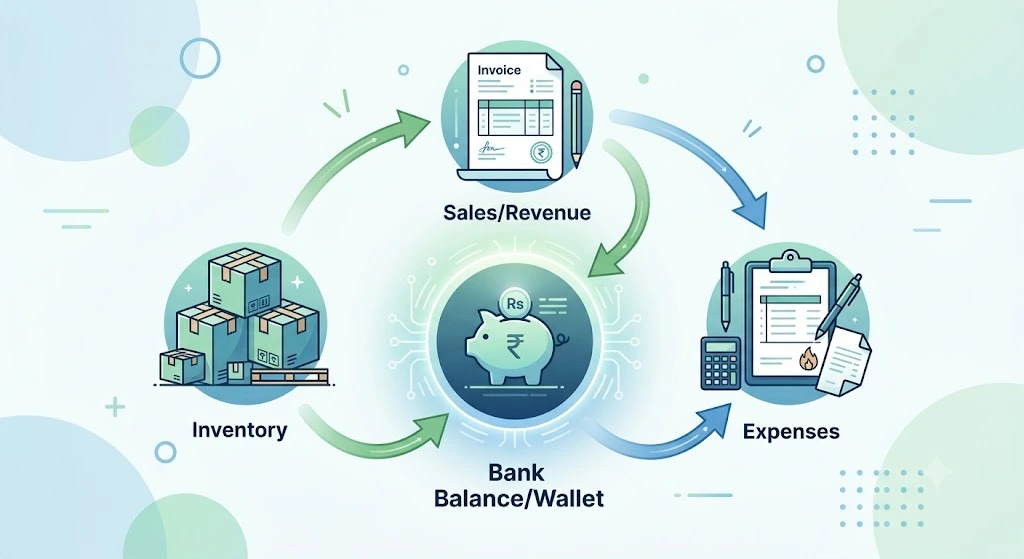
Revenue and cash are not the same thing, and confusing the two is one of the most common reasons businesses feel “successful but broke.” A credit sale gets recorded the day it happens, but the actual cash might not land for 30, 60, or even 90 days. Meanwhile, new orders often require upfront spending on inventory or labor—cash that leaves the business long before the matching payment arrives.
Here’s what that looks like in practice: a business closes a $20,000 sale, but the customer won’t pay for 60 days. That same month, $12,000 is due to suppliers and payroll. Revenue technically increased, but the business’s actual cash position just got weaker. Growth, ironically, can create the exact shortage it was supposed to solve.
Before making any changes, it’s worth taking a step back to calculate your gross profit margin so you know how much of each sale is genuinely available to work with once costs are covered.
Check Where Your Cash Is Getting Stuck
Cash typically gets trapped in one of four places. A quick diagnostic check tells you which lever to pull first, rather than guessing.
| Question | Metric to Track | Warning Sign |
|---|---|---|
| How fast do customers pay? | Days Sales Outstanding | The number is climbing. |
| How fast does inventory sell? | Inventory Days | Slow-moving stock is piling up. |
| How fast do you pay suppliers? | Days Payable Outstanding | You’re paying before customers pay you. |
| How fast are expenses growing? | Monthly Operating Expenses | Growing faster than revenue |
If you haven’t mapped this out before, this is also a good moment to create a small business budget so each of these metrics has a benchmark to be measured against going forward.
11 Cash Flow Improvement Strategies
These strategies are grouped around collections, inventory, expenses, and payment timing—the four areas identified above. You don’t need to implement all eleven at once; start with whichever diagnostic flagged the biggest warning sign.
1. Send Invoices Immediately
Invoice the moment work is complete—not at the end of the week or the end of the month. Batching invoices simply delays the start of your payment clock for no real benefit. Every invoice should clearly state the due date, accepted payment methods, and a direct contact for billing questions, so there’s no excuse for delay on the customer’s end.
2. Shorten Customer Payment Terms
Moving new contracts from Net 30 to Net 15 can meaningfully speed up collections over time. Don’t apply this retroactively to existing customers—that damages relationships. Instead, introduce shorter terms for new clients and renewals, and let the change roll out naturally.
3. Follow Up on Overdue Invoices Consistently
A simple, automated reminder sequence closes more gaps than most owners expect: one reminder before the due date, one on the due date, and follow-ups at 7 and 14 days overdue. Automating this removes the awkwardness of manual chasing and makes follow-up consistent instead of occasional—see how to automate invoice reminders for a step-by-step setup.
4. Request Deposits or Milestone Payments
For project-based work, a 30–50% deposit upfront protects your cash position from day one. Longer engagements can be broken into milestone payments tied to deliverables. This works especially well for agencies, contractors, consultants, and custom manufacturing.
5. Make Payments Easier for Customers
Every extra step between “invoice sent” and “payment received” is friction that delays cash. Offering card payments, bank transfers, and a direct payment link inside the invoice itself removes that friction. The easier you make it to pay, the faster you typically get paid.
6. Reduce Cash Tied Up in Inventory
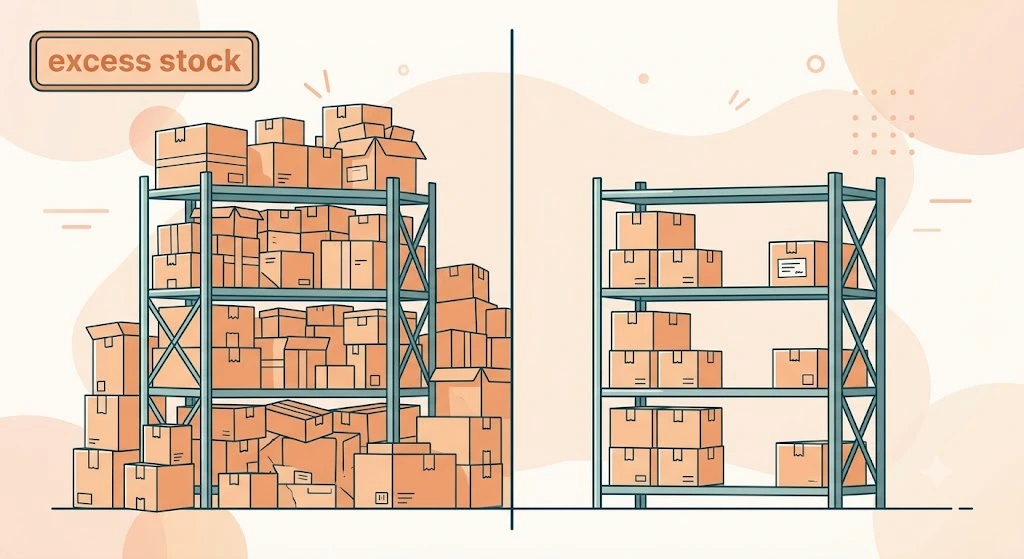
Identify slow-moving or obsolete stock and stop reordering it at the same pace. Smaller, more frequent orders reduce the amount of cash sitting on your shelves. Set clear reorder points based on actual sell-through, and consider clearance sales or supplier returns for stock that isn’t moving.
How Inventory Changes Cash Flow
The impact of trimming inventory is easier to see with real numbers than with a percentage. Here’s a simple example of how reducing excess stock—with no change in sales—can release cash over time.
| Situation | Before | After Change |
|---|---|---|
| Inventory Held | $30,000 | $22,000 |
| Monthly Sales | $20,000 | $20,000 |
| Potential Cash Released | — | Up to $8,000 |
Reducing inventory from $30,000 to $22,000 can release up to $8,000 over time if the business sells or returns excess stock and avoids replacing it unnecessarily. The benefit does not come from an accounting adjustment alone. It comes from converting existing stock into cash or reducing future inventory purchases. This is the core idea behind cash flow improvement strategies that don’t rely on growth: cash was already inside the business, just tied up in the wrong place.
7. Negotiate Better Supplier Payment Terms
If you’re currently paying suppliers on Net 15, ask about moving to Net 30 or Net 45. Align your outgoing payment dates as closely as possible with when customer payments land, so cash isn’t leaving before it arrives. Only take early-payment discounts when the savings genuinely outweigh the value of holding onto that cash a little longer.
8. Review Recurring Expenses
Recurring costs quietly erode cash flow because they’re easy to forget about. Audit for unused software subscriptions, duplicate services, and unnecessary storage, insurance, or professional fees. Rather than cutting everything by a flat percentage, target the specific low-value expenses that aren’t earning their keep.
9. Time Large Payments More Carefully
Compare the cost of paying annual expenses upfront versus spreading them monthly—sometimes a small fee for monthly billing is worth the improved cash flexibility. Forecast big-ticket items like taxes, insurance, and equipment purchases in advance, and schedule their due dates after expected cash inflows land, not before.
10. Improve Working Capital
Working capital is the clearest single measure of how much breathing room your business actually has: Working Capital = Current Assets − Current Liabilities
Increasing working capital on paper is not enough. The practical goal is to maintain enough accessible cash to cover short-term obligations without leaving unnecessary money tied up in receivables or inventory. To understand exactly how much cushion you need, it also helps to calculate your break-even point so working capital targets are grounded in real numbers.
11. Maintain a 13-Week Cash-Flow Forecast
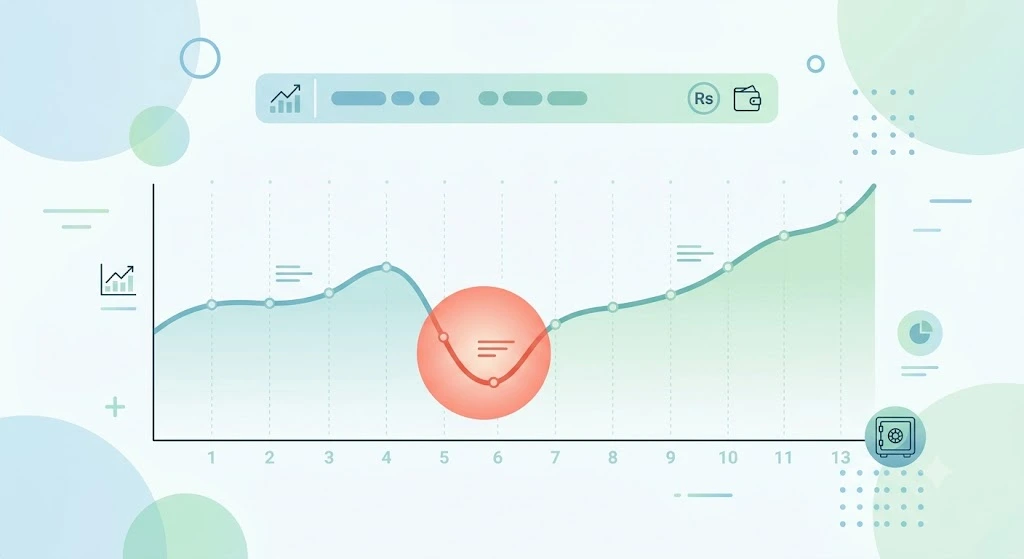
A rolling forecast can help identify a potential cash shortage early enough to take corrective action. It should include your opening cash balance, expected customer payments, payroll, supplier payments, rent, tax, and any debt obligations—updated weekly, not annually.
Measure Your Cash Conversion Cycle
The cash conversion cycle tells you, in days, how long your money is tied up before it comes back to you as usable cash. Cash Conversion Cycle = Inventory Days + Receivable Days − Payable Days
| Component | Days |
|---|---|
| Inventory Days | 45 |
| Receivable Days | 30 |
| Payable Days | 25 |
| Cash Conversion Cycle | 50 days |
In this example, cash is locked inside the operating cycle for roughly 50 days—from the moment inventory is purchased to the moment a customer’s payment actually clears. Shortening any one of these three numbers shortens the whole cycle, freeing up cash without a single new sale.
Which Cash-Flow Fix Should You Start With?
Not every business has the same bottleneck. Use this table to match your specific problem to the fastest first step.
| Problem | First Step | Likely Timeframe |
|---|---|---|
| Late customer payments | Invoice reminders | 7–30 days |
| Excess inventory | Identify slow-moving stock. | 30–60 days |
| Paying suppliers too early | Renegotiate terms. | Next contract cycle |
| Uncontrolled expenses | Recurring-cost audit | 7–14 days |
| Can’t see shortages coming | 13-week forecast | Immediate |
30-Day Cash-Flow Improvement Plan
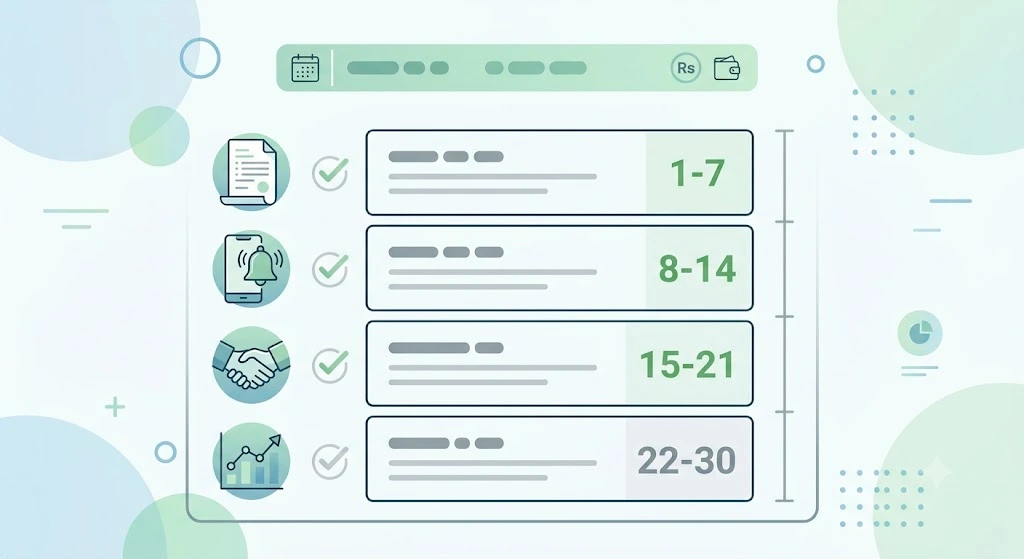
You don’t need a full quarter to see results. Here’s a practical four-week rollout that puts the strategies above into action in order of impact.
Days 1–7: List all outstanding invoices, review recurring expenses, and log the next 13 weeks of expected payments.
Days 8–14: Follow up on overdue invoices, open supplier term negotiations, and identify slow-moving inventory.
Days 15–21: Simplify the customer payment process, introduce a deposit policy, and start aligning payment dates with cash inflows.
Days 22–30: Review the updated forecast, calculate how much cash has actually been released, and set targets for the following month.
Common Cash-Flow Mistakes to Avoid
A few habits undo progress faster than any single strategy can fix it:
- Treating profit as if it were the same thing as available cash
- Cutting expenses indiscriminately instead of targeting low-value ones
- Offering customers payment terms that are too generous
- Over-ordering inventory “just in case”
- Only building a forecast once a crisis has already started
- Turning to expensive short-term borrowing instead of fixing the underlying timing issue
For a broader look at healthy financial habits, it’s worth reviewing how to manage your business finances through the U.S. Small Business Administration’s official guidance—a solid baseline for any owner tightening up cash management.
It’s also worth exploring how to improve your cash flow through the Australian Government’s business resources, which cover many of the same collection and payment-timing principles from a different regulatory lens.
And if forecasting still feels unfamiliar, SCORE’s cash-flow forecasting resources walk through building a rolling projection step by step—a genuinely useful companion to the 13-week forecast covered above.
Final Takeaway
Improving cash flow without increasing sales isn’t a workaround—it’s often the faster, more reliable fix. Collections, inventory, and payment timing are the three levers with the biggest impact, and none of them require winning a single new customer. Start with the cash-flow improvement strategies that match your biggest bottleneck, review your position weekly, and keep the forecast running even after things stabilize. Consistent cash-flow monitoring also makes future growth easier to plan and finance.
Ready to see where your own cash is getting stuck? Pull your last 90 days of invoices and expenses and run them through the diagnostic table above. A basic review can reveal whether overdue invoices, excess inventory, or poorly timed expenses deserve attention first. You can also explore how to scale a small business without increasing operating costs for the next step once your cash position is stable.
Frequently Asked Questions
Can a business really improve cash flow without more sales? Yes. Many cash-flow problems are caused by a mismatch between when money comes in and when payments are due, not by a lack of revenue. Speeding up collections and slowing down unnecessary outflows often releases more usable cash than a new sale would.
What’s the fastest cash flow fix for a small business? Following up on overdue invoices and reviewing recurring expenses usually show results within one to two weeks, making them the fastest starting points before tackling inventory or supplier renegotiations.
How often should I update my cash-flow forecast? A rolling 13-week forecast should be updated weekly. Weekly updates catch shortages early enough to act on them, while monthly or quarterly reviews often catch problems too late.
Is reducing inventory risky for customer satisfaction? Not when it’s done based on actual sell-through data. The goal isn’t to understock fast-moving items—it’s to stop overordering slow-moving ones, which frees up cash without affecting the products customers actually want.
What’s the difference between profit and cash flow? Profit is what’s left after subtracting expenses from revenue on paper, calculated regardless of when money actually changes hands. Cash flow is the real movement of money in and out of your bank account—and a business can be profitable while still running short on cash.