How to Read a Balance Sheet: A Simple Guide for Small Business Owners

Your profit can look healthy while your bank account feels thin. A balance sheet explains why.
Learning how to read a balance sheet means looking at what your business owns, what it owes and what is left over for you. It shows your financial position on one specific date, like a photo rather than a video. In this guide, you will learn the three main parts, a six-step reading method and the numbers worth checking. If you also track income and expenses, pair this with our small business profit and loss template.
What Is a Balance Sheet?
A balance sheet is a snapshot of your business on a single date. It lists everything the business owns, everything it owes and what remains for the owner.
Owners review it to answer simple questions. Can we cover our bills? How much do we owe? Is the business building value or slowly losing it?
Every balance sheet follows one rule:
Assets = Liabilities + Equity
If you want to see how balance sheets differ from other financial statements, the SEC’s beginner guide compares the balance sheet, the income statement and the cash flow statement.
The 3 Main Parts of a Balance Sheet
Before you can read the numbers, you need to know where they sit. Every balance sheet has the same three blocks.
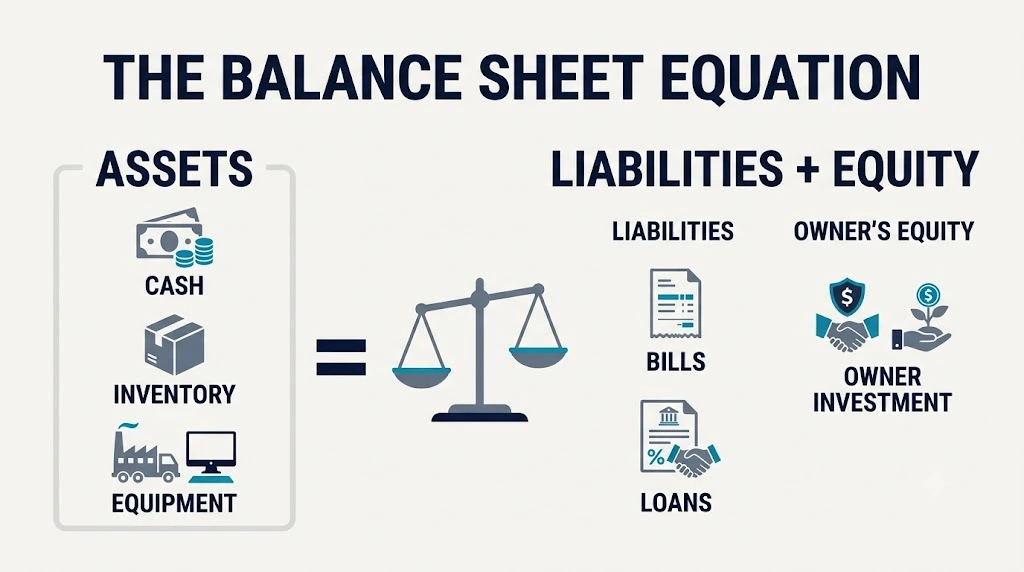
Assets — What Your Business Owns
Assets are things of value that the business holds. Common ones include:
- Cash: money in your bank accounts.
- Accounts receivable: money customers still owe you.
- Inventory: products you have bought or made but not yet sold.
- Equipment and other long-term assets: tools, vehicles, computers and machinery.
Liabilities — What Your Business Owes
Liabilities are obligations you must pay. Look for:
- Accounts payable: bills from suppliers you have not paid yet.
- Short-term loans: debt due within a year.
- Long-term business loans: debt repaid over several years.
- Taxes payable: taxes you owe but have not yet paid.
Owner’s Equity — What Remains After Liabilities
Equity is what is left after you subtract liabilities from assets. It usually includes:
- Owner contributions: money you put into the business.
- Retained earnings: profit kept in the business instead of withdrawn.
- Accumulated profits and losses: the running result of past performance.
Want a second explanation? Xero shows how assets, liabilities and equity work together with plain definitions.
How to Read a Balance Sheet Step by Step
This is the part that matters most. Take the six steps below in order, and a page of numbers turns into a clear story.
1. Check the Reporting Date.
Start at the top. Every balance sheet is tied to one date, such as 31 March.
That date matters because the numbers describe that day only. They do not cover the whole month or year. A balance sheet dated just after a big customer payment can look very different from one dated the day before.
2. Review Cash and Current Assets
Next, look at cash and other assets you can turn into cash within a year.
Ask yourself one question: could we pay our near-term bills with what we hold today? Cash is the most reliable answer. Everything else needs time or effort to convert.
3. Check Accounts Receivable and Inventory
These two lines look like assets, but they are not cash yet.
Receivables are only worth something once customers pay. Inventory only helps once it sells. If either line keeps growing while cash falls, the business may be tying up money it needs.
4. Review Short-Term and Long-Term Liabilities
Separate what is due soon from what is due later.
Short-term liabilities, like supplier bills and loan payments due this year, demand cash soon. Long-term debt gives you more breathing room but still shapes your future cash flow. Knowing the difference shows which payments are coming first.
5. Understand Owner’s Equity
Owner’s equity represents the residual book value of the business after liabilities are subtracted from assets. It may include owner contributions, retained earnings and accumulated losses. It is not necessarily the amount you would receive if you sold the business.
When equity rises over time, the business is usually retaining profit or receiving new owner investment. When it falls, losses or owner withdrawals may be outpacing profit. One number alone says little. The direction says a lot.
6. Confirm That the Balance Sheet Balances
Finish with a quick check:
Assets = Liabilities + Equity
If the totals match, the accounting equation balances. That does not guarantee every entry is accurate or complete, so still scan for items that look wrong. If the totals do not match, find the error before you rely on the numbers.
For a second walkthrough, read a step-by-step guide to reading a balance sheet from Xero.
Balance Sheet Example for a Small Business
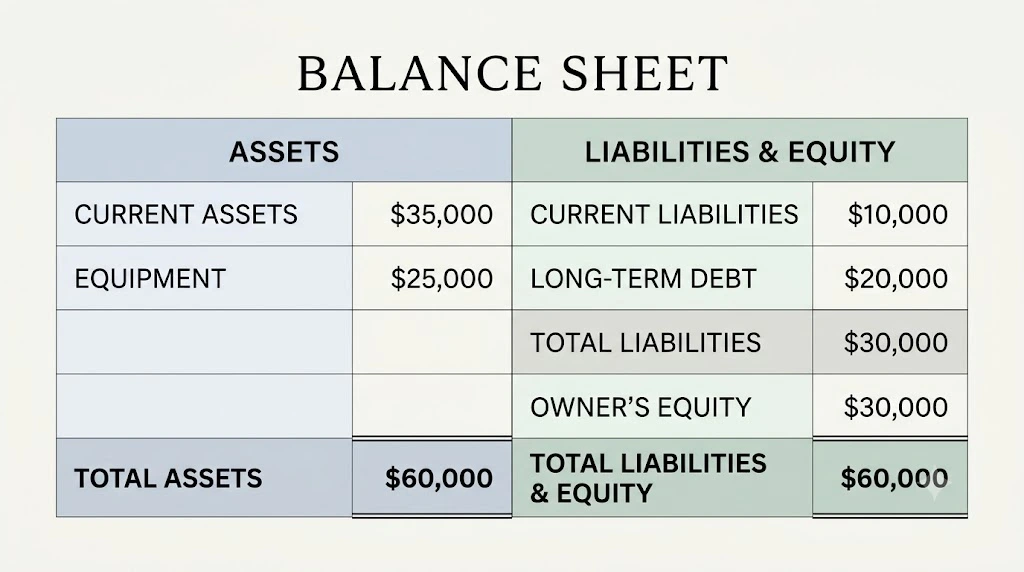
Numbers make this easier. Here is a fictional business we will use through the rest of this guide.
| Item | Amount |
|---|---|
| Cash | $15,000 |
| Accounts receivable | $10,000 |
| Inventory | $15,000 |
| Total current assets | $40,000 |
| Equipment | $20,000 |
| Total assets | $60,000 |
| Accounts payable | $8,000 |
| Current portion of loan | $2,000 |
| Total current liabilities | $10,000 |
| Long-term loan | $20,000 |
| Total liabilities | $30,000 |
| Owner’s equity | $30,000 |
| Total liabilities + equity | $60,000 |
Current means due or expected to turn into cash within 12 months. The $2,000 is the part of the loan due this year, and the other $20,000 is due later.
What These Numbers Tell the Owner
- The business has $60,000 in recorded assets.
- It owes $30,000 in liabilities.
- The business has $30,000 in recorded owner’s equity. Total liabilities of $30,000 plus equity of $30,000 equal total assets of $60,000.
- The sheet balances, but that alone does not prove the business is financially healthy.
Notice what sits inside the assets. Only $15,000 is cash. The rest is money customers owe, stock on shelves and equipment. If you want another worked sample, see a complete small business balance sheet example.
4 Numbers Every Small Business Owner Should Check
If you are wondering how to analyse a balance sheet, start with four simple calculations. You need nothing more than basic math.
Working Capital
Formula: Current Assets − Current Liabilities
This shows the short-term cushion left after paying near-term bills. Positive working capital suggests you can cover them. Negative working capital is a signal to look closer at upcoming payments.
Example: $40,000 − $10,000 = $30,000.
Current Ratio
Formula: Current Assets ÷ Current Liabilities
This measures short-term liquidity: how many dollars of current assets you hold for each dollar due within a year. No single ratio fits every business, so compare yours against your own history and your industry.
Example: $40,000 ÷ $10,000 = 4.0.
A high current ratio may indicate a larger short-term cushion, but it can also reflect slow-moving inventory or overdue receivables. Review the quality of current assets, not just the ratio. Here, $25,000 of the $40,000 is receivables and inventory, not cash.
Debt-to-Equity Ratio
Formula: Total Liabilities ÷ Owner’s Equity
This compares what the business owes with the owner’s recorded stake. Liabilities include more than loans, such as supplier bills and taxes owed. A rising ratio means outside obligations are growing faster than equity.
Example: $30,000 ÷ $30,000 = 1.0.
Total Owner’s Equity
Formula: Total Assets − Total Liabilities
Example: $60,000 − $30,000 = $30,000.
A single figure is a starting point. What matters is whether equity grows or shrinks from period to period. Look at these numbers together and over time, not one at a time.
Balance Sheet Red Flags to Watch For
A red flag is a reason to ask questions. It is not a verdict. Use this table as a checklist.
| Warning sign | What to investigate |
|---|---|
| Declining cash | Upcoming payments and cash flow |
| Increasing receivables | Overdue customer invoices |
| Growing inventory | Slow-moving stock |
| Rising short-term debt | Repayment obligations |
| Negative equity | Accumulated losses, withdrawals and liabilities |
Any one of these can have a harmless explanation. A seasonal stock build-up, for example, is normal for many shops. Patterns across several periods tell you more than one odd month.
If cash is the weak spot, these ideas can help you improve your small business cash flow.
A Real-World Data Check: How Thin Are Small Business Cash Cushions?
Cash is the line owners tend to underestimate. The JPMorgan Chase Institute’s 2016 report, Cash Is King: Flows, Balances, and Buffer Days, analysed anonymised transaction data from 597,000 US small businesses between February and October 2015.
Its key measure is “cash buffer days”: how many days of normal outflows a business could cover from its cash balance if all inflows stopped. The median was 27 cash buffer days, and half of the businesses held less than a month. Restaurants had a median of 16 days, while real estate firms had 47.
This is historical US data from 2015, so treat it as a reference point, not a current benchmark.
What you can do with it: use a simple estimate for your own business.
Cash balance ÷ average daily cash spending = approximate cash buffer days
In our example, if the business spends about $500 a day, its $15,000 in cash covers roughly 30 days. This is a rough estimate, not a formal liquidity measure, but it turns a cash line into something easy to picture.
Source: JPMorgan Chase Institute, “Cash Is King: Flows, Balances, and Buffer Days” (Finding Three).
How to Compare Balance Sheets Over Time
One balance sheet is a photo. Two or more show movement.
Compare in three ways:
- This month vs. last month: spot quick changes in cash and bills.
- This quarter vs. the previous quarter: catch trends that monthly noise hides.
- This year vs. last year: see real growth, or slow decline, in equity.
Here is a small comparison using our example business, with last quarter’s figures added:
| Item | Last quarter | This quarter | Direction |
|---|---|---|---|
| Cash | $18,000 | $15,000 | ↓ Decreasing |
| Accounts receivable | $6,000 | $10,000 | ↑ Increasing |
| Total loan balance | $25,000 | $22,000 | ↓ Decreasing |
| Owner’s equity | $28,000 | $30,000 | ↑ Increasing |
The story here is mixed. Debt fell and equity grew, which is good. But cash dropped while receivables climbed, so the owner should follow up on unpaid invoices.
Remember what a balance sheet cannot do. It shows your position on a date. A cash flow forecast estimates future cash movements. To see what is coming, build a 13-week cash flow forecast.
How to Use Your Balance Sheet to Make Business Decisions
A balance sheet is most useful when it guides a real choice. Here are four common ones.

Can I afford to hire? Check cash and working capital first. A new hire is a recurring cost, so affordability also depends on expected revenue and future cash flow, not only today’s balance.
Can I buy new equipment? Look at cash and existing debt. Paying from cash may drain your cushion, while financing adds liabilities. Compare both options against your current ratio.
Should I take a business loan? Review your debt-to-equity ratio first. If obligations are already high, extra debt adds pressure to every future month.
Can I safely withdraw money from the business? Withdrawals reduce equity and cash. Take only what leaves enough cash for bills and a safety buffer. It also helps to separate personal and business finances, so you can see clearly what you take out.
One caution: never decide from the balance sheet alone. Review it next to your cash flow, your profitability and your upcoming obligations. A written plan helps, so create a small business budget to match.
Frequently Asked Questions
What does a balance sheet tell you?
It tells you what a business owns, what it owes and what is left for the owner on a specific date. It helps you judge liquidity, debt and book value.
Can a business be profitable but have a poor balance sheet?
Yes. A business can report profit while cash is low, receivables are late or debt is high. Profit sits on the income statement, while financial health also depends on cash, debt and equity.
What is the difference between a balance sheet and an income statement?
A balance sheet shows financial position on one date. An income statement shows revenue, expenses and profit over a period of time.
What is negative owner’s equity?
It means liabilities are larger than assets. Common causes include accumulated losses, heavy owner withdrawals or high liabilities. It calls for a close look, not panic.
How often should a small business review its balance sheet?
Monthly is a good habit for most small businesses. At the very least, review it quarterly and before any major decision.
Your Next Step
Reading a balance sheet gets easier with practice. Pull up your latest one today and walk through the six steps. Write down four numbers: cash, receivables, debt and equity. Then compare them with last quarter.
If something looks off, ask your accountant before you act. A ten-minute review now can save you from a surprise later.