How to Calculate Your Small-Business Break-Even Point
A small-business break-even point tells you exactly how many sales you need before you stop losing money. Knowing that number replaces guesswork with a clear monthly sales target and gives you greater confidence when making pricing, hiring, and spending decisions.
In simple terms, your break-even point is the moment your total revenue finally matches your total costs. No profit yet, but no loss either. It’s the financial “zero line” every business needs to know before it can plan anything else — pricing, hiring, marketing spend, or even whether an idea is worth pursuing.
This guide walks you through exactly how to calculate break-even point for small business operations, step by step, with real formulas, a worked example, and a checklist you can reuse every quarter.
Quick answer: To calculate your break-even point, divide your total fixed costs by your contribution margin (selling price per unit minus variable cost per unit). The result tells you exactly how many units — or how much revenue — you need before your business starts making a profit.

What Is a Break-Even Point in a Small Business?
The break-even point is the exact sales level at which total revenue equals total costs. At this stage, your business isn’t losing money — but it isn’t earning profit either.
It’s easy to confuse break-even analysis with profitability, but they answer two different questions. Break-even analysis tells you the minimum you must sell to survive. Profitability tells you how much you’re earning above that survival line. One is a floor; the other is a goal.
Why Small Businesses Should Calculate Their Break-Even Point
Knowing your break-even number isn’t just an accounting exercise — it directly shapes daily decisions.
- Setting the right price for your product or service
- Knowing the minimum sales target you must hit each month
- Planning budgets and managing cash flow with confidence
- Deciding whether to hire staff or make a new investment
- Testing whether a new business idea is financially realistic
- Preparing accurate projections for loan or funding applications
Without this number, most of these decisions are just educated guesses. Once you know your break-even sales target, you can build a 13-week cash flow forecast to check whether incoming cash will cover expenses at the right time.
Break-Even Point Formula for Small Businesses
Break-Even Point in Units
Break-Even Point (Units) = Fixed Costs ÷ (Selling Price per Unit − Variable Cost per Unit)
The U.S. Small Business Administration’s break-even guidance uses the same core calculation: fixed costs divided by the difference between the selling price and variable cost per unit.
Break-Even Point in Sales Revenue
Break-Even Sales Revenue = Fixed Costs ÷ Contribution Margin Ratio
Contribution Margin Formula
Contribution Margin per Unit = Selling Price per Unit − Variable Cost per Unit
Contribution Margin Ratio = Contribution Margin ÷ Selling Price
| Calculation | Formula | What It Shows |
|---|---|---|
| Contribution margin | Selling price − Variable cost | Money left from each sale to cover fixed costs |
| Break-even units | Fixed costs ÷ Contribution margin | Minimum units you must sell |
| Contribution margin ratio | Contribution margin ÷ Selling price | Percentage of revenue that contributes to costs |
| Break-even revenue | Fixed costs ÷ Contribution margin ratio | Total sales revenue required |
How to Calculate Break-Even Point for Small Business: Step by Step
Step 1: List All Fixed Costs
Fixed costs stay the same no matter how much you sell. Common examples:
- Rent
- Salaries
- Insurance
- Software subscriptions
- Equipment lease
- Accounting and administrative costs
Step 2: Identify Variable Costs
These costs rise and fall with every sale you make:
- Raw materials
- Packaging
- Shipping
- Sales commission
- Payment-processing fees
- Direct labor tied to production
Step 3: Determine the Selling Price
If you sell multiple products at different prices, use your average selling price. Also factor in discounts and refunds — they quietly lower your real average price, and ignoring them will make your break-even number too optimistic.
Step 4: Calculate the Contribution Margin
Subtract the variable cost per unit from the selling price per unit. For example, if you sell a product for $100 and it costs $40 to produce and deliver, your contribution margin is $60.
Step 5: Divide Fixed Costs by Contribution Margin
If your monthly fixed costs are $6,000 and your contribution margin per unit is $60:
$6,000 ÷ $60 = 100 units
That’s your break-even point in units.
Step 6: Convert the Result Into a Sales Target
Break the number down into something you can act on daily:
- Monthly target: 100 units
- Weekly target: roughly 23–25 units
- Daily target: approximately 4 units per working day, based on 26 working days per month
Small-Business Break-Even Point Example
To show how to calculate break even point for small business owners in practice, let’s put real numbers to it:
- Monthly fixed costs: $6,000
- Selling price per unit: $100
- Variable cost per unit: $40
- Contribution margin: $60
- Break-even point: $6,000 ÷ $60 = 100 units
- Break-even revenue: 100 × $100 = $10,000
Takeaway: This business needs to sell 100 units, generating $10,000 in monthly revenue, before it earns a single dollar of profit.
Break-Even Point Example for a Service Business
Product-based examples are common, but service businesses need the same math with a different unit of measurement — projects, sessions, or billable hours instead of physical units.
Example: A Solo Marketing Consultant
This is a hypothetical example, not a verified real-world case study.
- Monthly fixed costs: $4,000
- Average project price: $1,500
- Variable cost per project (tools, subcontractors, ad spend testing): $500
- Contribution margin: $1,000
- Break-even projects: $4,000 ÷ $1,000 = 4 projects per month
For hourly-based businesses, replace “project” with “billable hour.” Divide your fixed costs by the contribution margin per hour, and you’ll know exactly how many billable hours you need before the lights stay on. This same approach to how to calculate break even point for small business services applies whether you bill by the project, the hour, or the retainer.
How to Calculate Break-Even Sales for Multiple Products
Most real businesses don’t sell just one product at one price, and this is where a straight formula gets tricky.
If your products have different selling prices and different costs, a single “break-even units” number stops being accurate. Instead, businesses use a weighted average contribution margin — a blended number based on how much each product actually contributes to total sales.
Here’s the catch: if your sales mix changes (say, customers suddenly buy more of your lower-margin item), your break-even point shifts too, even if nothing else changed. For businesses with a large or constantly shifting product range, spreadsheet models or accounting software will save hours of manual recalculation.
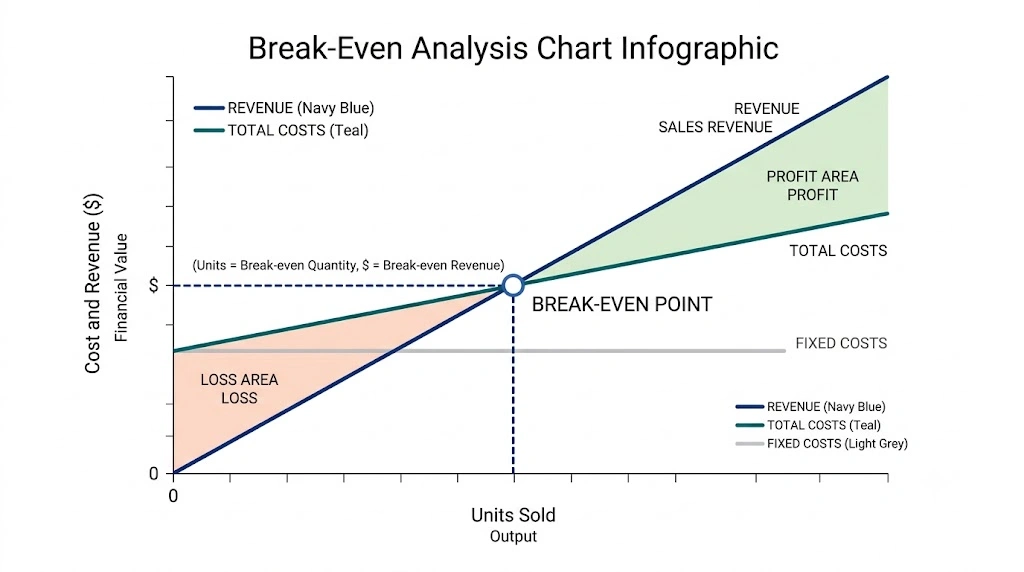
How to Create a Break-Even Chart
A break-even chart turns the math into something you can see at a glance.
- Horizontal axis: units sold
- Vertical axis: revenue and costs in dollars
- Fixed-cost line: flat, since it doesn’t change with sales
- Total-cost line: starts at fixed costs and rises with variable costs
- Revenue line: starts at zero and rises with each unit sold
- The point where the revenue line crosses the total-cost line is your break-even point
This visual is especially useful when presenting numbers to investors, partners, or a bank loan officer who wants the story in one glance, not a spreadsheet.
What Is a Good Break-Even Point for a Small Business?
There’s no universal “good” number — it depends entirely on your industry, margins, overhead structure, and available cash reserves.
Generally, a lower break-even point means lower financial risk, since you need fewer sales to stay afloat. But be careful: cutting costs aggressively just to lower this number — at the expense of quality, marketing, or growth — can quietly damage your business in the long run.
Quick answer: Is 100% profit the same as breaking even? No. At the break-even point, profit is exactly zero. Profit only begins after you cross that line.
How Pricing and Costs Affect Your Break-Even Point
| Change | Effect on Break-Even Point |
|---|---|
| Selling price increases | Break-even point decreases |
| Variable cost increases | Break-even point increases |
| Fixed cost increases | Break-even point increases |
| Contribution margin increases | Break-even point decreases |
| Discounts increase | Break-even point generally increases |
Common Break-Even Analysis Mistakes to Avoid
- Forgetting to include the owner’s own salary
- Ignoring payment-processing fees and shipping costs
- Treating every cost as fixed when many are actually variable
- Overlooking taxes and seasonal cost changes
- Using an inaccurate or outdated average selling price
- Not accounting for discounts, refunds, and product wastage
- Confusing break-even with an actual profit target
- Calculating once and never updating it again
How to Lower Your Small-Business Break-Even Point
- Negotiate better rates with suppliers
- Cancel unused software subscriptions
- Raise prices carefully and strategically
- Focus marketing effort on higher-margin products
- Reduce packaging and fulfillment costs
- Improve your overall product mix
- Convert fixed costs into variable arrangements where possible (e.g., pay-per-use tools instead of flat licenses)
These cost controls also make it easier to scale a small business without increasing operating costs unnecessarily.
Break-Even Point vs. Profit Target
Break-even tells you the minimum needed to survive. A profit target tells you what’s needed to actually thrive.
Target Profit Units = (Fixed Costs + Target Profit) ÷ Contribution Margin per Unit
Example: Using the earlier scenario ($6,000 fixed costs, $60 contribution margin), if you want to earn $5,000 in profit:
($6,000 + $5,000) ÷ $60 = 183 units (rounded up)
That’s how many units you’d need to sell — not just to break even, but to hit your actual profit goal.
When Should You Recalculate Your Break-Even Point?
Your break-even point isn’t a one-time calculation — it shifts whenever your business does. Recalculate when:
- Product prices change
- Supplier costs increase
- You hire a new employee
- You take on new office space or equipment
- You launch a new product
- You start offering discounts
- At minimum, once every quarter
By this point, you should have a clear picture of how to calculate break even point for small business finances using your own numbers. Business owners who want to organize these figures in a reusable worksheet can also use SCORE’s break-even analysis template.
Simple Break-Even Calculation Checklist
- [ ] Totaled all fixed costs
- [ ] Calculated variable cost per unit
- [ ] Determined average selling price
- [ ] Calculated contribution margin
- [ ] Calculated break-even units
- [ ] Calculated break-even revenue
- [ ] Converted to a weekly/monthly sales target
- [ ] Recalculated with a profit target included
Frequently Asked Questions
How do you calculate a business break-even point? Divide your total fixed costs by your contribution margin (selling price per unit minus variable cost per unit) to get break-even units, or divide fixed costs by your contribution margin ratio to get break-even revenue.
What is the basic break-even point formula? Break-Even Point (Units) = Fixed Costs ÷ (Selling Price per Unit − Variable Cost per Unit).
How do you calculate break-even sales revenue? Break-Even Sales Revenue = Fixed Costs ÷ Contribution Margin Ratio.
Is 100% profit the same as breaking even? No. At the break-even point, profit is exactly zero — revenue only equals costs. Profit begins after you sell beyond that point.
What fixed costs should a small business include? Rent, salaries, insurance, software subscriptions, equipment leases, and administrative or accounting costs are the most common fixed costs to include.
How often should a business calculate its break-even point? At least once every quarter, and immediately after any major change in pricing, costs, staffing, or product lineup.
Can a service business calculate a break-even point? Yes. Instead of “units,” service businesses use projects, sessions, or billable hours as the base unit for the same formula.
What happens when sales are above the break-even point? Once sales exceed the break-even point, the contribution margin from each additional sale increases operating profit, assuming prices and costs remain unchanged.
Final Takeaway
Your break-even point formula boils down to one simple idea: Fixed Costs ÷ Contribution Margin = Break-Even Point. But remember — this number is your minimum survival target, not your final profit goal. Treat it as the floor you build on, not the ceiling you aim for. Once you understand how to calculate break even point for small business operations, you have a repeatable process you can apply every time your costs or pricing change. After reaching break-even, the next objective is to scale a small business without burning cash or damaging its margins.
Ready to know your real number? Pull together your latest monthly fixed costs, variable costs, and selling price, run the calculation today, and set a reminder to update it every quarter. A business that knows its break-even point makes faster, more confident decisions — and that clarity is worth the fifteen minutes it takes to calculate.