How to Scale a Small Business Without Burning Cash: A Practical Growth Strategy for 2026

More revenue doesn’t always mean a healthier business.
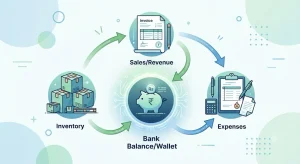
Every year, a wave of small businesses grow their top line and end up in worse financial shape than when they started. Orders go up. Headcount goes up. Ad spend goes up. And somewhere in the middle of that “growth,” the bank balance quietly goes down.
This isn’t a rare edge case. In the Federal Reserve’s 2025 Report on Employer Firms (based on the 2024 Small Business Credit Survey), rising costs were the single most-cited financial challenge among small employer firms, and uneven cash flow was close behind: 75% of firms cited rising costs of goods, services, and wages, and 51% cited uneven cash flow as ongoing financial challenges. That’s not a story about weak demand. It’s a story about timing—the gap between when money goes out and when it comes back in.
Relay’s 2025 Cash Flow Compass adds another layer to that picture: more than half of small businesses—54%—report less than 31 days of operating cash on hand, even while the large majority expect to grow this year. Rising revenue and shrinking liquidity are happening at the same time, in the same businesses.
In 2026, small businesses have more scaling tools available than ever: AI-assisted operations, automation platforms, and low-cost digital channels. Used well, they compress years of manual growth work into months. Used carelessly, they let a founder scale a broken business faster—and burn cash faster while doing it.
This guide is not another list of “10 growth hacks.” It’s a framework for answering five questions in order: what to scale, when to scale it, how much to spend, where the risk sits, and how to execute the next 90 days.
1. Growth vs. Scaling: What’s the Difference?
Founders use these words interchangeably. They shouldn’t.
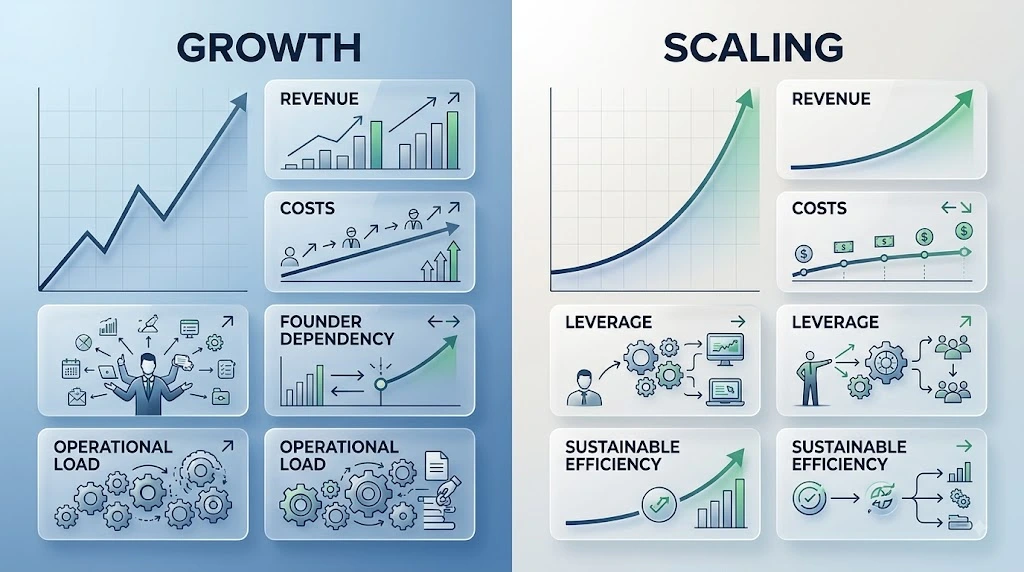
Growth means revenue is increasing. Scaling means revenue is increasing faster than costs—so each new dollar of sales requires less incremental effort, cash, and founder attention than the one before it.
| Growth | Scaling | |
|---|---|---|
| Revenue | Increases | Increases efficiently |
| Costs | Often rise in proportion to revenue | Grow slower than revenue. |
| Dependency | Founder-dependent | System-dependent |
| Nature | More activity | More leverage |
This is the basic idea behind economies of scale: as output grows, the fixed costs of running the business (software, management, core infrastructure) get spread across more units of revenue, so the cost per unit falls. A business that’s merely growing adds a proportional amount of cost, time, and stress for every proportional unit of revenue. A business that’s scaling breaks that link.
Most small businesses that “burn out from growth” aren’t actually scaling—they’re just doing more of the same thing, harder, with a thinner cash cushion.
2. Is Your Business Ready to Scale?
Scaling too early is one of the most expensive mistakes a founder can make, because it multiplies whatever is already broken. Before spending on growth, run through this checklist honestly.
Scaling Readiness Checklist
- Is demand for the product or service proven—not hoped for?
- Do you have a clearly defined target customer, not “everyone who might buy this”?
- Is your sales process repeatable without you personally closing every deal?
- Are your unit economics healthy (more on this in Section 3)?
- Do customers stick around and/or come back?
- Are your core processes documented, or only in your head?
- Is cash flow predictable month to month?
- Can the business function for two weeks without you?
A simple decision rule:
- If most answers are “no,” → fix first. Spending on growth now will scale the dysfunction, not the business.
- If most answers are “yes” and a few are “not yet,” → fix the gaps, then scale.
- If nearly all are “yes,” → you’re a genuine scale candidate.
3. Fix Unit Economics Before Scaling
This is the analytical core of the entire framework. If you scale before your unit economics work, you will lose money faster, not slower—you’ll just do it with better marketing.
The five numbers that matter:
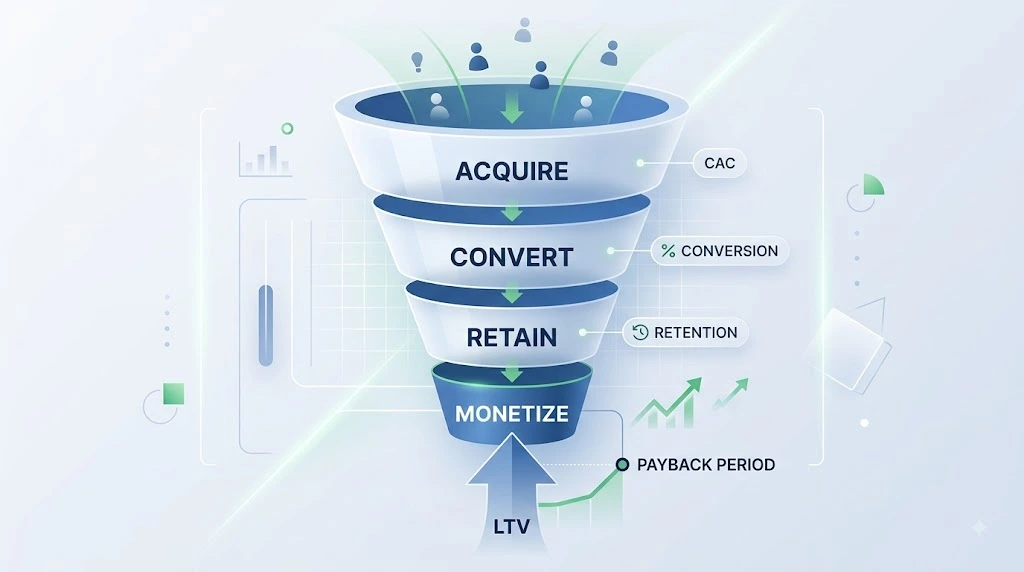
- CAC (Customer Acquisition Cost)—total sales + marketing spend divided by new customers acquired.
- LTV (Lifetime Value)—the total gross profit a customer generates over the life of the relationship.
- Gross margin—revenue minus the direct cost of delivering the product or service.
- Contribution margin — gross margin minus variable selling costs (the profit left per unit after everything that scales with volume).
- Payback period—how many months it takes to recover CAC from that customer’s margin.
A simple worked example:
A service business spends ₹15,000 to acquire a customer (CAC). That customer generates ₹6,000/month in gross margin. Payback period = ₹15,000 ÷ ₹6,000 ≈ 2.5 months. If the average customer stays 12 months, LTV ≈ ₹72,000 against a ₹15,000 CAC. That produces an illustrative LTV:CAC ratio of roughly 4.8:1. Whether that’s healthy depends on the business model, margins, retention, and payback period—there’s no single universal benchmark. What’s clear either way: if that same customer only stayed 2 months, LTV would barely cover CAC, and pouring more ad spend into that channel would just accelerate cash burn.
Mini framework: Acquire → Convert → Retain → Monetize
Each stage has its own leak points. A business can have a great acquisition engine and still lose money if retention is weak, because it never gets far enough down the funnel to recover CAC.
4. Find Your Most Profitable Growth Channel
Traffic is not the goal. Profitable, repeatable customer acquisition is.
Compare channels on more than just cost:
| Channel | Cost | Conversion | Customer Quality | Scalability | Payback Speed |
|---|---|---|---|---|---|
| SEO/Content | Low ongoing, slow to build | Medium | High | High (compounds) | Slow |
| Referrals | Very low | High | Very high | Medium (capped by base) | Fast |
| Partnerships | Low–medium | Medium–high | High | Medium | Medium |
| Paid ads | High, immediate | Medium | Variable | High (with budget) | Fast if margins allow |
| Social | Low–medium | Low–medium | Variable | Medium | Slow |
| Very low | High (existing list) | High | Medium | Fast | |
| Outbound | Medium–high (time cost) | Low–medium | High if targeted | Low–medium | Medium |
| Marketplaces | Commission-based | High (built-in demand) | Medium | High | Fast |
Build a Growth Channel Scorecard: score each channel 1–5 on cost efficiency, conversion rate, customer quality, scalability, and payback speed. The channel with the best combined score—not the one with the most traffic—is where you concentrate spending before scaling. Organic search and content can become a lower-cost acquisition channel when built around a clear strategy—see our Content Marketing SEO Guide for how to build that out.
Before increasing your marketing budget, explore how to scale sales without upfront costs through existing leads, stronger follow-ups, partnerships, and better conversion.
A common trap: chasing the channel that produces the most visits or leads, while ignoring that it produces the weakest customers. Volume without quality just moves the cash problem downstream. If your paid acquisition costs are rising, it’s worth understanding CAC properly before increasing spend further—our breakdown on Meta Ads CAC Too High? walks through the common causes.
5. Build Repeatable Systems Before Scaling
If the business can’t run without you, it can’t scale—it can only get bigger and more stressful.
Founder dependency shows up everywhere: you’re the only one who can close a sale, calm down an upset customer, or remember how invoicing actually works. Every one of those is a scaling ceiling.
Areas to systemize first:
- Sales SOP (a documented, repeatable process—not “how I feel like doing it”)
- Customer onboarding
- Delivery/fulfillment
- Support
- Billing
- Reporting
- Hiring
Framework: Document → Standardize → Measure → Improve → Automate
You document what actually happens today (not the idealized version); standardize it into a repeatable process; measure whether it’s working; improve the weak points; and only then automate—because automating a broken process just makes mistakes happen faster. Once a process is standardized, connecting the tools and apps it runs on is usually the next practical step—see No-Code Integration Tools for options that don’t require a developer.
6. Use AI & Automation as Leverage
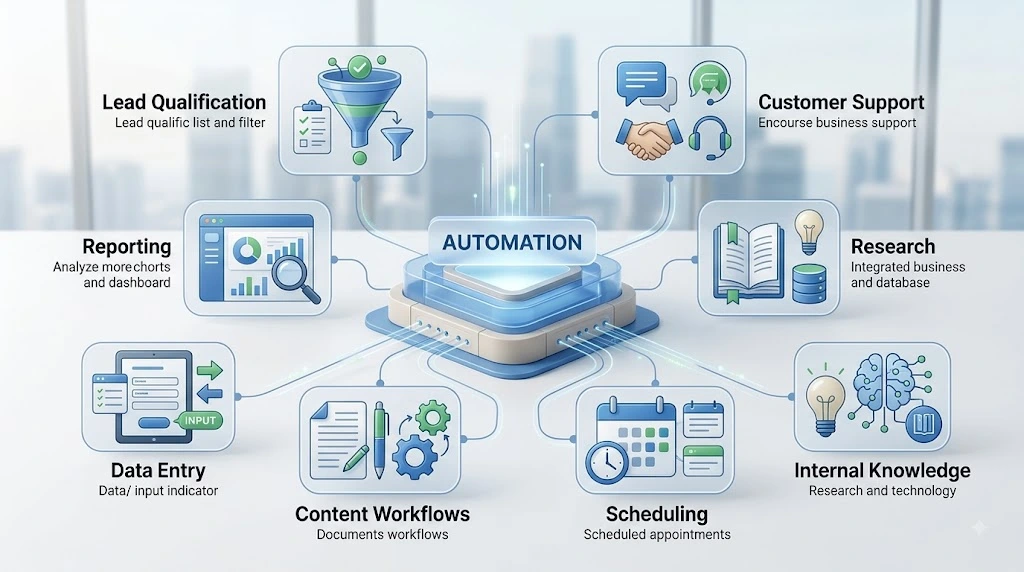
2026 gives small businesses genuine automation leverage that didn’t exist a few years ago. But the goal isn’t to sound “AI-powered”—it’s to remove repetitive work from people who should be doing higher-judgment work instead.
For repetitive workflows specifically, our guide on business automation strategies for small businesses covers how to identify what’s worth automating first.
Practical, non-hype use cases:
- Lead qualification—routing and scoring inbound leads before a human spends time on them
- Customer support—handling common, repetitive questions; escalating anything nuanced
- Reporting—pulling recurring numbers into a dashboard instead of manual spreadsheet work
- Research—first-pass market or competitor scans that a person then verifies
- Content workflows—drafting and structuring, with a human doing the final edit and fact-check
- Scheduling—calendar and appointment coordination
- Data entry—moving information between systems without manual retyping
- Internal knowledge systems—making company documentation searchable instead of buried in someone’s inbox
The rule that keeps this from becoming hype: automate repetitive work, not critical judgment. Pricing decisions, sensitive customer situations, and financial calls should stay with a person, at least until the automation has a long track record of getting it right.
This isn’t a niche trend anymore. The Federal Reserve’s 2025 Small Business Credit Survey found that 46% of small employer firms reported using AI in some form, with another 15% planning to adopt it within the next 12 months—meaning roughly six in ten small businesses will have some AI use underway within the year. The most common uses reported were writing or marketing, individual productivity, and planning or analysis—closer to everyday operational leverage than anything exotic.
7. Hire for Bottlenecks, Not Headcount
Hiring is one of the fastest ways to burn cash if it’s done to “feel” like scaling rather than to solve a specific constraint.
When to hire:
- A specific task is consistently the bottleneck slowing revenue or delivery
- You’ve already tried to systemize or automate the task, and it still needs a person
- The role is revenue-generating or directly protects revenue (sales, delivery, retention)
When to outsource instead: one-off or specialized work (bookkeeping, design, legal, certain marketing tasks) where you don’t need full-time capacity yet.
When a full-time hire makes sense: the workload is consistent, growing, and central to the business—not seasonal or occasional.
Should You Hire? — A Quick Decision Tree
- Is this task a genuine bottleneck right now (not “might be” in six months)? If no → don’t hire yet.
- Can it be solved with a process fix or automation first? If yes, try that first.
- Is the workload consistent enough to justify ongoing costs? If no, outsource or contract.
- Does the role directly protect or grow revenue? If yes, prioritize it over a cost-center hire.
Hiring ROI should be calculated the same way you’d calculate CAC payback: how many months until this hire pays for itself in revenue protected or generated?
8. Protect Cash Flow While Scaling
This is where most “how to scale” advice goes quiet—and where this framework needs to be loudest, because the data is unambiguous. As noted earlier, 51% of small businesses report uneven cash flow as a recurring financial challenge (Federal Reserve, 2025 Report on Employer Firms), and 54% report less than 31 days of operating cash on hand (Relay, 2025 Cash Flow Compass)—even while expecting growth. Scaling widens exactly the gap that’s already straining most small businesses—new orders, new hires, and expansion costs typically hit the bank account before the revenue they generate does.
Key concepts to track while scaling:
- Profit vs. cash flow—profit is an accounting figure recognized when a sale is booked; cash is what’s actually in the bank. A business can be profitable on paper and still be unable to make payroll if customers haven’t paid yet.
- Working capital—the cash tied up in the gap between paying suppliers/staff and collecting from customers.
- Payment terms—the longer you give customers to pay (and the shorter suppliers give you), the wider your cash gap.
- Inventory—cash sitting on a shelf until it sells.
- Hiring costs—salary is rarely the whole cost; recruiting, onboarding, and ramp time all hit cash before the hire is fully productive.
- Marketing spend—often paid upfront, weeks or months before the resulting revenue arrives.
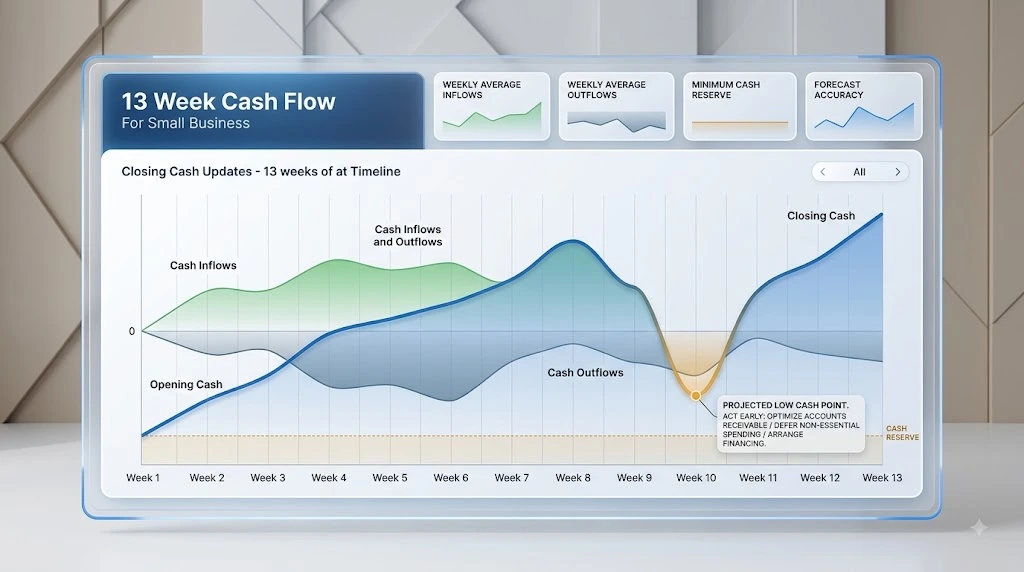
A simple 13-week cash forecast structure:
Opening Cash + Inflows − Outflows = Closing CashRun this week by week, not just monthly. A 13-week (roughly one-quarter) rolling forecast is long enough to see a cash crunch coming and short enough to stay accurate. If closing cash in any future week goes negative or dangerously thin, that’s your signal to slow spending, tighten payment terms, or arrange financing before the gap hits—not after.
9. Revenue Growth vs. Profitable Growth
Consider two hypothetical companies:
- Company A grows revenue 60% year over year, but margins are thin, CAC is rising, and cash reserves are shrinking to fund that growth.
- Company B grows revenue 25% year over year, with stable margins, a shorter cash conversion cycle, and a growing cash buffer.
On a revenue chart, Company A looks like the winner. On a survivability chart, Company B is in a far stronger position. Revenue growth is easy to celebrate and easy to headline. Profitable, cash-generative growth is what keeps a business alive long enough to compound.
The lesson isn’t “grow slower.” It’s “don’t judge business health by the top line alone.”
10. Create a 90-Day Scaling Plan
Days 1–30—Diagnose
- Audit unit economics (CAC, LTV, margins) by channel and by customer segment
- Identify which customers are actually profitable
- Map current channels against the Growth Channel Scorecard
- Build a rolling 13-week cash forecast
- Identify the single biggest operational bottleneck
Days 31–60 — Optimize
- Adjust pricing or packaging where margins are thin
- Fix the weakest point in the conversion funnel
- Improve retention in the highest-value customer segment
- Document and standardize the top 2–3 most founder-dependent processes
- Pilot one automation in a genuinely repetitive task
Days 61–90 — Scale
- Increase spending on the single best-performing channel (not all of them)
- Add capacity (systems or people) only where the bottleneck audit pointed
- Hire strategically for the one role solving the clearest bottleneck
- Explore 1–2 partnership opportunities that fit your existing customer profile
- Expand marketing spend in controlled, measured increments—not all at once
This sequence matters: diagnosing before optimizing and optimizing before scaling are what prevent a founder from pouring money into a channel or hiring that the first 30 days would have shown was the wrong move.
11. Build a Small-Business Scaling Dashboard
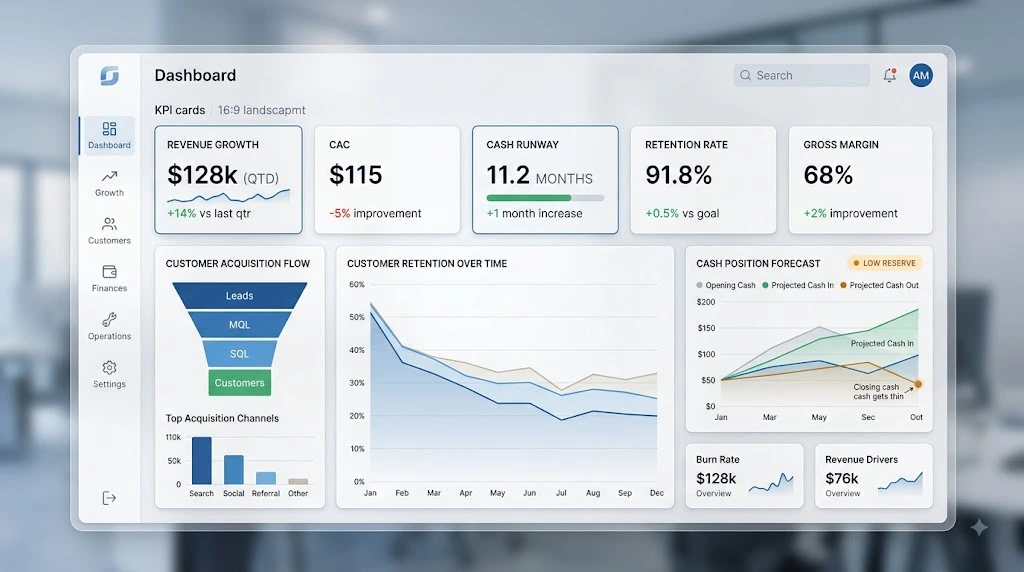
Don’t track 50 metrics. Track the numbers that actually change a decision.
Growth
- Revenue and revenue growth rate
- New customers acquired
Acquisition
- CAC by channel
- Lead-to-customer conversion rate
Customer
- Retention rate
- Repeat purchase rate
- Churn rate
Financial
- Gross margin
- Contribution margin
- Cash balance and cash runway (days/weeks of cash on hand)
Operations
- Delivery time
- Support volume
- Capacity utilization
A dashboard with 8–10 well-chosen numbers, reviewed weekly, beats a 50-metric report nobody reads.
12. When Should You Consider Funding?
Funding is a growth accelerator, not a growth strategy. It should fund a proven pattern, not create one.
Good reasons to raise funding or take on financing:
- Expanding a channel that’s already proven profitable
- Adding capacity to meet demand you already have
- Investing in technology that measurably improves margin or capacity
- Entering a new, validated market
- Bridging genuine working capital timing gaps (see Section 8)
Bad reasons:
- Covering losses from a business model that isn’t working yet
- Funding an unproven product indefinitely, hoping it finds traction
- Avoiding operational problems instead of fixing them
Before applying for financing, answer one question honestly: what specific milestone will this capital help us reach? If the answer is vague (“more growth,” “more runway”), that’s a sign to fix the underlying issue first—financing on top of a broken model just makes the eventual failure bigger and more expensive.
This isn’t a hypothetical concern. In the Fed’s latest survey (2026 Report on Employer Firms, based on the 2025 SBCS), the most common reason firms sought financing was to meet operating expenses (56%), followed by pursuing an expansion or new opportunity (46%). Operating-expense financing isn’t automatically a red flag—but it’s worth noticing that it now edges out expansion financing as the top reason firms borrow, and founders should be clear-eyed about which category their own financing needs falls into.
13. 7 Common Scaling Mistakes
- Scaling before product-market fit. Fix demand and retention first—spending accelerates whatever already exists, good or bad.
- Hiring too early. Hire for a proven bottleneck, not for how a growing team “should” look.
- Chasing every channel at once. Concentrate on the 1–2 channels with the best scorecard, then expand.
- Ignoring retention. Acquiring customers faster than you keep them is a leaking bucket, not growth.
- Ignoring margins. Revenue growth with shrinking margins is a slower path to the same cash problem.
- Automating broken processes. Fix the process first; automation just makes a broken process fail faster.
- Treating funding as the strategy. Capital should accelerate a working model, not substitute for one.
14. The Gofundscale Scaling Framework
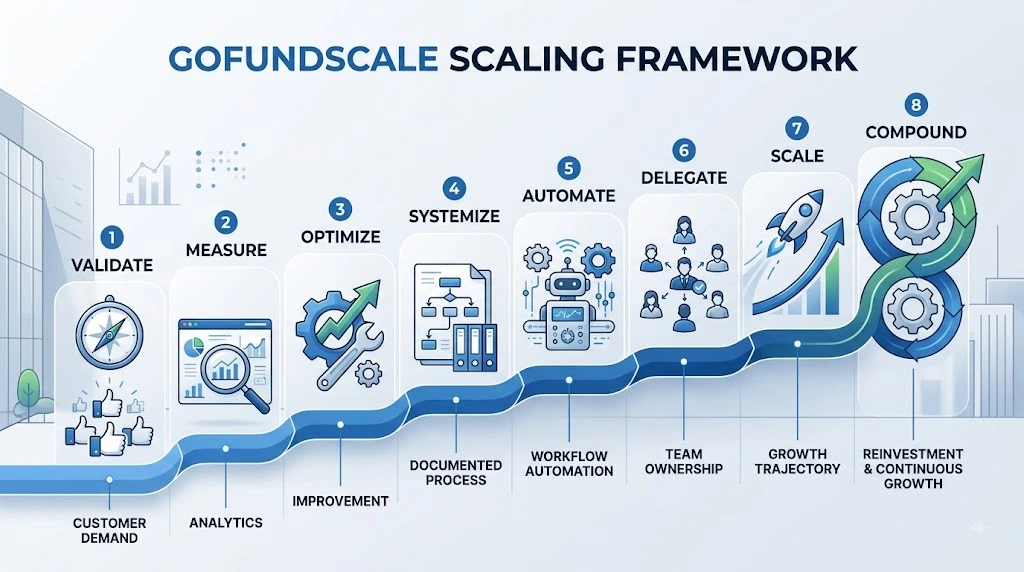
Validate → Measure → Optimize → Systemize → Automate → Delegate → Scale → Compound
- Validate—confirm real demand and a repeatable sale before investing further.
- Measure—establish your unit economics and baseline KPIs.
- Optimize—fix the weakest points in the funnel, pricing, and retention.
- Systemize—document and standardize the processes that currently depend on you.
- Automate—remove repetitive work from people, carefully and selectively.
- Delegate—hire or outsource for genuine bottlenecks, not headcount targets.
- Scale—increase investment in what’s already proven to work.
- Compound—reinvest the resulting margin and cash into the next validated opportunity.
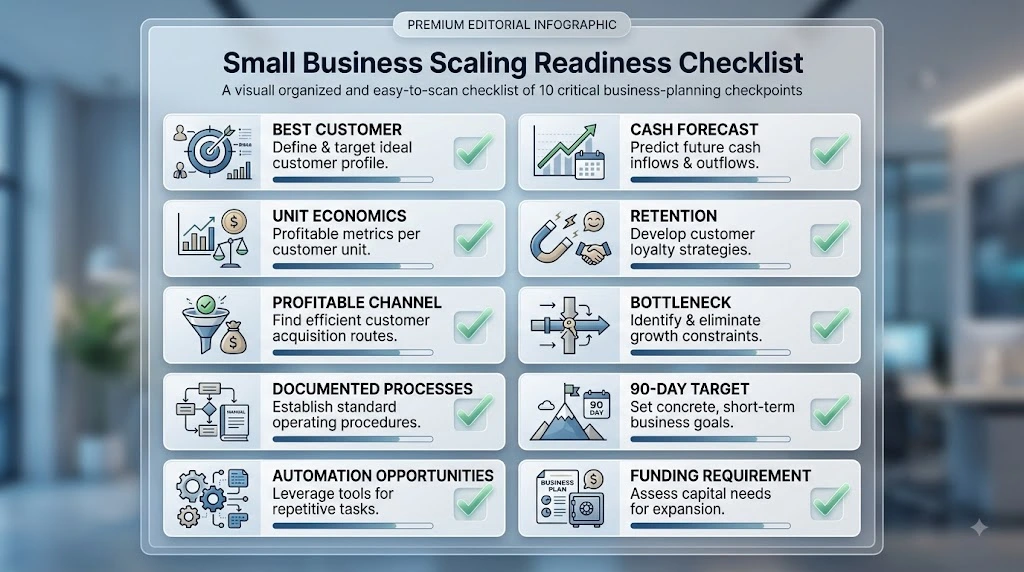
15. Final Scaling Checklist
- ☐ Best customer identified
- ☐ Unit economics understood
- ☐ Profitable channel identified
- ☐ Processes documented
- ☐ Automation opportunities identified
- ☐ Cash forecast created
- ☐ Retention measured
- ☐ Bottleneck identified
- ☐ 90-day target defined
- ☐ Funding requirement justified (if applicable)
FAQ
Can a small business scale without funding? Yes. Many businesses scale using reinvested profit and operational efficiency alone. Funding can accelerate scaling, but it isn’t required if unit economics and cash flow are already healthy.
How do you know when a small business is ready to scale? When demand is proven, unit economics are healthy, core processes are documented rather than founder-dependent, and cash flow is predictable—most items on the Scaling Readiness Checklist in Section 2 should be “yes.”
What is the biggest mistake when scaling a small business? Scaling spend or headcount before fixing unit economics or systemizing processes. It amplifies existing problems rather than solving them.
How can AI help a small business scale? By automating repetitive, well-defined tasks—support triage, reporting, scheduling, and data entry—people can focus on judgment-heavy work like sales conversations, product decisions, and customer relationships.
Should I hire employees before scaling? Only for a proven, consistent bottleneck. Outsource or automate first where possible; hire full-time when the workload is ongoing and directly tied to revenue or delivery.
How much cash should a small business keep while scaling? There’s no universal number, but a rolling 13-week cash forecast is the practical tool: it should show a comfortable buffer in every future week, not just the current one. Many small businesses currently operate with less than a month of cash on hand, which leaves very little room for the timing gaps that scaling creates.
What is the difference between growth and scaling? Growth is revenue increasing. Scaling is revenue increasing faster than costs, so each additional dollar of sales requires proportionally less cash, time, and founder effort.
Conclusion
Sustainable scaling isn’t about doing more of everything. It’s about doing more of what already works—while protecting margins, cash flow, customer experience, and operational capacity along the way. The businesses that scale successfully in 2026 won’t be the ones that spend the fastest. They’ll be the ones that diagnose before they spend, systemize before they automate, and protect cash while they grow.
Sources
- Federal Reserve Banks, 2025 Report on Employer Firms: Findings from the 2024 Small Business Credit Survey (source for the 75% rising costs and 51% uneven cash flow figures) — fedsmallbusiness.org
- Federal Reserve Banks, 2026 Report on Employer Firms: Findings from the 2025 Small Business Credit Survey (source for the AI adoption and financing-reason figures)—fedsmallbusiness.org
- Relay, 2025 Cash Flow Compass—State of Small Business Cash Flow